
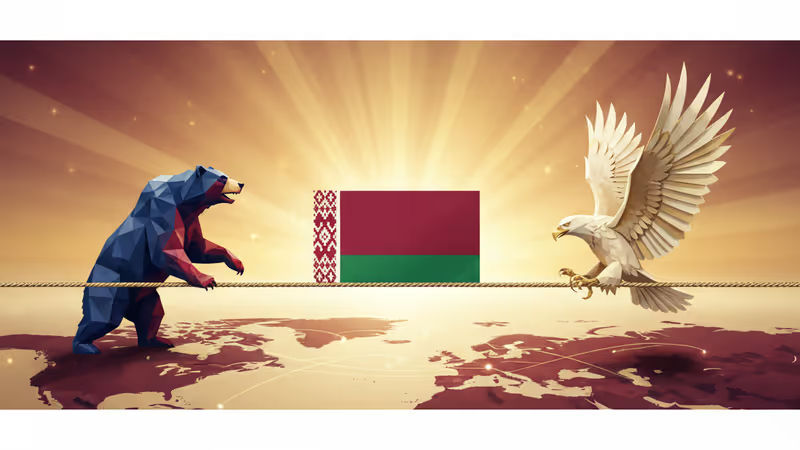
Belarus Courts U.S. in High-Stakes Pivot From Moscow
As Russia's war in Ukraine continues, its key ally Belarus is making overtures to the U.S., releasing political prisoners in exchange for potential sanctions relief. The move signals a high-stakes attempt by President Lukashenko to reduce dependence on Moscow.
With Russia still mired in its war in Ukraine, its sole European ally, Belarus, is making a calculated bid to thaw relations with the United States. In a bid to reduce his nation's heavy dependence on the Kremlin, Belarusian President Alexander Lukashenko appears to be reviving his long-standing "multi-vector" foreign policy, trading the release of political prisoners for the prospect of sanctions relief and diplomatic normalization with Washington.
Throughout 2025, Lukashenko's government has made a series of moves aimed at mending ties with the Trump administration. In early March, he publicly praised President Donald Trump, and by June, he had freed a group of political prisoners, including Siarhei Tsikhanouski, the husband of exiled opposition leader Sviatlana Tsikhanouskaya.
The diplomatic dance continued with an August phone call between Lukashenko and Trump. A month later, another group of prisoners was released. According to a report from the South China Morning Post, these actions prompted a significant response. In September, U.S. representative John Coale announced that the U.S. might soon reopen its embassy in Minsk and work to normalize economic ties, signaling a potential rollback of restrictions imposed after the controversial 2020 Belarusian presidential election.
The most substantial development came this month. Following another meeting with Lukashenko, Coale declared that the U.S. would lift sanctions on Belarusian potassium, the country's key export. In what appears to be a direct exchange, Belarusian authorities released 123 political prisoners. This group notably included Nobel Peace Prize laureate Ales Bialiatski and key opposition figure Maria Kolesnikova. This quid pro quo suggests a serious, if tentative, recalibration of Minsk's foreign policy and a clear strategic opening for Washington to weaken Moscow's influence in its own backyard.
This U.S.-Belarus rapprochement is highly conditional. Lukashenko's survival has long depended on Moscow's security and economic backing, a reality that hasn't fundamentally changed. Washington is betting it can create a lasting wedge, but any serious pressure from the Kremlin or a shift in the Ukraine war could force Minsk to snap back into Russia's orbit, making this a reversible and fragile diplomatic maneuver.
本コンテンツはAIが原文記事を基に要約・分析したものです。正確性に努めていますが、誤りがある可能性があります。原文の確認をお勧めします。
関連記事

ロシアによるウクライナへのミサイル攻撃、イスラエル国防相のガザに関する強硬発言など、世界各地で地政学的緊張が高まっています。シリアや南米でも対立が続く現状を解説します。
CBSニュースの人気番組「60ミニッツ」が、トランプ政権が移民を送還したエルサルバドルの刑務所に関する特集を放送直前に中止。社内外から「政権への忖度」との批判が噴出している。新経営陣の意向が働いたのか、報道の自由が問われる事態に。
米国通商代表部(USTR)は、中国の半導体産業政策が不公正であるとし、新たな関税措置を発表しました。当初の税率は0%ですが、2027年6月には引き上げられる予定です。

ガザ地区の保健省は、イスラエルの封鎖により医療システムが崩壊寸前だと警告。医薬品の4分の3が不足し、2万人の患者が治療を待つ中、死者も出ています。人道危機の現状を詳しく解説します。