
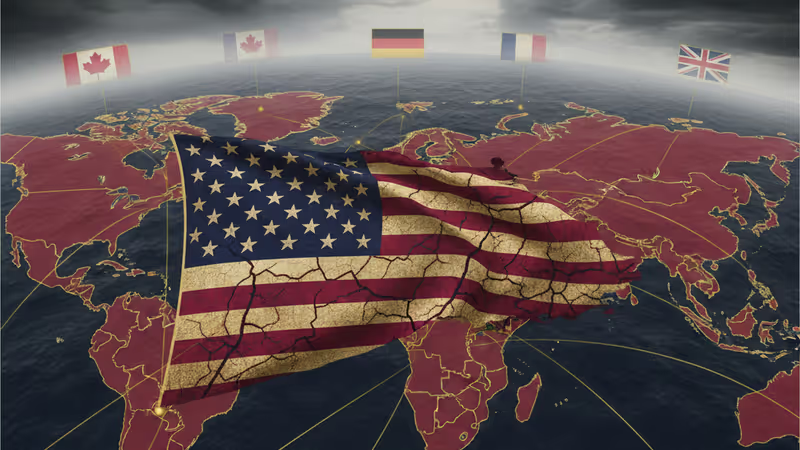
US Allies' Confidence Crumbles: Poll Shows Trump's America Seen as a 'Negative Force'
A new POLITICO-Public First poll shows a dramatic shift in perception among key U.S. allies like Canada, Germany, and France, who now view America as an unreliable and negative global force under President Trump.
Unreliable, a source of global problems, and a negative force on the world stage—this is the stark assessment of the United States held by large shares of its closest allies, according to a new international poll. The findings, from POLITICO-Public First polling, reveal the deep impact of President Donald Trump's sweeping foreign policy overhaul on transatlantic and North American relations.
A Transatlantic Trust Deficit in Numbers
The polling data paints a grim picture of America's standing. Pluralities in Germany and France, and a majority of Canadians, now say the U.S. is a negative force globally. In the United Kingdom, views are more mixed, but a significant 35% share that dim assessment.
Furthermore, near-majorities in all four allied nations believe the U.S. tends to create problems for other countries rather than solve them. When asked whether Washington supports or challenges its allies, a majority of Canadians and just under half of respondents in Germany and France say it challenges them. In the U.K., roughly 4 in 10 agree, while more than a third say the U.S. cannot be depended on in a crisis.
Allies Recalibrate Amid Trump's Doctrine
During his first year back in office, Trump has blurred traditional lines of global alliances. He recently described Europe as a “decaying” group of nations in a POLITICO interview, and his sweeping National Security Strategy argued the continent has lost its “national identities and self-confidence.” This skepticism from allied leaders is likely seeping into public sentiment, according to Matthew Kroenig of the Atlantic Council’s Scowcroft Center.
Public opinion in democracies often reflects elite opinion... you do have politicians in these countries expressing skepticism about the United States and about the Trump administration, and that's being reflected in the public opinion polling.
— Matthew Kroenig, Atlantic Council
In response, allied nations are recalibrating their policies.
- Germany: Chancellor Friedrich Merz has secured a historic spending overhaul, unlocking hundreds of billions of euros for defense, driven by wavering U.S. support for Ukraine and questions over Washington's commitment to NATO.
- France: President Emmanuel Macron is using Trump's unpredictability to bolster arguments for greater European strategic autonomy, a long-held French ambition.
- United Kingdom: Prime Minister Keir Starmer is attempting a delicate balancing act—finalizing a U.K.-U.S. trade deal while coordinating a European response on Ukraine, all without angering the White House.
- Canada: Relations have seen the sharpest deterioration amid a punishing trade war. Flavio Volpe of the Automotive Parts Manufacturers' Association noted, "People lost their jobs... and billions of dollars in Canadian capital evaporated."
A Nation Divided: American Perceptions of Its Global Role
In contrast to their allies, Americans view their own country more favorably. Overall, 51% see the U.S. as a positive force globally. However, these numbers mask a deep partisan divide.
According to Public First polling, almost half of voters who backed former Vice President Kamala Harris (47%) say the U.S. is a negative force, compared with just 13% of Trump voters. Conversely, three in four Trump voters (77%) say the U.S. is a positive force.
This shift among Democrats is recent and dramatic. Polling from October of last year found strong majorities of both Democrats (71%) and Republicans (69%) viewing America's historical role positively. One year later, while the Republican figure remains high, the Democrat figure has plummeted to 58%. Seb Wride, head of polling at Public First, notes this means "around 1 in 8 Democrats changing their views on the role the U.S. has played in its entire history, in just one year."
The poll's numbers signal more than diplomatic discontent; they reveal a fundamental erosion of trust in America's role as a global stabilizer. As allies like Germany and France accelerate their push for 'strategic autonomy,' the long-term risk is a more fragmented West, less capable of unified responses to challenges from powers like Russia and China.
本コンテンツはAIが原文記事を基に要約・分析したものです。正確性に努めていますが、誤りがある可能性があります。原文の確認をお勧めします。
関連記事
最新の世論調査で、ドイツ、フランス、カナダなど米国の主要同盟国がトランプ政権の外交政策を「否定的」と評価していることが判明。同盟関係の亀裂と各国の対応、米国内の分断を分析します。
トランプ前米大統領の側近がウクライナ和平案を提示。現状の戦線を基に停戦し、交渉に応じなければ軍事支援を停止するという内容。ロシアにはウクライナのNATO加盟延期を提案。計画の詳細と各国の反応を解説。

トランプ米大統領が、ルイジアナ州知事をグリーンランド担当特使に任命。同島の米国編入を公言し、NATO同盟国デンマークとの間に緊張が走る。北極圏をめぐる地政学的対立の新たな局面を解説します。
スウェーデンのNATO加盟がバルト海地域の安全保障をどう再構築し、欧州全体の地政学的バランスに与える影響を深掘りします。非同盟政策の転換、防衛技術の統合、ロシアの反応、そしてグローバルな投資示唆までをPRISMが分析。