
'I’m Shocked How Many People Do This': ER Doctors and Nurses Share the Top Habits Secretly Damaging Your Health
ER doctors, nurses, and other medical staff on Reddit reveal the common habits that are secretly damaging your health. From sleep deprivation to ignoring symptoms, here's what they wish you knew.
We all have them: bad habits. Whether it's doomscrolling on the sofa for hours or coping with stress by smoking or overeating, you're not alone. According to one report, 36% of Americans have at least one unhealthy behavior, and 23.9% have two. They're common, often harmless-seeming parts of daily life.
But what if some of those 'harmless' habits are far more dangerous than we think? We dove into three Reddit threads where doctors, nurses, and other healthcare professionals shared the most underestimated health risks they see every day. The consensus was clear: the biggest threats aren't rare diseases, but common, everyday choices.
### 1. The 'Wait and See' Fallacy
A recurring frustration among medical staff is patients ignoring symptoms until they become critical. 'Don't let your abdominal pain go on for a week before you seek medical attention,' warned one surgical physician associate. 'Operating on a gallbladder that’s been infected for a week... is astronomically more challenging.'
This is especially true for older individuals. One user pleaded, 'I'm SHOCKED how many people call us b/c their parents are on their third/fourth day of a symptom. After a certain age you shouldn't just let something 'run its course'. Call. Your. Doctor.' Ignoring a problem doesn't make it go away; it often makes it worse and harder to treat.
### 2. Neglecting the Absolute Basics
Time and again, professionals stressed fundamentals over complex medical knowledge. The most frequently cited underestimated dangers were a trio of simple issues: **sleep deprivation, lack of hydration, and a sedentary lifestyle.**
Proper hand washing was another hot topic. 'Wash your hands! Thumbs, top of the hands, all of it,' an infection control NCO advised. 'Squirting Purell doesn't cut it.' Dental hygiene was also a key point, with one user noting, 'Brushing your teeth is only half the job. Flossing removes food particles that... become acidic, slowly eroding away at your enamel.' These aren't new ideas, but they are consistently ignored.
### 3. Being a Passive Patient
One of the biggest hurdles in emergency care is a lack of information. An ambulance worker shared a frustratingly common exchange: '"You have any medical conditions?" "No." "Take any medications?" "Yeah, insulin." GET IT TOGETHER.' Knowing your own medical history and medications is not optional; it's critical.
Following instructions is equally important. Take antibiotics exactly as prescribed and finish the course. When a doctor tells you to follow up, do it. As one ER worker put it, 'The reason your condition gets worse is that you don't know really anything about it... That's what your doctors are for, and that's why I tell you to see them even if you feel fine now.'
### 4. Facing Mortality with Dignity
Perhaps the most sobering advice centered on end-of-life care. Multiple professionals described the trauma of performing aggressive, painful procedures on very elderly patients who have no realistic chance of a meaningful recovery. 'Making your 90 year old meemaw a full code (that means yes to CPR, intubation...) is just downright cruel,' one wrote. They urged everyone to have an advanced directive (like a DNR, or 'Do Not Resuscitate' order) and to discuss these wishes with family. It's about choosing a peaceful end over a prolonged, painful one.
**PRISM Insight: The Great Disconnect: Why Modern Medicine's Biggest Challenge Is Human Behavior.** The overwhelming pattern in this advice is the gap between what medicine *can* do and what people *actually* do. In an era of gene therapy and robotic surgery, the front line of healthcare is still a battle against basic human habits: procrastination, poor nutrition, and a lack of self-awareness. These professionals aren't asking for patients to understand complex biology; they're asking for proactive participation in the simple, daily work of staying healthy. This suggests that the next great leap in public health may not come from a lab, but from successfully bridging this behavioral divide.
Ultimately, the advice from the medical front lines is a call for personal responsibility. Listen to your body, master the basics, know your own health, and make conscious choices. These simple actions can prevent a world of pain and are more powerful than any high-tech intervention.
本コンテンツはAIが原文記事を基に要約・分析したものです。正確性に努めていますが、誤りがある可能性があります。原文の確認をお勧めします。
関連記事
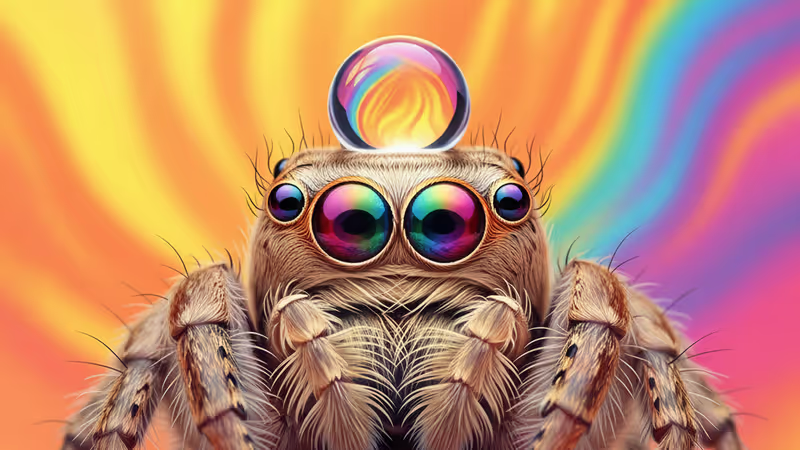
飼い主が頭に水滴を乗せたハエトリグモの写真が「可愛すぎる」とSNSで話題に。まるで水晶の帽子をかぶったような姿が、多くの人々の心を癒しています。

アマゾンでレゴ ボタニカルコレクション「フラワーアレンジメント」が40%オフの65.99ドルでセール中。1,161ピースのこのセットは過去最安値で、大人向けのプレゼントや趣味に最適です。

アマゾンの最新モデル「Fire TV Stick 4K Select」がクーポン利用で75%オフの9.99ドルに。過去最安値を更新したこのセールは期間限定。製品の特長と、この価格戦略の背景にあるエコシステムについて解説します。

クリスマス飾りの定番、キャンディケインの起源は17世紀ドイツにあった?赤と白の縞模様の秘密から、年間17億本以上が生産される背景まで、知られざる物語を解説します。