

Netflix's 'Cashero': The K-Drama Where Money is a Superpower is Already a Viral Meme
Netflix's new K-drama 'Cashero,' where money equals superpower, has become a viral sensation. We break down the best reactions and analyze why it's resonating globally.
Why the Internet is Obsessed with a Show That Hasn't Aired Yet
In a world saturated with superhero content, it takes a truly wild concept to cut through the noise. Netflix just found it. The announcement of its upcoming K-drama, “Cashero,” has sent the internet into a speculative frenzy, not because of a trailer, but because of its brilliantly absurd premise: a hero whose physical strength is directly proportional to the amount of cash he's holding.
Based on a popular webtoon, the series stars Lee Junho as a regular civil servant who suddenly acquires this bizarre ability. This single-sentence concept is so perfectly tailored for our times that it has become an instant global meme, sparking hilarious debates and sharp social commentary before a single episode has even dropped.
The Story: How a Simple Premise Broke the Internet
The news itself was a standard industry update: Netflix released character stills for “Cashero,” highlighting stars Lee Junho, Kim Hye Jun, and the villainous siblings played by rising star Lee Chae Min and veteran Kang Han Na. But while the A-list cast is impressive, it was the show's core mechanic that captured the collective imagination. In the “Cashero” universe, power isn't earned through training or a radioactive spider-bite; it’s determined by your bank balance. This immediately turned a K-drama announcement into a global 'what if' game.
The Best Reactions: A Masterclass in Meme-Making
The online discourse exploded with a mix of razor-sharp wit and existential dread. Here’s a curated look at the conversation defining the “Cashero” phenomenon.
The Billionaire Superhero Debate
The first and most obvious conclusion everyone jumped to? In this world, the planet's mightiest heroes would be tech billionaires. The memes practically wrote themselves, envisioning the world's wealthiest individuals as unstoppable forces.
- “So you’re telling me Elon Musk could punch a planet out of orbit just by logging into his bank app?” became a top-tier comment, summarizing the hilarious implications.
- Another popular thread imagined fight scenes: “Villain robs a bank. Hero shows up. Villain throws a bag of money at him. Hero accidentally powers up and wins. Cinema.”
The Painfully Relatable 'Powerless' Jokes
For every joke about a billionaire's strength, there were a thousand about our own weakness. The premise turned into a form of mass therapy through self-deprecating humor.
- The most common sentiment was perfectly captured by this idea: “My superpower after paying rent would be the ability to open a stubborn pickle jar. Maybe.”
- Users riffed on the specifics: “I’d be at my strongest for the 0.2 seconds between my paycheck landing and my automatic bill payments going out.”
Anticipating the K-Drama Tropes
Longtime K-drama fans immediately began applying classic tropes to the new concept, predicting plot points with uncanny accuracy.
- “Can’t wait for the rich, evil CEO to offer the hero a briefcase of cash, not as a bribe, but to see how strong he really is,” one user theorized, a prediction many agreed was inevitable.
- Others focused on the romance: “The rich female lead is going to be his 'super-suit.' He literally can't function without her.”
Cultural Context: Why 'Cash is King' Resonates Globally
The viral reaction to “Cashero” isn't just about a funny idea; it's a reflection of our current cultural moment. In an era defined by conversations about wealth inequality, inflation, and the immense power wielded by the super-rich, a story that literally equates money with physical power feels less like fiction and more like a documentary.
This is a masterstroke of Korean content creation, which has become a global leader in using genre storytelling to dissect pressing social issues. Following in the footsteps of Parasite (class struggle), Squid Game (debt), and Moving (state power), “Cashero” uses the superhero framework as a Trojan horse to explore the absurdities of modern capitalism. Its premise is a meme, a joke, and a deadly serious critique all at once—a formula that translates perfectly across any culture concerned with the cost of living.
PRISM Insight: High-Concept IP as a Self-Marketing Machine
The “Cashero” phenomenon offers a critical insight into the future of content strategy in the streaming wars. The show's core concept is so potent and meme-ready that it functions as its own marketing campaign. In a landscape where it costs millions to get attention, “Cashero” achieved global recognition from a logline alone.
This represents a shift towards creating 'discourse objects'—IP designed not just for viewing, but for immediate discussion, debate, and meme-ification. The logline, “a hero as strong as the cash he holds,” is the entire pitch, advertisement, and social media prompt rolled into one. It doesn't need a massive trailer drop; it just needs to be seeded into the internet to grow on its own. For creators and studios, the lesson is clear: the most valuable IP in the attention economy isn't just a good story, but a good conversation starter. “Cashero” proves that in 2025, the best marketing is a premise so wild, the internet can't help but talk about it.
関連記事
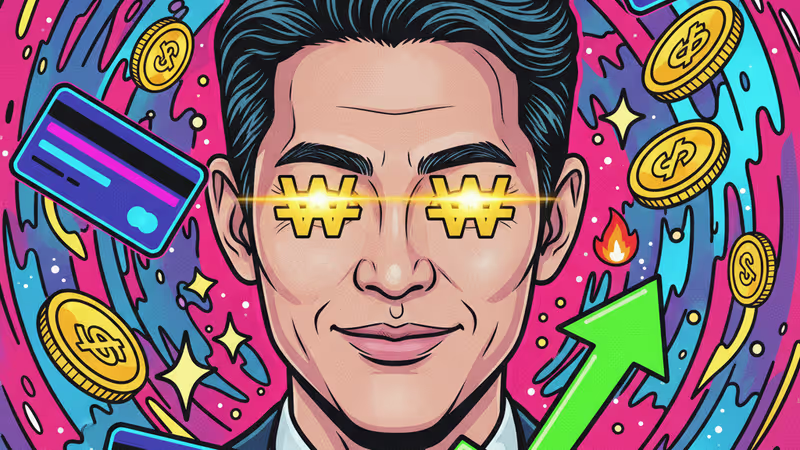
Netflix新作『キャシャロ』の悪役、イ・チェミンとカン・ハンナに注目が集まる理由とは?Webtoon原作の新感覚ヒーロー作品の魅力を海外の反応と共に分析。
『ストレンジャー・シングス』最終章Vol.2の衝撃的な予告編が公開。世界中のファンの絶叫と緻密な考察、そしてPRISM独自の文化的分析をお届けします。
Netflix新ドラマ『キャッシュヒーロー』の悪役ビジュアルが解禁。なぜイ・チェミンとカン・ハンナの兄妹役が世界中で話題なのか?海外の反応と専門的分析をお届けします。
『ストレンジャー・シングス』最終シーズンの新予告編が公開され、世界中のファンが騒然。衝撃の内容と海外の反応、そしてこの熱狂が示す文化的意味を専門家が分析します。