
Sudan's Forgotten Crisis: A Doctor's Dispatch from a Camp That Grew 500% in Two Weeks
In December 2025, a displacement camp in al-Dabba, Sudan, swelled from 2,000 to over 10,000 people in two weeks. A doctor’s firsthand account reveals the human cost of the world’s largest, yet forgotten, humanitarian crisis.
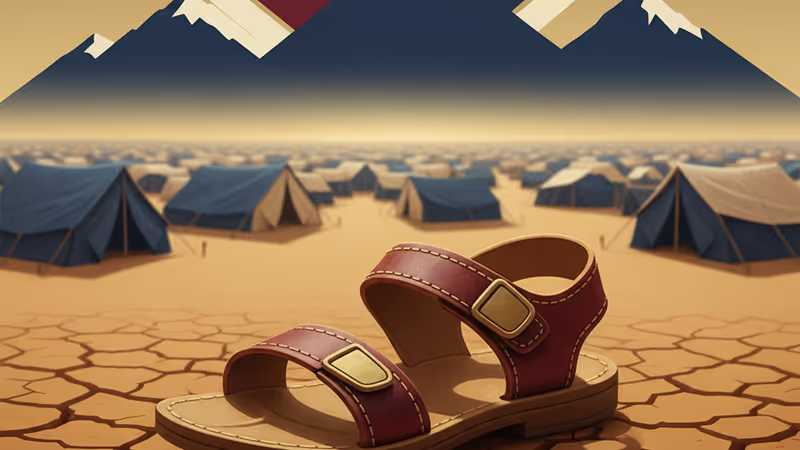
In the first two weeks of `stat(December 2025)`, the population of an internally displaced persons (IDP) camp in al-Dabba, `keyword(Sudan)`'s Northern State, exploded from `stat(2,000)` to over `stat(10,000)`, according to a harrowing first-person account from Dr. Nabiha Islam, a physician volunteering in the `area`. The surge, driven by families fleeing intense fighting in cities like el-Fasher between the `keyword(Sudanese)` army and the paramilitary Rapid Support Forces (RSF), is stretching already scarce resources—food, water, and medicine—to a breaking point.
Portraits of Loss and Survival
Dr. Islam’s report highlights the profound human cost of the conflict through the stories of those she treated. She met Fatima, a `stat(15-year-old)` girl who was `stat(10 weeks)` pregnant after being raped. It had taken her `stat(21 days)` to flee el-Fasher. Another patient, Aisha, a mother of five who had lost her husband on the journey, was suffering from severe anemia but hesitated to leave her traumatized children for a necessary blood transfusion.
Perhaps most devastating was the story of Khadija. After witnessing her husband's murder, she fled on foot with three young children. Her youngest died of malnutrition en route. Then, after hitching a ride, a motor vehicle accident killed her second child. She arrived at the camp `stat(36 weeks)` pregnant, with only her eldest son surviving.
Resilience Amid the Ruins
Despite the overwhelming despair, Dr. Islam repeatedly witnessed what she described as the "courage, generosity, and selflessness" of the `keyword(Sudanese)` people. She describes an elderly woman, Auntie Najwa, who freely offered her prayer mat—one of her few possessions—to anyone in need. Her translator, Ahmed, had moved his family to safety in `keyword(Egypt)` at the war's start in `stat(2023)` but chose to return to `keyword(Sudan)` to continue his humanitarian work, a story of sacrifice she heard over and over from local staff.
A Global Blind Spot
The physician’s account serves as a stark reminder that behind the statistics lies immeasurable personal tragedy. Dr. Islam concludes with a powerful indictment of the international community's inaction. "I don’t know where the solutions lie," she writes. "But I do know we, as an international community, have failed `keyword(Sudan)` and its people over and over again... We can do better. We must do better." Her dispatch is a desperate call to look beyond geopolitical headlines and focus on the human reality of a deeply underreported crisis.
`keyword(Sudan)`'s crisis highlights a severe disconnect between humanitarian scale and global attention. As the world's largest displacement crisis, its failure to capture sustained media coverage and funding reveals how geopolitical priorities and 'crisis fatigue' can leave millions in a state of catastrophic neglect.
本コンテンツはAIが原文記事を基に要約・分析したものです。正確性に努めていますが、誤りがある可能性があります。原文の確認をお勧めします。
関連記事

スーダンの準軍事組織RSFが12月初旬にヘグリグ油田を掌握。戦闘を逃れた1,700人近くが避難民となり、劣悪な人道状況に直面している。3年近く続く内戦は、国連が「世界最大の人道危機」と呼ぶ事態に発展している。

ロシアによるウクライナへのミサイル攻撃、イスラエル国防相のガザに関する強硬発言など、世界各地で地政学的緊張が高まっています。シリアや南米でも対立が続く現状を解説します。
CBSニュースの人気番組「60ミニッツ」が、トランプ政権が移民を送還したエルサルバドルの刑務所に関する特集を放送直前に中止。社内外から「政権への忖度」との批判が噴出している。新経営陣の意向が働いたのか、報道の自由が問われる事態に。
米国通商代表部(USTR)は、中国の半導体産業政策が不公正であるとし、新たな関税措置を発表しました。当初の税率は0%ですが、2027年6月には引き上げられる予定です。