
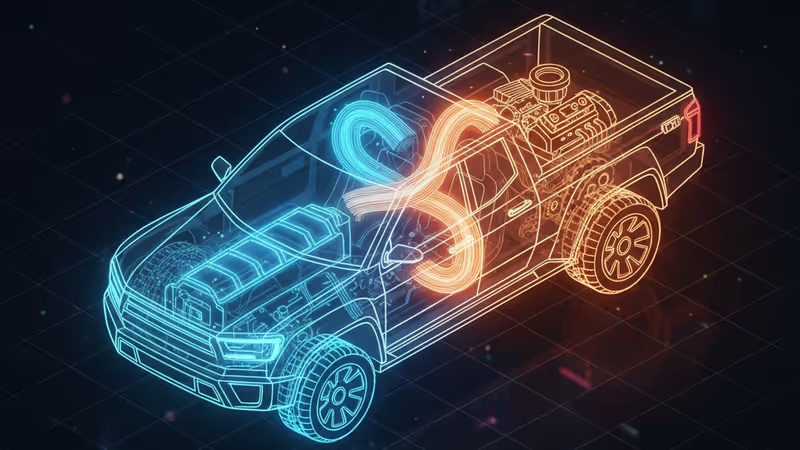
Ford's F-150 Lightning Pivot: Why the EV Revolution Needs a Gas Engine
Ford is scaling back the all-electric F-150 for a range-extended model. Our expert analysis explains why this isn't an EV failure, but a genius strategic pivot.
The Big Picture
Ford is hitting the brakes on its all-in strategy for the pure-electric F-150 Lightning, retooling the line to build more gas and hybrid trucks. This isn't the EV dream collapsing; it's a dose of strategic realism hitting the auto industry's most important and profitable segment. By announcing a next-generation Lightning with a gasoline range-extender (EREV), Ford is publicly admitting a hard truth: the all-electric future for workhorse trucks isn't here yet, and forcing it on customers is a losing battle. This is a pivot from EV purism to market pragmatism, and it will have shockwaves across the entire industry.
Why It Matters: More Than Just a Powertrain Swap
This decision is far more significant than a simple production adjustment. It's a foundational shift in strategy with critical second-order effects:
- Validates the Hybrid Bridge: This move gives immense credibility to competitors like Stellantis (with its range-extended Ram 1500 REV) and Toyota, who have long argued for a multi-powertrain, hybrid-focused transition. The narrative that hybrids are a necessary bridge to a fully electric future just got its biggest endorsement.
- Pressures the Pure-Plays: The gauntlet has been thrown down to Tesla and Rivian. Their core value proposition is an uncompromising, all-electric experience. Ford is now directly targeting the biggest weakness of that proposition—towing range and charging downtime—with a solution that, while less ideologically pure, is undeniably practical for a massive segment of truck buyers.
- Signals a Market Correction: The EV adoption curve is proving to be slower and more challenging than the hype suggested, especially outside of coastal urban centers. Ford's move is a clear signal that automakers are now listening more to current market demand and profitability concerns than to future-facing mandates and investor narratives.
The Analysis: Pragmatism Overrides Purity
The Ghost of the Chevy Volt: Why Range Extenders Are Back
The concept of an Extended-Range Electric Vehicle (EREV) is not new. The Chevrolet Volt pioneered this "series hybrid" model over a decade ago: a primary electric motor with a small gasoline engine acting solely as a generator to recharge the battery. While the Volt was a cult classic, it was ultimately a niche car. Ford is resurrecting this technology for a completely different and, arguably, more suitable application. A full-size truck's primary challenge is energy consumption under load. Towing a heavy trailer can slash a pure EV's range by 50% or more, turning a 300-mile truck into a 150-mile truck that requires long, inconvenient charging stops. The EREV model directly solves this "non-negotiable" customer pain point, eliminating range anxiety and making the electric-drive experience viable for real-world work and long-distance travel.
Redefining "Electric Vehicle" for the Mainstream
For years, the industry has operated under a binary definition: a vehicle is either a gas-guzzling ICE or a zero-emission EV. Ford's pivot helps mainstream a more nuanced reality. The next F-150 Lightning will still offer the most desirable aspects of an EV—instant torque, quiet operation, and emissions-free daily commuting—while using gasoline as an energy-dense insurance policy for the demanding tasks. This approach acknowledges that the charging infrastructure and battery technology are not yet mature enough to serve all use cases. It's a strategy designed to meet customers where they are today, not where policymakers hope they will be tomorrow.
PRISM Insight: Investment and Fleet Implications
From an investment perspective, this is a de-risking of Ford's EV strategy. Instead of burning capital to build pure EVs that are struggling to find a mass market, the company is redirecting resources toward hybrid and EREV technologies where demand is proven and growing. While this may temper the high-growth "tech company" valuation some investors had hoped for, it points to a more stable and profitable path in the medium term. Watch for Ford's margins on its hybrid F-150s versus its pure EV Lightning; the results will be telling.
For commercial fleet managers, the F-150 Lightning EREV is a game-changer. Fleets have been hesitant to go all-in on electric trucks due to unpredictable operational downtime from charging and severe range limitations when hauling equipment. An EREV offers the best of both worlds: the low running costs and ESG benefits of electric power for local routes, combined with the go-anywhere, do-anything reliability of a gas generator. This single vehicle could significantly accelerate the electrification of commercial and government fleets that previously saw pure EVs as too compromised.
PRISM's Take
Ford's retreat from a pure-EV F-150 isn't a failure; it's a necessary and intelligent course correction. The attempt to shoehorn a one-size-fits-all EV solution into America's most versatile vehicle segment was a strategic overreach based on hype rather than reality. This pivot to a range-extended model is a victory for customer-centric design and pragmatism. It acknowledges the real-world physics of towing and the current limitations of infrastructure. By building a practical bridge to the electric future—one that happens to have a gas-powered generator on it—Ford is likely to convert more truck buyers to an electric drivetrain in the next five years than a pure-EV-or-nothing approach ever could.
関連記事

InstacartがAIで顧客ごとに価格を最大23%も変動させていたことが発覚。これは単なる値上げではない。アルゴリズムによる価格差別の実態と、消費者が取るべき対策を専門家が解説。

Uber Oneが同意なき課金と『解約地獄』で米23州から提訴。急成長するサブスク経済に潜む『ダークパターン』の問題点と消費者が知るべき自衛策を専門家が解説。

AIの急成長を支えるデータセンターが、地域住民の電気料金を急騰させている問題が浮上。米上院が調査を開始し、巨大テック企業の社会的責任が問われています。

GrindrはAIとヘルスケアを軸に「ゲイ版スーパーアプリ」への進化を目指す。CEOが語る壮大なビジョンと、プライバシー問題という根深い課題を専門家が徹底分析。