
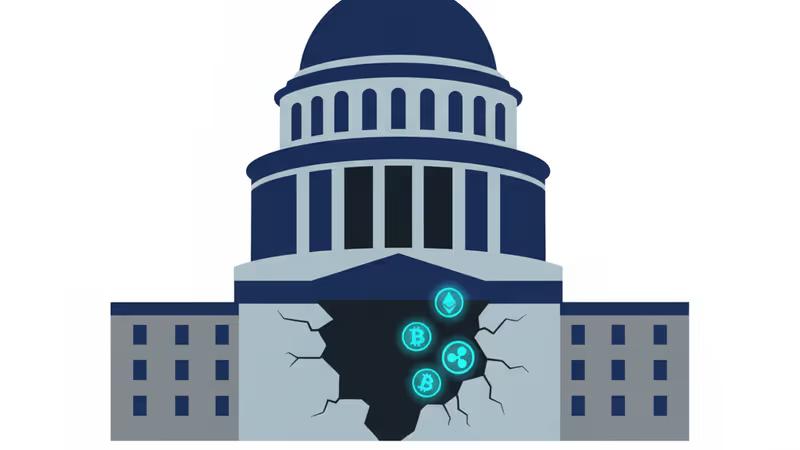
Crypto's Key Senate Ally Is Out: The End of an Era Creates a Perilous DC Vacuum
Sen. Cynthia Lummis, crypto's top ally in the U.S. Senate, is retiring. Our analysis explores the leadership vacuum and what it means for regulation.
The Lede: A Strategic Asset Vanishes
For global crypto investors and builders, Senator Cynthia Lummis wasn't just a friendly vote; she was a strategic political asset—an educated, credible, and relentless champion in the world's most powerful legislative body. Her planned retirement in 2027 isn't just a personnel change; it's a material event that fundamentally increases the political risk for the digital asset industry in the United States. A key advocate is being written off the balance sheet, and there is no clear successor to fill the void.
Why It Matters: The Clock Just Sped Up
Lummis’s departure creates a leadership vacuum and injects a powerful sense of urgency into the crypto industry's legislative agenda. The implications are immediate and structural:
- A Legislative Cliff-Edge: With her term ending after 2026, Lummis's statement that she intends to "deliver major legislation to President Donald Trump's desk next year" transforms the next 24 months into a do-or-die sprint. The crypto market structure bill is no longer just a priority; it's a legacy project with a hard deadline. Failure to pass a bill by 2026 means the industry loses its most effective negotiator and starts from a significantly weaker position in 2027.
- The Senate Power Vacuum: Unlike the House of Representatives, where pro-crypto advocacy is more distributed among members like Patrick McHenry (now retired) and French Hill, the Senate's efforts have been highly concentrated in Lummis. Her absence removes the primary Republican anchor on the powerful Senate Banking Committee, potentially ceding ground and influence to staunch crypto critics like Senator Elizabeth Warren.
- The End of the 'Bitcoin Senator': Lummis wasn't a recent convert. As a known Bitcoin holder and early advocate, she brought a level of authenticity and deep subject matter expertise that is nearly impossible to replicate. New allies can be found, but a champion with her seniority and credibility cannot be created overnight.
The Analysis: From Key Person to Systemic Risk
The digital asset industry's reliance on Senator Lummis has long been a classic example of "key person risk" in a political context. Her bipartisan work with Senator Kirsten Gillibrand on the landmark (though so far unsuccessful) Responsible Financial Innovation Act set the entire framework for the regulatory debate in Washington. It moved the conversation from "if" to "how" crypto should be regulated.
Her exit exposes the fragility of a lobbying strategy built around personalities rather than broad, institutionalized support. While the industry has poured hundreds of millions into lobbying, it has failed to cultivate a deep bench of Senate champions who can carry the legislative torch. Lummis’s retirement is a stress test for the entire crypto political machine. The safely Republican nature of her Wyoming seat is irrelevant; the industry isn't losing a vote, it's losing its voice.
This development forces the industry to confront a harsh reality: its political capital is more concentrated and vulnerable than previously assumed. The fight for regulatory clarity now becomes exponentially harder without its most seasoned general on the field.
PRISM Insight: Recalibrating US Regulatory Risk
For investors and fintech operators, the calculus on U.S. regulatory risk must be adjusted. The probability of achieving a comprehensive, favorable market structure bill in the medium term (post-2026) has decreased. This uncertainty could have tangible consequences:
- Capital Flight Acceleration: Jurisdictions with established regulatory frameworks, such as the EU (with MiCA), the UAE, and Singapore, become more attractive. Projects and venture capital may increasingly de-prioritize the U.S. market until the legislative fog clears, accelerating the trend of innovation happening offshore.
- Focus on State-Level and Judicial Arenas: With the federal legislative path becoming more treacherous, expect the industry to double down on securing wins at the state level (as seen in Wyoming) and through the court system (as with Ripple and Grayscale). This creates a fragmented, inefficient, but necessary path forward in the absence of federal clarity.
PRISM's Take: A Forced Maturation
Senator Lummis's retirement is a significant short-term blow, but it serves as a crucial, if painful, catalyst for the crypto industry's political maturation. Relying on a single, passionate champion was never a sustainable long-term strategy. This moment forces a transition from personality-driven politics to a more resilient, broad-based, and bipartisan foundation of support. The industry's ability to navigate this leadership vacuum and cultivate the next wave of advocates will determine its trajectory in the world’s most critical market for the next decade. The era of the lone crypto champion is over; the era of coalition-building must now begin in earnest.
関連記事

ビットコインの用途を巡る論争が激化。ベテラン開発者ルーク・ダッシュジュニアはOrdinalsを『スパム』と批判。BTCの思想と未来を深掘り分析します。

テスラのイーロン・マスク氏の巨額報酬が復活。これは単なる報酬問題ではない。デラウェア州の権威を揺るがし、CEOのあり方とコーポレートガバナンスを再定義する歴史的転換点だ。

トランプ・メディアが核融合技術のTAEと合併。政治的ミーム株とディープテックの異色タッグの背景、投資家への警鐘、そして未来のエネルギー市場への影響を深掘り分析します。

米製薬業界が直面する「特許の崖」。その解決策として中国バイオに注目が集まるが、地政学リスクが影を落とす。投資家と業界関係者必見の分析。