
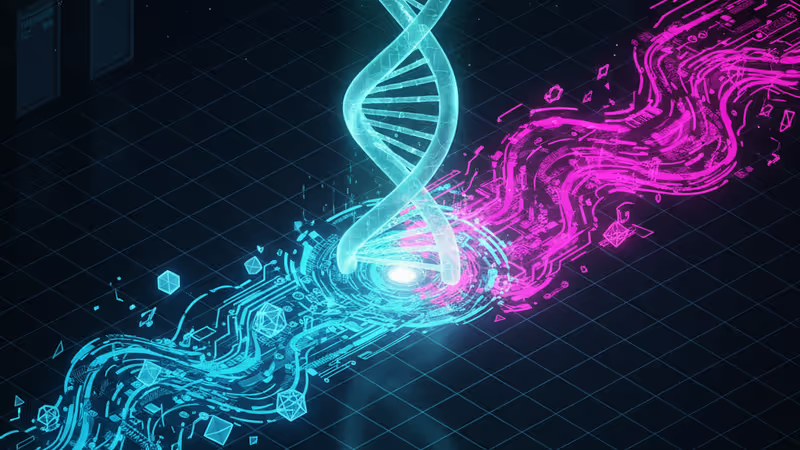
Chai Discovery's $1.3B Valuation Isn't About Drugs—It's About the AI Platform Wars Invading Biotech
Chai Discovery's $130M raise at a $1.3B valuation isn't about a single drug. It's a strategic move by OpenAI's ecosystem to build the dominant AI platform for biotech.
The Lede
Chai Discovery's $130 million Series B at a $1.3 billion valuation isn't just another biotech funding announcement. It's a strategic beachhead for the AI platform wars in the multi-trillion-dollar pharmaceutical industry. Backed by OpenAI and led by one of its alumni, Chai's valuation isn't based on a future drug pipeline; it's a high-stakes bet that the company can become the foundational 'operating system' for molecular design, fundamentally altering the economics of drug discovery.
Why It Matters
For decades, drug discovery has been a game of brute force, trial-and-error, and astronomical costs. Chai's funding round, led by giants like General Catalyst and Oak HC/FT, signals a pivotal shift in investor mentality. The focus is moving from funding individual drug 'shots on goal' to funding the platform that can generate an infinite number of shots. This matters for three key reasons:
- The Platform is the Product: Investors are valuing Chai like a high-growth enterprise AI company, not a pre-clinical biotech. The bet is that its 'computer-aided design suite for molecules' will become an indispensable tool for the entire pharma industry, creating a recurring revenue model that's far more scalable than traditional drug development.
- The OpenAI Halo Effect: OpenAI's participation is more than capital; it's a powerful validation of Chai's 'foundation model' approach. It signals to the market that the core technology is an extension of the same paradigm that powers ChatGPT, attracting elite talent and instilling confidence that this isn't just another incremental improvement in computational biology.
- De-Risking R&D: The core premise is that AI can drastically shorten development timelines and increase the success rate of finding viable drug candidates. By designing custom antibodies from scratch (de novo), Chai aims to transform drug discovery from an art of discovery into a science of engineering, fundamentally changing the risk profile of biotech investing.
The Analysis
From Prediction to Creation: Biology's Generative AI Moment
The history of AI in biology has been largely predictive. DeepMind's AlphaFold was a landmark achievement, solving the protein folding problem and providing a static map of biological structures. Chai Discovery represents the next evolutionary step: generative biology. Instead of just predicting what a molecule looks like, its Chai 2 model aims to design and build novel molecules with specific, desired functions. This is the difference between analyzing a blueprint and being the architect. While competitors like Recursion Pharmaceuticals and Absci are also pioneering AI-driven drug discovery, Chai's tight integration with the OpenAI ecosystem and its 'foundation model-first' philosophy positions it as a pure-play bet on the generative AI paradigm.
A Bet on Platform, Not Pills
A $1.3 billion valuation for a company founded just last year (2024) with no drugs in clinical trials is telling. The venture capital flowing into Chai isn't underwriting a specific cure for a specific disease. It's underwriting the creation of a horizontal technology platform. The strategic playbook appears to mirror that of AI giants: build a powerful, generalizable model and then deploy it across numerous verticals. Chai's success won't be measured by its first drug approval, but by its ability to secure partnerships with major pharmaceutical companies, enabling them to accelerate their own pipelines. The real product is speed, probability, and design capability.
PRISM Insight: Investment and Industry Implications
For Investors: Recalibrate Your Biotech Scorecard
Evaluating Chai Discovery with a traditional biotech lens is a mistake. The key performance indicators are not Phase I trial data or IND filings. Instead, investors should focus on metrics typical of an AI platform company:
- Model Performance: How do Chai 2's success rates in designing viable antibodies compare to both traditional methods and rival AI platforms?
- Scalability & Generalization: How effectively can the platform be applied to different and more challenging disease targets beyond its initial focus?
- Partnership Velocity: The rate and quality of partnerships with established pharmaceutical giants will be the most critical early indicator of market validation and future revenue.
This is a bet on a winner-take-most dynamic, where the dominant design platform captures a disproportionate share of the market's value.
For Industry Execs: The 'Build vs. Buy' Dilemma Intensifies
For pharmaceutical and biotech leaders, Chai's rise presents a strategic crossroads. Do you invest billions building an in-house AI capability to rival these specialized platforms, or do you partner with them and risk ceding a critical part of the value chain? Companies that view AI as a mere IT upgrade will be outmaneuvered. The new competitive frontier is 'discovery velocity,' and platforms like Chai are selling it as a service. This will force a radical rethinking of R&D budgets and strategies across the entire industry.
PRISM's Take
Chai Discovery's funding is a watershed moment, marking the formal expansion of the AI platform wars from the digital realm of bits and bytes to the physical world of biology. While the scientific and regulatory hurdles to creating AI-designed drugs remain immense, the convergence of elite AI talent, massive capital, and a proven foundation model approach creates the most credible threat to the traditional pharma R&D model to date. The race is no longer just to find the next blockbuster drug; it's to build the AI engine that designs all of them. With OpenAI's backing, Chai Discovery isn't just a promising biotech startup; it's a standard-bearer for a new, engineered era of medicine.
関連記事

OpenAIがChatGPT無料版の重要機能を停止。Googleとの競争激化の中、なぜ『最高の答え』より『最速の応答』を優先したのか?AIの未来を左右する戦略転換を専門家が分析します。
OpenAIが次世代AI、GPT-5で生物学研究を加速。AI科学者の誕生が意味するものとは?技術的ブレークスルーとデュアルユースのリスクを専門家が徹底分析。

OpenAIが科学研究AIの新ベンチマークFrontierScienceを発表。単なる知識テストを超え、AIが真の科学的発見を行えるかを探るこの動きが、研究開発の未来と産業界に与える影響を専門的に分析します。
BBVAがOpenAIと提携し、全従業員12万人にChatGPTを導入。これが金融業界のAI活用をどう変えるか?PRISMがその戦略的意味と将来性を徹底分析します。