
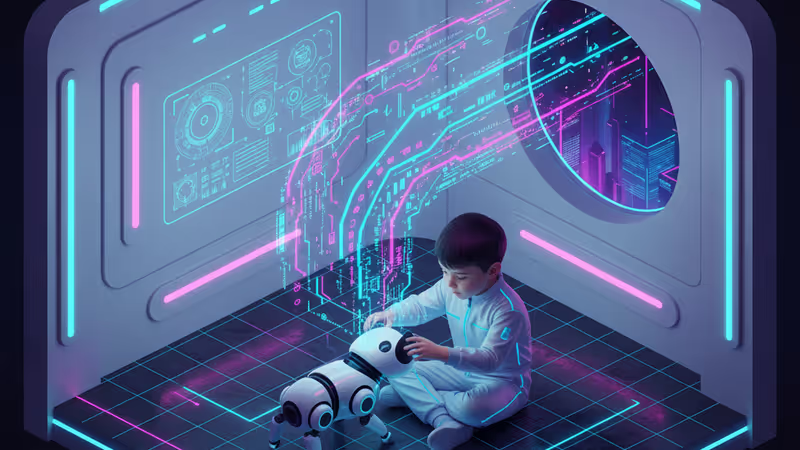
Beyond Playtime: China's $4B AI Toy Gambit Is Training an AI-Native Generation
China's $4B AI toy market is more than child's play. Discover the strategic implications for data, culture, and the race to create an AI-native generation.
The Big Picture
China's burgeoning $4 billion AI toy industry isn't just a new category of gadget; it's a strategic masterstroke. While the West debates AI ethics in boardrooms, China is deploying it in the playroom, creating the world's first generation of 'AI natives.' This move, blending national tech ambitions with the toy industry, has profound implications for global tech dominance, data collection, and the very nature of childhood.
Why It Matters Now
For executives, investors, and parents, this trend signals a seismic shift beyond simple manufacturing. This is the frontline of AI adoption, normalizing human-AI interaction from the earliest age. The second-order effects are what most are missing:
- The Ultimate Data Moat: These toys are not just playthings; they are sophisticated data funnels. Every conversation, question, and emotional response is a data point, providing an unparalleled, longitudinal dataset on childhood development and consumer behavior. This data is the raw material for training more advanced, culturally-attuned AI models in the future.
- Cultural Soft Power: An AI companion that tells stories, answers questions, and offers advice is a powerful vessel for cultural and ideological values. While a toy giving anti-drug advice seems benign, it establishes a framework where technology becomes a moral arbiter, programmed with state-sanctioned norms.
- Accelerated AI Adoption: By making AI a child's first 'friend,' China is dismantling psychological barriers to AI integration. This generation will enter the workforce with an innate trust and fluency in AI systems, creating a significant long-term economic and strategic advantage.
The Analysis: From Factory to 'Friendgineering'
China's evolution from the world's contract toy manufacturer to a pioneer in AI-driven companionship is a pivotal leap. Unlike the clunky, pre-programmed smart toys of the past (think Teddy Ruxpin or Furby), this new wave leverages cloud-based Large Language Models (LLMs), enabling dynamic, evolving conversations. Companies like Haivivi and Chongker are not just embedding chips; they are 'friendgineering'—designing personalities and emotional bonds powered by data.
The Double-Edged Sword of an AI Pal
The allure of a perfect, ever-patient companion for a child is powerful, but it comes with complex risks that go far beyond the LLM 'hallucinations' mentioned in passing. The core dilemma is the trade-off between protection and privacy, a line drawn very differently in Beijing than in Brussels or Washington.
The feature allowing parents to monitor transcripts of their child's conversations is marketed as a safety tool. However, it also normalizes a level of surveillance within the family unit that would trigger significant backlash in Western markets. More profoundly, what is the long-term psychological impact on a child whose primary emotional bond might be with an algorithm designed for perfect agreeableness? This could fundamentally alter the development of empathy, resilience, and complex social skills learned through navigating imperfect human relationships.
PRISM Insight: The Investment and Market Impact
Look Beyond the Plush Shell: The smart money isn't just betting on the $4 billion hardware market. The real investment thesis lies in the recurring revenue and platform potential. These toys are Trojan horses for subscription services, educational content, and, most importantly, the AI platforms that power them. Investors should be tracking the companies providing the underlying cloud infrastructure, voice recognition engines, and data analytics—that's where the long-term value is being built.
A 'Kodak Moment' for Western Toy Giants: Companies like Mattel and Hasbro, built on physical IP and traditional play patterns, are at risk of a major disruption. Their business model is being challenged by a new paradigm that merges hardware, software, and services. Failure to develop a coherent AI strategy could leave them competing on nostalgia alone. Furthermore, expect a fractured global market as Western regulators, citing privacy and child safety laws like GDPR and COPPA, create significant barriers to entry for these data-intensive Chinese products.
PRISM's Take
This is not a story about toys; it's a story about the future of human-AI symbiosis. China is running a nationwide, real-time experiment in raising an AI-native populace. By embedding AI into the fabric of childhood, it's ensuring its next generation sees AI not as a tool to be picked up, but as a fundamental, ever-present part of their world. While the immediate products may seem trivial, the long-term strategy of cultivating deep AI literacy and dependence from the cradle is a formidable competitive advantage that Western markets are currently underestimating at their peril.
関連記事

Uber Oneの「解約させない」手口にFTCと24州が提訴。これは単なる一社の問題ではない。サブスク経済に潜むダークパターンの本質と、企業・消費者が取るべき対策を専門家が分析。
Mozillaが直面する収益と理想の矛盾を深掘り。Google依存の構造と、オープンなウェブの未来に向けた戦略を専門家が分析します。

マイクロソフトが脆弱な暗号RC4を26年ぶりに廃止。この決定の背景にあるサイバー攻撃、政治的圧力、そして企業が学ぶべき「技術的負債」のリスクを専門家が深く分析します。

米辞書メリアム・ウェブスターが2025年の言葉に『slop』を選出。AIが生成する低品質コンテンツがなぜ問題なのか、その背景と未来への影響を専門家が徹底解説します。