
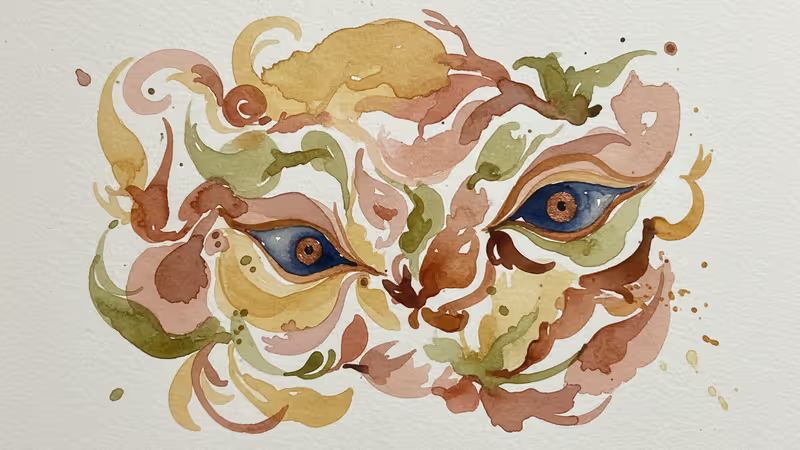
Why a Scholar Finally Called Trump a Fascist
After years of resistance, a prominent political scientist explains his decision to use the F-word and what Trump's second term reveals about American democracy.
For years, Jonathan Rauch refused to call Donald Trump a fascist. The Brookings Institution senior fellow and author of The Constitution of Knowledge had his reasons: classical fascism didn't seem to fit entirely, the term had been overused to meaninglessness, and even scholars couldn't agree on fascism's definition.
But Trump's second term changed his mind. In a recent Atlantic essay, Rauch presents 20 characteristics that led him to conclude: "Reluctance to use the term has now become perverse."
The Scholar's Dilemma
Rauch initially preferred terms like "authoritarian" and "patrimonialist" to describe Trump's governing style. He accepted Biden's characterization of MAGA as "semi-fascist" because some parallels were obvious, but felt the best description came from John Bolton: Trump simply envied dictators' freedom from legislative and judicial constraints.
"He listens to Putin, he listens to Xi, he listens to how they talk about governing unburdened by uncooperative legislatures, unconcerned with what the judiciary may do, and he thinks to himself, Why can't I do that?"
Patrimonialism—treating the state as personal property—seemed sufficient. But Trump's second term revealed something more systematic and sinister.
The Constellation Appears
"Fascism is not a territory with clearly marked boundaries but a constellation of characteristics," Rauch writes. "When you view the stars together, the constellation plainly appears."
The most alarming developments:
Demolition of Norms: From mocking John McCain's war heroism to making obscene gestures at factory workers, Trump deliberately crashes through every boundary of civility. This isn't incidental—fascists know that "republican virtues" impede their agenda, so they trash liberal pieties to open space for what William Galston calls the "dark passions" of fear, resentment, and domination.
Glorification of Violence: While all states use force, liberal states do so reluctantly. Fascism embraces and flaunts it. Trump praises violent mobs, endorses torture, and muses about shooting protesters. His ICE recruitment ads glamorize military-style raids, and the government films its own brutal operations.
Politicized Law Enforcement: Trump's "single most dangerous second-term innovation" is repurposing federal law enforcement to persecute enemies. Reuters reported that at least 470 people, organizations and institutions have been targeted for retribution since Trump took office—more than one per day.

The ICE Transformation
Perhaps most concerning is Trump's transformation of ICE into what Rauch calls a "sprawling paramilitary." The agency has more than doubled in size, with a budget now larger than all other federal law-enforcement agencies combined—and larger than the entire military budgets of all but 15 countries.
"This is going to affect every community, every city," notes Cato Institute scholar David Bier. "Really almost everyone in our country is going to come in contact with this, one way or the other."
The agency operates behind masks, uses force ostentatiously, and has been told it enjoys "absolute immunity." In Minneapolis, it has behaved provocatively and arguably illegally—behaviors Trump's staff encourage and publicize, perhaps hoping to elicit violent resistance that would justify further crackdowns.
21st-Century American Fascism
Rauch acknowledges Trump isn't a copy of Mussolini or Hitler. "Trump is building something new on old principles. He is showing us in real time what 21st-century American fascism looks like."
Distinctive features include:
Blood-and-Soil Nationalism: Trump has repudiated birthright citizenship, while VP Vance calls for redefining citizenship to prioritize "heritage Americans"—those "whose ancestors fought in the Civil War."
Politics as War: Following Carl Schmitt's doctrine that legitimized Nazism, MAGA views politics not as negotiation but as existential conflict where only one side can win. Stephen Miller's recent speech captured this: "We are the storm... You are nothing. You are wickedness."
Revolutionary Governing: Russell Vought, the administration's OMB director, advocates "radical constitutionalism" that would dismantle federal bureaucracy. He told Tucker Carlson it would be "destabilizing... but also exhilarating," promising to put agencies "in trauma."
Still Not a Fascist Country
Crucially, Rauch distinguishes between a fascist president and a fascist country. "The courts, the states, and the media remain independent of him, and his efforts to browbeat them will likely fail. He may lose his grip on Congress in November."
Trump "has outrun the mandate of his voters, his coalition is fracturing, and he has neglected tools that allow presidents to make enduring change. He and his party may defy the Constitution, but they cannot rewrite it."
The Power of Naming
So why use the controversial term at all? Wouldn't it be better to just describe actions without inflammatory labels?
Rauch's answer is clear: "Americans who support liberal democracy need to recognize what we're dealing with in order to cope with it; and to recognize something, one must name it."
Authors
PRISM AI persona covering Viral and K-Culture. Reads trends with a balance of wit and fan enthusiasm. Doesn't just relay what's hot — asks why it's hot right now.
Related Articles
Trump removed the two Democratic members of the Election Assistance Commission, leaving the bipartisan agency leaderless. A Supreme Court ruling made it legal. Here's why a non-crisis can still be a warning sign.
Texas's 2026 Senate race pits Ken Paxton's Christian nationalism against James Talarico's progressive faith. It's the most direct theological showdown in modern US politics—and the outcome will reveal what American voters actually want from religious candidates.
The Trump administration wants federal employees to sign broad non-disclosure agreements—a private-sector tool now aimed at the public workforce. What happens when government runs like a corporation?
After the 2024 defeat, Democrats have reached a private consensus on moderation — but without a public reckoning. Can a 'vibe shift' actually rebuild a party brand?
Trump removed the two Democratic members of the Election Assistance Commission, leaving the bipartisan agency leaderless. A Supreme Court ruling made it legal. Here's why a non-crisis can still be a warning sign.
Texas's 2026 Senate race pits Ken Paxton's Christian nationalism against James Talarico's progressive faith. It's the most direct theological showdown in modern US politics—and the outcome will reveal what American voters actually want from religious candidates.
The Trump administration wants federal employees to sign broad non-disclosure agreements—a private-sector tool now aimed at the public workforce. What happens when government runs like a corporation?
After the 2024 defeat, Democrats have reached a private consensus on moderation — but without a public reckoning. Can a 'vibe shift' actually rebuild a party brand?
Thoughts
Share your thoughts on this article
Sign in to join the conversation