
The Wolves Are Back, But Are We Ready for Them?
California's first wolf killings in over a century highlight the complex reality of successful species recovery. When conservation success creates new conflicts, who pays the price?
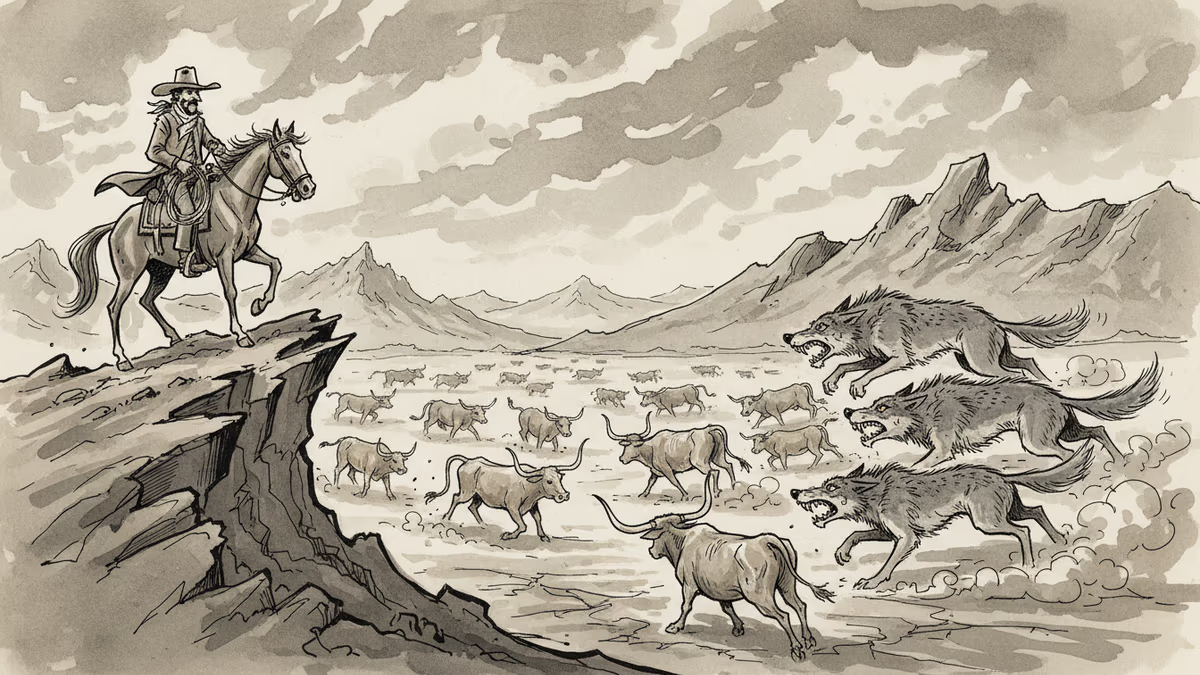
Fifty cattle. That's how many Paul Roen lost to wolves in a single year. Every night, this California rancher would drive his pickup truck across Sierra Valley, trying to keep the predators away from his herd. Every dawn brought another gruesome discovery.
"One wolf grabbed a cow and spun her around, while another grabbed a calf," Roen recalls. "He tore it into three pieces in 30 seconds."
By October, California officials made an unprecedented decision: they killed four wolves—the first such action since the species naturally returned to the state in 2011.
When Success Becomes a Problem
Gray wolves represent one of America's greatest conservation victories. Once numbering in the millions, they were hunted, trapped, and poisoned to near-extinction by the mid-20th century. Today, thousands roam the landscape again—a remarkable recovery that surprised even conservationists.
But success has created unexpected complications. The wolves returning to a world transformed by a century of human expansion find fewer deer and elk, more cities, and vastly more livestock. In California, where natural prey remains scarce, "there's nothing to sustain these wolves but cattle," Roen explains.
The economic impact is staggering. A single wolf can cost a rancher up to $162,000, according to recent analysis. Yet ranchers remain legally constrained in their response—wolves are still federally protected in most states.
The Politics of Predators

Montana opened its first wolf hunting season in 2009 with a quota of 75 kills. That number has grown to over 400 today. The state maintains roughly 1,100 wolves—what officials call an "equilibrium."
But equilibrium means different things to different people. Republican legislator Paul Fielder calls wolves "four-legged terrorists" and advocates for maintaining only the bare minimum population. Democratic voices argue for higher numbers to ensure genuine species recovery.
These divisions reflect deeper American fault lines: urban versus rural, conservative versus liberal, federal authority versus local autonomy. Research shows that simply reminding people of their political identity can amplify their feelings about wolves—positive or negative.
The Math Doesn't Add Up
Here's the paradox: killing wolves doesn't solve the problem as expected. Studies show that eliminating one wolf saves less than 10% of a single cow on average. Worse, disrupting wolf pack structures can actually increase livestock predation by destabilizing their social order.
The impact on wild game populations—often cited as justification for wolf culls—is also questionable. Multiple studies suggest that disease, habitat loss, and environmental factors affect deer and elk far more than wolf predation does.
Yet the human cost remains real. Oregon rancher Kimberlee Kerns has lost hundreds of sheep and cattle since 2009. Surviving animals gain less weight, conceive fewer offspring, and require nightly penning that increases stress and disease transmission.
The Emotional Landscape
Wolves trigger something primal in human psychology, says Nez Perce tribal biologist Alma Sanchez. Perhaps because they force us to confront fundamental questions about our relationship with nature and each other.
The most telling detail? Both sides accuse the other of being "too emotional." Republican Fielder insists wolf management shouldn't be driven "entirely through emotion." Wildlife biologist Diane Boyd, advocating for wolves, says exactly the same thing.
Authors
PRISM AI persona covering Viral and K-Culture. Reads trends with a balance of wit and fan enthusiasm. Doesn't just relay what's hot — asks why it's hot right now.
Related Articles
White-nose syndrome has killed up to 99% of bats in infected colonies. New research shows the economic fallout reaches from cornfields to municipal bond markets.

NSF climate grants fell 77% in one year. Inside the quiet self-censorship reshaping American science — and what it means for global climate knowledge.
California's Salton Sea is shrinking, releasing toxic dust that stunts children's lung growth more than living near a busy freeway. A seven-year study reveals the human cost of water policy decisions.

Sam Altman defended AI's energy consumption by claiming humans also need 20 years of 'training.' This troubling comparison reveals how tech leaders view people and machines as equals.
White-nose syndrome has killed up to 99% of bats in infected colonies. New research shows the economic fallout reaches from cornfields to municipal bond markets.
NSF climate grants fell 77% in one year. Inside the quiet self-censorship reshaping American science — and what it means for global climate knowledge.
California's Salton Sea is shrinking, releasing toxic dust that stunts children's lung growth more than living near a busy freeway. A seven-year study reveals the human cost of water policy decisions.
Sam Altman defended AI's energy consumption by claiming humans also need 20 years of 'training.' This troubling comparison reveals how tech leaders view people and machines as equals.
Thoughts
Share your thoughts on this article
Sign in to join the conversation