

Beijing's Playbook: What 5 Years of PLA Activity Near Taiwan Reveals
As the US's commitment to defending Taiwan appears to waver, China's military activity has become a critical barometer. Observers analyze five years of PLA movements to decode Beijing's intentions for reunification.
Is the Taiwan Strait the world's next flashpoint? As Beijing’s “Chinese dream” of eventual reunification with Taiwan looms, the United States—Taipei’s most crucial international backer—appears less likely to intervene in a conflict. In this fraught environment, the actions of the People’s Liberation Army (PLA) have become the most critical barometer of China’s intentions.
A Constant State of Pressure
Over the past five years, PLA activity near Taiwan has escalated in both frequency and sophistication. Many observers observe this not as simple military drills, but as a calculated political campaign. These incursions by jets and warships are seen as a multi-pronged strategy: to test Taiwan’s defense readiness, exhaust its military resources, and desensitize the international community to a constant Chinese military presence.
Testing America's 'Strategic Ambiguity'
The PLA’s posturing is also a direct test of Washington’s resolve. The U.S. has long maintained a policy of 'strategic ambiguity' to deter an invasion, but shifts in the American political landscape have cast doubt on its willingness to commit forces. Beijing appears to be exploiting this uncertainty, attempting to incrementally shift the military status quo in its favor without triggering a direct confrontation.
This content is AI-generated based on source articles. While we strive for accuracy, errors may occur. We recommend verifying with the original source.
Related Articles
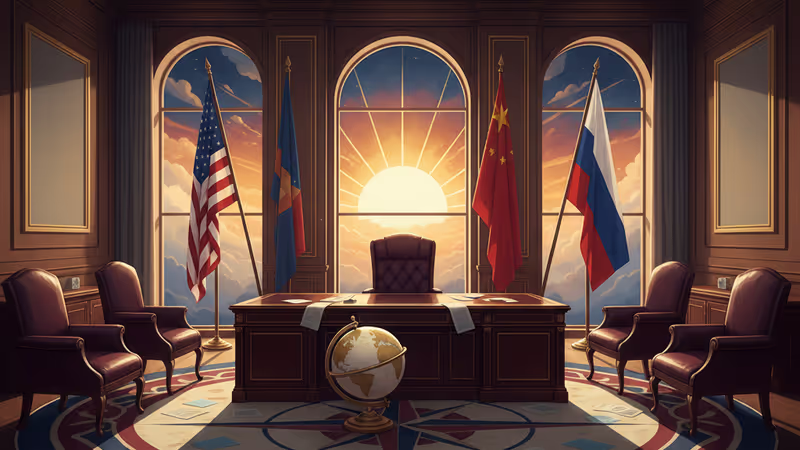
The Trump administration's recall of nearly 30 career ambassadors has prompted a stark warning from Democrats, who claim the move leaves over 100 posts vacant and creates a diplomatic vacuum for China and Russia to exploit.
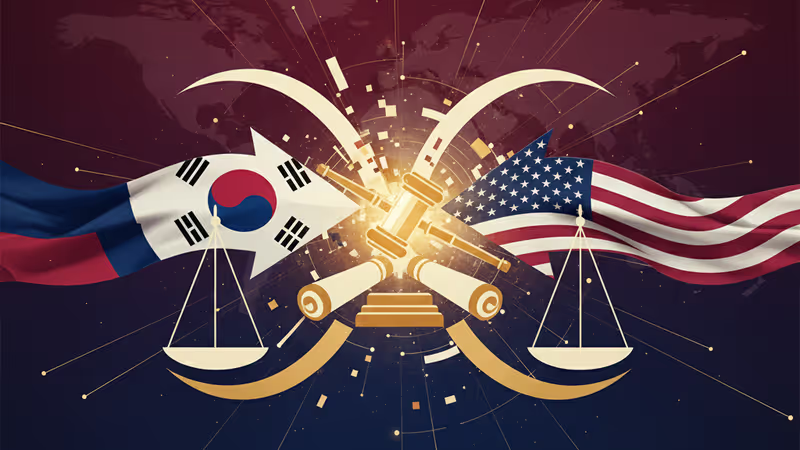
President Lee Jae-myung's backing of the Unification Ministry's role in North Korea policy is fueling a conflict between 'self-reliance' and 'pro-alliance' factions within Seoul, with major implications for the U.S. alliance amid growing U.S.-China tensions.

An analysis of how China's 'panda diplomacy' reflects shifting relations with Japan and France. The movement of these animals is more than goodwill; it's a tool in Xi Jinping's foreign policy.
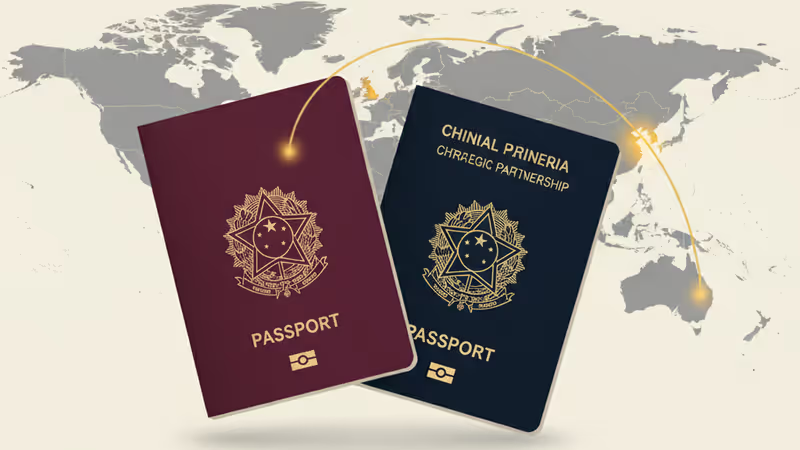
Brazil is preparing to waive visa requirements for Chinese tourists and business travelers, with an announcement expected in early 2026. The move aims to deepen ties with its largest trading partner, China.
The Trump administration's recall of nearly 30 career ambassadors has prompted a stark warning from Democrats, who claim the move leaves over 100 posts vacant and creates a diplomatic vacuum for China and Russia to exploit.
President Lee Jae-myung's backing of the Unification Ministry's role in North Korea policy is fueling a conflict between 'self-reliance' and 'pro-alliance' factions within Seoul, with major implications for the U.S. alliance amid growing U.S.-China tensions.
An analysis of how China's 'panda diplomacy' reflects shifting relations with Japan and France. The movement of these animals is more than goodwill; it's a tool in Xi Jinping's foreign policy.
Brazil is preparing to waive visa requirements for Chinese tourists and business travelers, with an announcement expected in early 2026. The move aims to deepen ties with its largest trading partner, China.