
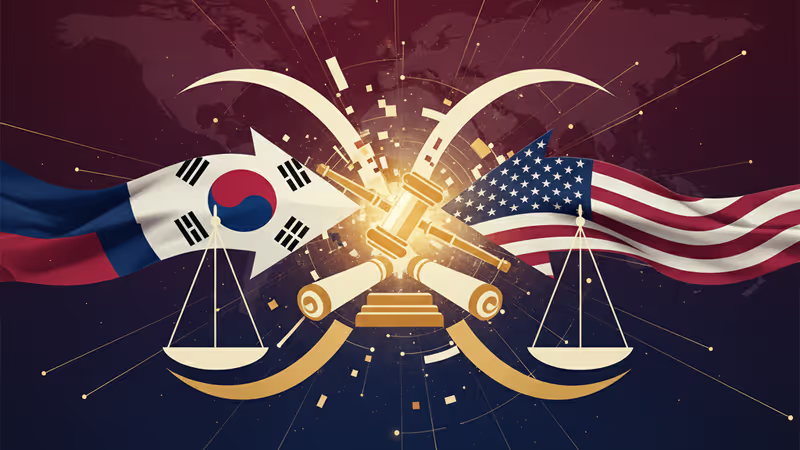
Seoul's Two Voices: Internal Rift Deepens Over North Korea Policy in Lee Jae-myung's Government
President Lee Jae-myung's backing of the Unification Ministry's role in North Korea policy is fueling a conflict between 'self-reliance' and 'pro-alliance' factions within Seoul, with major implications for the U.S. alliance amid growing U.S.-China tensions.
One hand reaffirms the U.S. alliance while the other pushes for autonomy. President Lee Jae-myung's recent endorsement of the Ministry of Unification has exposed a deep-seated rift within South Korea's foreign policy establishment, pitting the 'self-reliance faction' (Ja-Ju-Pa) against the 'pro-alliance camp' (Dong-Maeng-Pa). Amid intensifying U.S.-China strategic competition, the internal disarray over Seoul's diplomatic direction appears to be growing.
President Backs Unification Ministry, Sidelines Foreign Ministry
The conflict came to a head on December 19 at a joint policy briefing in Seoul. President Lee stated, "South Korea must act with patience and do its utmost to reduce hostility between the two Koreas," adding that this role "is one the Ministry of Unification must play." The remarks were widely seen as handing the reins of North Korea policy to the 'self-reliance faction' centered around the ministry.
This followed an incident that highlighted the interministerial friction. On December 16, Vice Minister for Diplomatic Strategy and Intelligence Jeong Yeon-doo met with acting U.S. Ambassador Kevin Kim to coordinate North Korea policy, but the Unification Ministry declined to participate. Instead, it held a separate policy briefing for foreign diplomats, a move that reportedly surprised and dismayed some U.S. officials.
Déjà Vu: A Two-Decade Conflict Revived
The discord between the self-reliance and pro-alliance factions is not new, dating back to the Roh Moo-hyun administration (2003-08). At that time, a progressive, pro-autonomy faction centered around the National Security Council (NSC) and Unification Ministry clashed with a conservative, pro-alliance faction led by the Foreign Ministry and Defense Ministry. In a striking echo of the past, key figures from that era are back in power: Lee Jong-seok, a central figure of the self-reliance camp, now heads the National Intelligence Service, while Wi Sung-lac of the pro-alliance camp is the National Security Adviser.
Then, as now, the core disagreement was the approach to Pyongyang. The pro-autonomy faction argued that improving inter-Korean relations would advance denuclearization, while the pro-alliance camp insisted that sanctions and pressure were necessary to bring North Korea to the table. Today, Unification Minister Chung Dong-young and Foreign Minister Cho Hyun are seen as representing these opposing views.
High Stakes Amid External Pressures
This internal division comes at a particularly sensitive time, as President Lee recently declared that South Korea can no longer rely on its traditional "security with the U.S., economy with China" policy, known as "Ahn Mi-kyung-joong." The declaration followed a stark warning from U.S. Secretary of Defense Pete Hegseth at the Shangri-La Dialogue on May 31, where he cautioned countries against pursuing economic ties with China and defense cooperation with the United States simultaneously. As Washington's pressure mounts, a divided message from Seoul risks undermining the credibility of its foreign policy.
This content is AI-generated based on source articles. While we strive for accuracy, errors may occur. We recommend verifying with the original source.
Related Articles
As the US's commitment to defending Taiwan appears to waver, China's military activity has become a critical barometer. Observers analyze five years of PLA movements to decode Beijing's intentions for reunification.
As South Korea pursues greater military autonomy, including the OPCON transfer and nuclear submarines, the 70-year alliance with the U.S. is at a turning point. An analysis of the motives and future.

North Korea's state media KCNA reports that leader Kim Jong Un has overseen the construction of a nuclear-powered submarine, a major development that could shift the security balance in Northeast Asia.
Bangladesh's main opposition party, the BNP, is preparing to welcome back its leader Tarique Rahman from a 17-year exile with a rally of up to 5 million supporters, a key event ahead of the February general election.
As the US's commitment to defending Taiwan appears to waver, China's military activity has become a critical barometer. Observers analyze five years of PLA movements to decode Beijing's intentions for reunification.
As South Korea pursues greater military autonomy, including the OPCON transfer and nuclear submarines, the 70-year alliance with the U.S. is at a turning point. An analysis of the motives and future.
North Korea's state media KCNA reports that leader Kim Jong Un has overseen the construction of a nuclear-powered submarine, a major development that could shift the security balance in Northeast Asia.
Bangladesh's main opposition party, the BNP, is preparing to welcome back its leader Tarique Rahman from a 17-year exile with a rally of up to 5 million supporters, a key event ahead of the February general election.