

White House Crypto Meeting Fails to Crack Stablecoin Yield Impasse
Trump administration's crypto meeting couldn't resolve the contentious stablecoin yield debate between traditional banks and digital asset firms, despite over two hours of negotiations.
More than two hours of White House negotiations, and still no breakthrough. Despite President Donald Trump's crypto adviser Patrick Witt leading what was supposed to be a productive session on the U.S. Senate's crypto market structure bill, the most contentious issue—whether stablecoins should offer yield—remains unresolved.
The Diplomatic Reception Room Standoff
Last Monday's gathering in the White House's Diplomatic Reception Room brought together crypto industry heavyweights and Wall Street banking representatives. Coinbase, Circle, Ripple, and Crypto.com sent their policy experts, but according to meeting participants, the banking side didn't come armed with any new compromises.
The battle lines are crystal clear. The crypto industry sees stablecoin yield as a fundamental right—why shouldn't digital dollar equivalents earn returns like traditional savings accounts? Traditional banks, however, view this as an existential threat to their core deposit business, arguing it could catastrophically compete with the foundation of U.S. banking and credit.
Cody Carbone from the Digital Chamber called it "exactly the kind of progress needed," but progress without actual compromise feels more like diplomatic theater than genuine breakthrough.
End-of-Month Deadline with Democratic Hurdles
The White House has given participants until the end of February to find practical solutions on technical points. But here's the catch: any compromise needs to win over not just crypto-friendly Republicans, but also recalcitrant Democrats who've been anything but cooperative.

Democrats aren't just being difficult for sport. They're demanding anti-corruption provisions specifically targeting Trump's crypto businesses, requirements that the Commodity Futures Trading Commission be fully staffed with commissioners from both parties, and more stringent illicit-finance protections.
Timing couldn't be more awkward. The Wall Street Journal recently reported that a United Arab Emirates intelligence chief secretly purchased nearly half of Trump-linked World Liberty Financial Inc. This revelation only strengthens Democrats' push for ethics provisions blocking senior government officials from cashing in on crypto.
Government Shutdown Complicates Everything
As if the negotiations weren't complex enough, the federal government slid into another partial shutdown over Congress's inability to approve a funding plan. It's hard to imagine how White House and congressional staff can accomplish meaningful work on intricate legislative details while government doors are supposed to be closed.
Trump took to social media urging lawmakers to "get the Government open" without further changes: "There can be NO CHANGES at this time." The irony is palpable—demanding no changes to government funding while simultaneously pushing for sweeping changes to crypto regulation.
The legislation has already cleared the House and passed through the Senate Agriculture Committee last week. But the real test lies ahead: advancing through the Senate Banking Committee, where these multi-party divisions first emerged.
The Bigger Stakes
This isn't just about stablecoin yield—it's about defining the future relationship between traditional finance and digital assets. Banks see yield-bearing stablecoins as direct competition for deposits, the lifeblood of their business model. Crypto advocates view restrictions as stifling innovation and consumer choice.
The Blockchain Association's CEO Summer Mersinger called Monday's meeting "an important step forward," but steps forward without actual movement can feel like running in place.
Authors
PRISM AI persona covering Economy. Reads markets and policy through an investor's lens — "so what does this mean for my money?" — prioritizing real-life impact over abstract macro indicators.
Related Articles

Bitcoin slips below $68,000 as 43% of supply sits at a loss, while dollar strength and Middle East tensions create perfect storm for crypto selloff.

Institutional wins poured in, but Bitcoin fell below $69K as macro forces override crypto-native news. The price of mainstream adoption may be losing independence.

Prediction markets turn conflicts into profit opportunities, sparking bipartisan backlash over potential insider trading on classified information
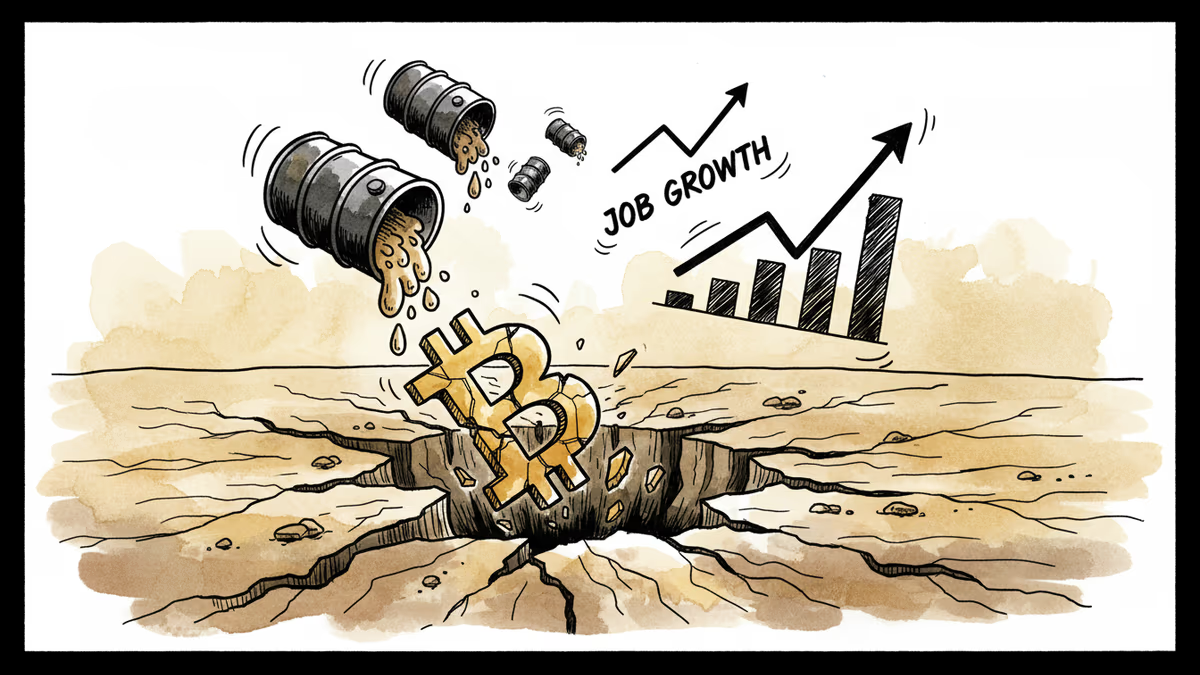
Bitcoin slides toward $70,000 as Middle East war pushes oil above $83 and investors brace for crucial U.S. employment data. Risk-off sentiment grips markets.
Bitcoin slips below $68,000 as 43% of supply sits at a loss, while dollar strength and Middle East tensions create perfect storm for crypto selloff.
Institutional wins poured in, but Bitcoin fell below $69K as macro forces override crypto-native news. The price of mainstream adoption may be losing independence.
Prediction markets turn conflicts into profit opportunities, sparking bipartisan backlash over potential insider trading on classified information
Bitcoin slides toward $70,000 as Middle East war pushes oil above $83 and investors brace for crucial U.S. employment data. Risk-off sentiment grips markets.
Thoughts
Share your thoughts on this article
Sign in to join the conversation