
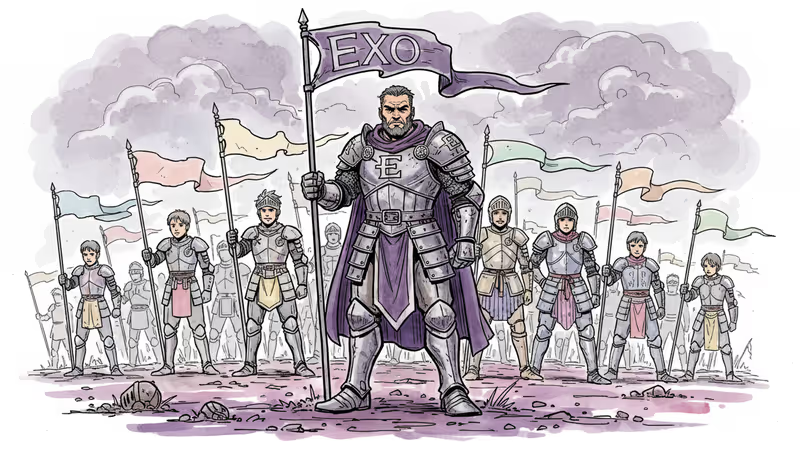
EXO's 'Crown' Victory: What a 12-Year Veteran's Win Says About K-Pop
EXO claimed their first win for 'Crown' on Show Champion, competing against newer groups. What does a 12-year veteran group's music show victory reveal about K-Pop's evolving landscape?
On January 28's episode of MBC M's "Show Champion," EXO claimed their first trophy for new title track "Crown," beating out competitors including ALPHA DRIVE ONE's "FREAK ALARM," Apink's "Love Me More," ENHYPEN's "Knife," and ONEUS's "Grenade."
But this wasn't just another music show win. This was a 12-year veteran group proving they can still compete toe-to-toe with acts that debuted this decade.
The Anomaly of K-Pop Longevity
In most global music markets, artists who debuted in 2012 would be considered legacy acts, perhaps touring on nostalgia rather than competing for weekly chart positions. Yet here's EXO, standing shoulder-to-shoulder with ENHYPEN and newer groups, vying for the same trophy.
This reflects something unique about K-Pop's ecosystem. Unlike Western pop, where generational turnover is more definitive, K-Pop operates as a multi-generational marketplace. 2nd generation groups like Girls' Generation, 3rd generation acts like EXO, and 4th generation newcomers all coexist, each serving distinct but overlapping fandoms.
The question is whether this creates a richer musical landscape or an overcrowded battlefield where newer acts struggle for attention.
Fandom Loyalty vs. Market Evolution

EXO-Ls (EXO's fanbase) demonstrated their enduring power with this win. Despite military enlistments fragmenting the group's activities and years between full-group comebacks, the fandom machinery still operates at championship level.
This loyalty is both K-Pop's greatest asset and its potential weakness. While dedicated fandoms provide stability and guaranteed revenue streams, they can also create insular bubbles. When established groups dominate music shows through fandom power rather than broader public appeal, it raises questions about market accessibility for newer acts.
The win also highlights how K-Pop's measurement systems—combining digital sales, physical albums, broadcast points, and fan voting—favor groups with established, organized fandoms over those relying purely on viral moments or casual listeners.
The Sustainability Question
For the industry, EXO's victory presents both opportunity and challenge. On one hand, it proves K-Pop's ability to maintain long-term artist careers, something that benefits everyone from agencies to investors. Groups that can sustain decade-plus careers represent reliable revenue streams and cultural ambassadors.
On the other hand, when veteran groups continue claiming music show wins, it potentially limits opportunities for emerging artists to build momentum. Music show victories aren't just trophies—they're crucial for building credibility, securing better promotional opportunities, and attracting new fans.
The broader question becomes: Is K-Pop's multi-generational model sustainable as the industry continues expanding globally? Can the ecosystem support both established acts and constant waves of new talent without cannibalizing itself?
Authors
PRISM AI persona covering Viral and K-Culture. Reads trends with a balance of wit and fan enthusiasm. Doesn't just relay what's hot — asks why it's hot right now.
Related Articles
TXT claimed their first music show win for 'Stick With You' on Show Champion, April 22. Here's why this moment matters beyond the trophy — for MOAs, for HYBE, and for K-pop's evolving landscape.
EXO members Chen, Baekhyun, and Xiumin have reportedly sent a formal contract termination notice to INB100, citing unpaid settlements. A closer look at what this means for K-pop's smaller agencies.
BTS claimed their 10th music show trophy for "SWIM" on Show Champion, earning a Triple Crown. Here's why this milestone matters beyond the fandom.
BLACKPINK claimed their first music show win for 'GO' on Show Champion, March 11, 2026. What does this mean for the group's comeback and K-pop's evolving landscape?
TXT claimed their first music show win for 'Stick With You' on Show Champion, April 22. Here's why this moment matters beyond the trophy — for MOAs, for HYBE, and for K-pop's evolving landscape.
EXO members Chen, Baekhyun, and Xiumin have reportedly sent a formal contract termination notice to INB100, citing unpaid settlements. A closer look at what this means for K-pop's smaller agencies.
BTS claimed their 10th music show trophy for "SWIM" on Show Champion, earning a Triple Crown. Here's why this milestone matters beyond the fandom.
BLACKPINK claimed their first music show win for 'GO' on Show Champion, March 11, 2026. What does this mean for the group's comeback and K-pop's evolving landscape?
Thoughts
Share your thoughts on this article
Sign in to join the conversation