
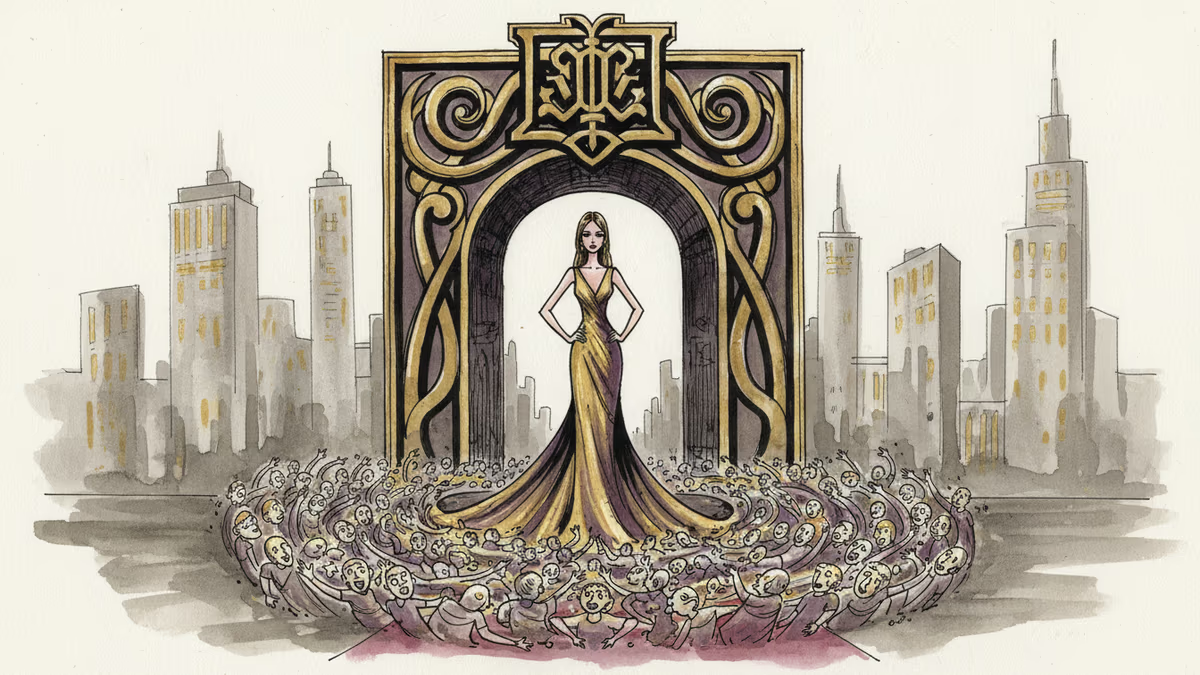
What Ningning Wearing Gucci Actually Means
aespa's Ningning just became Gucci's newest global ambassador. But behind the announcement lies a calculated bet by both a luxury house in decline and a K-pop star building a solo career.
Of aespa's four members, Ningning got to a luxury maison first. That sequence is not accidental.
On April 29, Gucci officially announced Ningning as its newest global ambassador. "I am excited and delighted to have been chosen as a global ambassador for Gucci," she said in the announcement. "It's a brand I've loved for a long time, which makes this even more meaningful." The reveal dropped simultaneously across official social channels alongside video content—the standard playbook for a major fashion house unveiling a new face.
The Calculation Behind the Casting
K-pop and luxury fashion have been in a committed relationship for years. EXO's Kai served as a Gucci ambassador back in 2019. BTS's V went to Celine, BLACKPINK's Lisa to Bvlgari. By now, the K-pop-to-luxury-house pipeline is less a trend than a structural feature of both industries. What makes Ningning's appointment worth examining is the specific timing and the specific brand.
Gucci is not in a comfortable position. After Alessandro Michele's departure in 2023 and Sabato De Sarno's arrival, the house has been navigating a difficult identity reset—trying to shed Michele's maximalist era without losing the cultural heat it generated. Parent company Kering reported significant revenue declines through 2024, with Asia-Pacific markets underperforming. Bringing in a K-pop ambassador is partly a brand statement, and partly a cost-efficient way to generate organic fan-driven content at a fraction of what a traditional campaign costs.

Ningning is a specific kind of asset for Gucci. She's a Chinese national who is simultaneously a core member of a Korean group with global reach. That dual identity gives Gucci access to two of the markets it most needs to recover in—South Korea and mainland China—through a single contract. In luxury marketing terms, that's a high-leverage move.
Who's Really Getting the Better Deal
The K-pop ambassador economy has matured considerably since the early days of red carpet appearances and Instagram posts. Today's deals typically layer campaign shoots, front-row show placements, and sometimes co-designed capsule collections. The fan response is measurable: when Louis Vuitton partnered with BTS, search volume for related products reportedly spiked by multiples. Luxury brands have learned to treat idol fandoms as precision-targeted distribution networks for brand awareness.
But the transaction is asymmetric in ways that don't always favor the brand. Luxury houses temporarily rent a fandom's attention. The idol, in return, absorbs the brand's cultural authority—and keeps it. Ningning being associated with Gucci's aesthetic language, its heritage, its visual identity, becomes part of her long-term career capital in a way that outlasts any contract term. Whether that's a fair exchange depends entirely on what happens after the deal expires.
For Ningning specifically, the timing aligns with aespa entering a phase where individual members are building parallel solo identities alongside the group. A Gucci ambassadorship is the fastest way to signal that transition to audiences beyond the fandom—fashion editors, brand collaborators, casting directors. It's less about selling bags and more about establishing a lane.
This content is AI-generated based on source articles. While we strive for accuracy, errors may occur. We recommend verifying with the original source.
Related Articles

CORTIS claimed a 4th music show win and Triple Crown for "REDRED" on M Countdown, beating BABYMONSTER. Here's what the numbers reveal about K-pop's scoring architecture.
aespa dropped the dance practice video for 'WDA (Whole Different Animal)' feat. G-Dragon. Beyond the choreography, the collab reveals a quiet but deliberate shift in how SM Entertainment is repositioning its flagship 4th-gen act.
Grammy winner Anderson .Paak teases collaboration with aespa, signaling K-Pop's evolution from guest to partner in global music. What does this mean for the industry?
RIIZE's Shotaro directly addressed dating rumors with aespa's Giselle, highlighting the complex dynamics between K-Pop idols and their fandoms
CORTIS claimed a 4th music show win and Triple Crown for "REDRED" on M Countdown, beating BABYMONSTER. Here's what the numbers reveal about K-pop's scoring architecture.
aespa dropped the dance practice video for 'WDA (Whole Different Animal)' feat. G-Dragon. Beyond the choreography, the collab reveals a quiet but deliberate shift in how SM Entertainment is repositioning its flagship 4th-gen act.
Grammy winner Anderson .Paak teases collaboration with aespa, signaling K-Pop's evolution from guest to partner in global music. What does this mean for the industry?
RIIZE's Shotaro directly addressed dating rumors with aespa's Giselle, highlighting the complex dynamics between K-Pop idols and their fandoms
Thoughts
Share your thoughts on this article
Sign in to join the conversation