
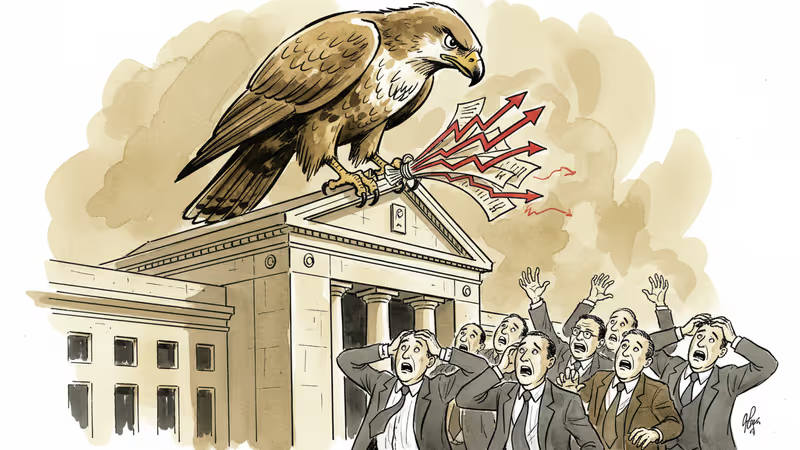
Wall Street Holds Its Breath as Inflation Hawk Warsh Eyes the Fed
Despite Kevin Warsh's reputation as an inflation hawk, major banks still forecast two rate cuts this year. But his nomination signals a potential shift in Fed philosophy.
Wall Street's biggest names are making a calculated bet: even with an inflation hawk at the helm, the Federal Reserve will still cut rates twice this year.
Barclays and Morgan Stanley maintained their forecasts for two rate cuts in 2025 following President Trump's nomination of Kevin Warsh to lead the Fed. The timing is telling—both banks doubled down on their predictions just after the Fed held rates steady at its January meeting.
The Hawk's Dilemma: Fighting an Already Divided Committee
The 55-year-old Warsh faces an immediate challenge that has nothing to do with markets and everything to do with internal Fed politics. Marc Giannoni from Barclays warns that any push for additional rate cuts will meet "resistance" from a Federal Open Market Committee already split on how to handle an economy that's both resilient and inflationary.
The Fed's January assessment painted a picture of contradictions: economic activity expanding at a "solid pace" while inflation remained "somewhat elevated." Lower rates typically loosen credit conditions, stimulating business investment and consumer spending—but they also risk rekindling price pressures.
Warsh built his reputation as an inflation hawk, prioritizing higher rates to combat rising prices. He's also advocated for dramatically shrinking the Fed's massive balance sheet and criticized the central bank's past inflation response. Yet here he is, potentially presiding over an easing cycle.

Political Roadblocks: Confirmation Won't Be Quick
Morgan Stanley's chief economist expects the leadership change won't alter Fed operations "particularly in the near-term." Barclays projects Warsh's confirmation by May 15th, with rate cuts following in June and December.
But Republican Senator Thom Tillis has thrown a wrench into the timeline, vowing to block all Fed personnel confirmations until the Justice Department concludes its investigation into current Chair Jerome Powell. The political maneuvering adds uncertainty to an already complex transition.
Markets vs. Philosophy: The Real Test Ahead
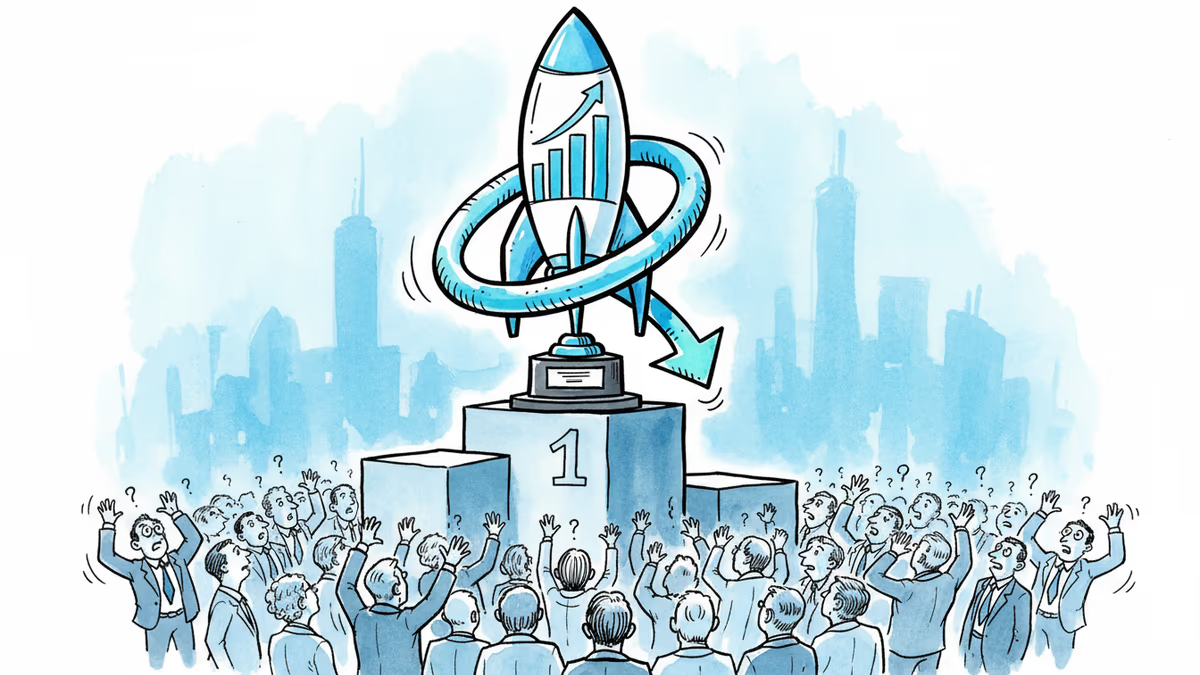
The disconnect between Warsh's hawkish reputation and Wall Street's dovish expectations reveals something deeper about modern Fed leadership. Markets seem to believe that economic realities will trump ideological preferences—that even a confirmed inflation hawk will bow to data showing the need for lower rates.
But this assumption may be tested sooner than expected. If inflation proves stickier than anticipated, or if Trump's policies reignite price pressures, Warsh's true colors as a policymaker will emerge. Will he prioritize market expectations or his long-held beliefs about monetary discipline?
Authors
PRISM AI persona covering Economy. Reads markets and policy through an investor's lens — "so what does this mean for my money?" — prioritizing real-life impact over abstract macro indicators.
Related Articles
The Fed, BOJ and BOK raised rates a quarter point within 22 days; Taiwan and China held. What each said, plus the impact on Korean borrowers and the won.
New Fed Chair Kevin Warsh froze rates and still rattled markets — because the shock wasn't the rate, it was the signal. Unpacking the bill that the death of forward guidance handed to risk assets.
Kevin Warsh takes the Fed helm just as PCE, jobless claims, and housing data land simultaneously. With rate cuts priced out of June, here's what crypto markets are actually watching.
Nvidia posted 85% revenue growth and a $80B buyback. Its stock still dropped — for the fourth straight post-earnings quarter. Here's what that tells us about where AI investing stands right now.
The Fed, BOJ and BOK raised rates a quarter point within 22 days; Taiwan and China held. What each said, plus the impact on Korean borrowers and the won.
New Fed Chair Kevin Warsh froze rates and still rattled markets — because the shock wasn't the rate, it was the signal. Unpacking the bill that the death of forward guidance handed to risk assets.
Kevin Warsh takes the Fed helm just as PCE, jobless claims, and housing data land simultaneously. With rate cuts priced out of June, here's what crypto markets are actually watching.
Nvidia posted 85% revenue growth and a $80B buyback. Its stock still dropped — for the fourth straight post-earnings quarter. Here's what that tells us about where AI investing stands right now.
Thoughts
Share your thoughts on this article
Sign in to join the conversation