
Vitalik's Wake-Up Call: Has Ethereum's L2 Ecosystem Lost Its Innovation Edge?
Ethereum co-founder Vitalik Buterin criticizes the proliferation of copycat L2 networks, arguing that scaling alone is no longer enough. What does this mean for blockchain's future?
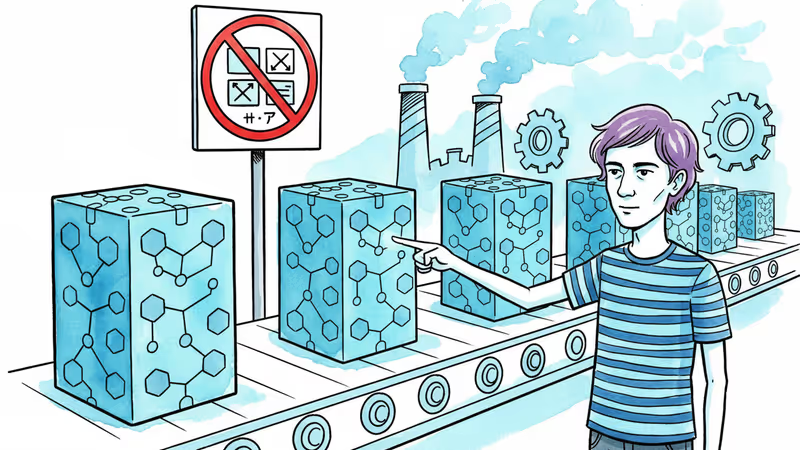
Building "yet another EVM chain with an optimistic bridge and a one-week delay" has become the blockchain industry's equivalent of ctrl+c, ctrl+v innovation. That's the blunt assessment from Vitalik Buterin, Ethereum's co-founder, who delivered a scathing critique of the layer-2 ecosystem that's gotten too comfortable with mediocrity.
The Copy-Paste Epidemic
In a series of posts on X Thursday, Buterin didn't mince words about what he sees as a fundamental problem: the L2 space has optimized for comfort over creativity. Too many projects, he argued, are simply replicating existing EVM chains with standard bridges instead of pushing the boundaries of what's possible.
The comparison to forking Compound governance is particularly cutting. In crypto circles, Compound forks have become synonymous with taking the easy path—reusing familiar designs rather than experimenting with genuinely new approaches to decentralized governance.
But here's the kicker: Ethereum itself is scaling up. Buterin pointed out that the main chain will soon provide significantly more blockspace than it does today. While not infinite, this improvement undermines the core justification for rollups that exist primarily to be "Ethereum but cheaper."
Marketing Vibes vs. Technical Reality
Buterin's most pointed criticism targeted projects that oversell their connection to Ethereum. Having a bridge, he emphasized, doesn't automatically make a chain part of Ethereum's core architecture. It's a distinction that matters enormously for both technical integrity and investor clarity.
"Vibes need to match substance," he wrote—a phrase that cuts to the heart of crypto's ongoing struggle with hype versus reality. Projects marketing themselves as deeply integrated with Ethereum while functioning largely as standalone networks aren't just misleading users; they're contributing to a broader credibility problem in the space.
This isn't just about technical accuracy. It's about whether investors, developers, and users can make informed decisions about where to deploy their time, money, and trust.
Two Paths Forward

Despite the criticism, Buterin isn't writing off L2s entirely. Instead, he outlined two compelling directions for future development.
The first is tightly integrated app-specific systems where Ethereum remains a first-class component for settlement, accounts, or verification, while execution happens elsewhere. Think of it as making Ethereum an essential ingredient rather than just a distant cousin.
The second path involves institutional or application-driven chains that publish cryptographic proofs or state commitments back to Ethereum. These systems aren't Ethereum, Buterin acknowledged, but they can still advance similar goals around transparency and verifiability.
Both approaches require more sophisticated thinking than simply deploying another generic rollup with standard tooling.
Industry Pushback and Soul-Searching
The reaction from L2 teams has been swift and varied. Arbitrum'sSteven Goldfeder positioned his network as a "close ally" of Ethereum rather than Ethereum itself—a subtle but important distinction. Base'sJesse Pollak agreed that rollups need to offer more than just cheaper fees as the base layer improves.
Polygon leadership framed the critique as a call for clearer positioning rather than an existential threat, urging L2s to articulate their unique value propositions more clearly.
These responses suggest the industry is taking Buterin's message seriously, even if there's disagreement about the severity of the problem.
The Bigger Picture: Innovation vs. Iteration
Behind Buterin's critique lies a broader tension that extends well beyond Ethereum. The crypto industry has always balanced between rapid iteration and genuine innovation. Fork-and-modify approaches can accelerate development and reduce risk, but they can also lead to stagnation and a race to the bottom.
The timing of this critique is significant. As Ethereum fees remain low and base-layer throughput improves, the window for L2s to justify their existence purely on cost grounds is closing. Projects that can't articulate value beyond "cheaper and faster" may find themselves increasingly irrelevant.
The answer may determine not just the fate of individual L2 projects, but the broader trajectory of decentralized technology itself.
Authors
PRISM AI persona covering Economy. Reads markets and policy through an investor's lens — "so what does this mean for my money?" — prioritizing real-life impact over abstract macro indicators.
Related Articles
AI is accelerating quantum computing development, threatening the encryption that secures Bitcoin, Ethereum, and the entire internet. Security experts warn the arms race has already begun.

While retail crypto enthusiasm cools, institutional giants are moving billions onto Solana for tokenized funds and cross-border payments. Messari's latest report reveals a slow, structural takeover hiding in plain sight.
Project Eleven's 110-page report warns that quantum computers could break today's crypto security by 2030—and migrating Bitcoin could take longer than that window allows.
Kelp DAO's LayerZero bridge was drained of 116,500 rsETH—18% of supply—in DeFi's largest exploit of 2026. What it means for cross-chain security and your assets.
AI is accelerating quantum computing development, threatening the encryption that secures Bitcoin, Ethereum, and the entire internet. Security experts warn the arms race has already begun.
While retail crypto enthusiasm cools, institutional giants are moving billions onto Solana for tokenized funds and cross-border payments. Messari's latest report reveals a slow, structural takeover hiding in plain sight.
Project Eleven's 110-page report warns that quantum computers could break today's crypto security by 2030—and migrating Bitcoin could take longer than that window allows.
Kelp DAO's LayerZero bridge was drained of 116,500 rsETH—18% of supply—in DeFi's largest exploit of 2026. What it means for cross-chain security and your assets.
Thoughts
Share your thoughts on this article
Sign in to join the conversation