
How Trump's China Tariffs Accidentally Created a Vietnamese Boomtown
Donald Trump's tariffs on China have turned Vietnam's Mong Cai into a major hub for rerouting goods to the U.S. An analysis of the supply chain shifts reshaping global trade.
For nearly nine years, former President Donald Trump's tariffs have targeted U.S. imports from China. But instead of crippling Chinese exports, they've created a bustling trade hub in the Vietnamese border city of Mong Cai. According to a Nikkei report, the city has become a primary conduit for redirecting Chinese goods to the American market, a stark example of how the escalating U.S.-China rift is reshaping Asia's supply chains.
The Great Supply Chain Reroute
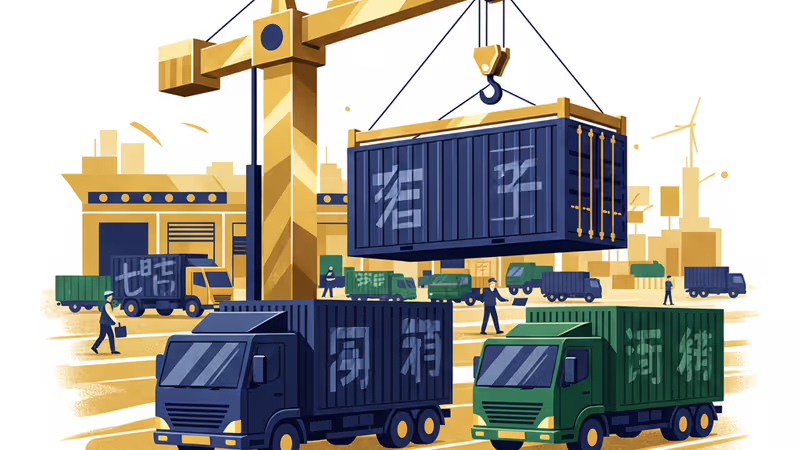
The strategy is straightforward: Chinese goods are moved across the border to Mong Cai. There, they undergo minimal processing or are simply repackaged before being shipped to the U.S. with a "Made in Vietnam" label. It's a workaround that allows companies to sidestep the steep tariffs imposed on direct imports from China, a tactic honed since Trump's first term began.
A New Map for Global Trade
This isn't just a local phenomenon. While Trump's tariffs have dented direct U.S.-China trade, overall imports from Southeast Asia have surged. This suggests that while official data may show a shift away from China, a significant volume of Chinese products is likely still entering the U.S. market through these backdoors. The entire 'world's factory' is in a constant state of flux, adapting to geopolitical pressures—a trend that complicates any policymaker's attempt to isolate a single economy.
This illustrates the law of unintended consequences in economic policy. Tariffs, a blunt instrument, don't eliminate trade flows; they reroute them along the path of least resistance. For businesses and investors, the key takeaway is to look beyond a policy's stated intent and identify the second-order winners—like Vietnamese logistics hubs or Thai manufacturers—who are capitalizing on the disruption.
This content is AI-generated based on source articles. While we strive for accuracy, errors may occur. We recommend verifying with the original source.
Related Articles

President Donald Trump has indicated he might approve Japan's 'kei' minicars for U.S. roads. We analyze the significant regulatory hurdles, consumer acceptance doubts, and the potential trade policy implications.

Iconic American bourbon maker Jim Beam is shutting down a Kentucky distillery for at least a year, grappling with the long-term effects of retaliatory trade tariffs and slowing consumer demand. An analysis of the impact on the global spirits supply chain.

Suntory Global Spirits will suspend production of its flagship Jim Beam bourbon for all of 2026 at its main Kentucky distillery, a direct result of slowing exports and high inventory due to trade tariffs.

The AI industry's massive demand for HBM memory chips is creating a supply shortage for the videogame industry, potentially delaying and increasing the price of the next PlayStation and Xbox.