
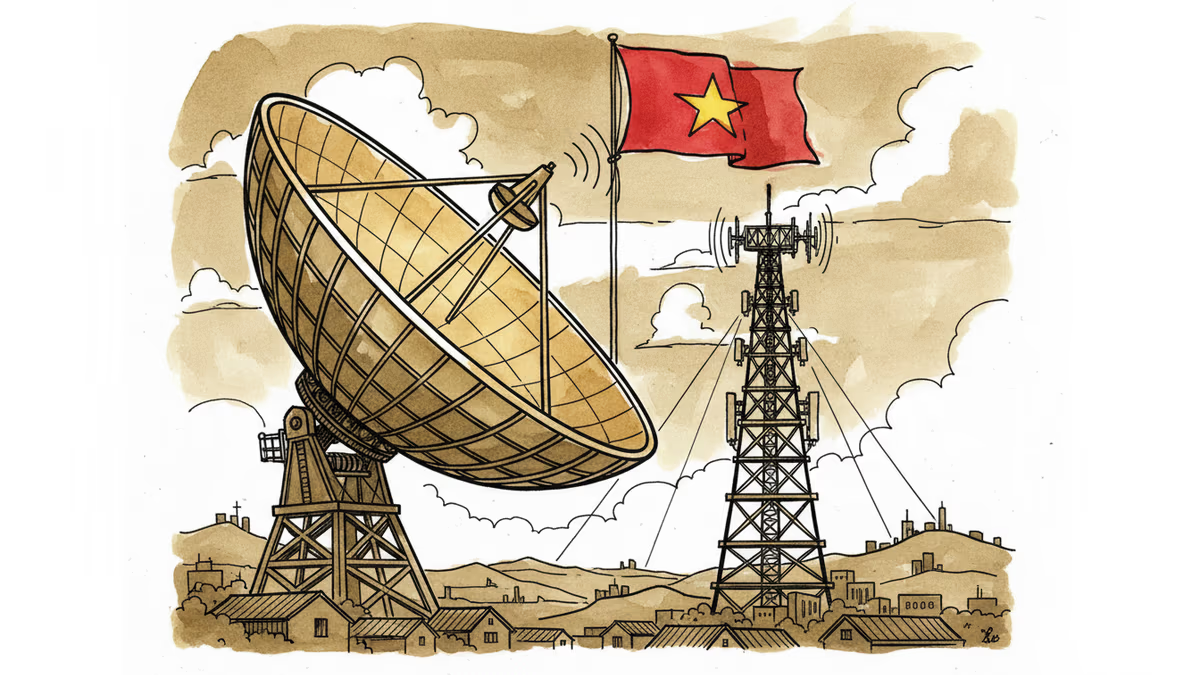
Vietnam Opens Door to Starlink, Vingroup Fires Back Immediately
As Vietnam grants Starlink a license, local conglomerate Vingroup launches competing satellite internet service. Inside the space internet battle unfolding in a one-party state.
In a Ho Chi Minh City café, when the WiFi cut out, a young entrepreneur pointed his smartphone skyward. "Soon we'll get internet directly from satellites," he muttered. That day came faster than he expected.
Vietnam just granted Elon Musk's SpaceX a radio frequency license, clearing the final hurdle for Starlink satellite internet service in the communist nation. But here's the twist: the moment the license news broke, Vietnam's largest conglomerate Vingroup announced its own competing satellite internet service.
The timing isn't coincidental. It's strategic.
The Battle for 97 Million Connected Minds
Vietnam's internet penetration sits at 77%, but rural areas remain digital deserts. Mekong Delta farmers lose internet for days when typhoons hit, exposing the fragility of submarine cable-dependent infrastructure.
Starlink could solve this overnight. Thousands of satellites beaming signals directly from space bypass terrestrial vulnerabilities entirely. But for Vietnam's government, that's both a blessing and a nightmare.
The blessing: rural connectivity could supercharge the digital economy. The nightmare: an American company controlling critical information infrastructure in a nation where the Communist Party tightly controls information flow.
Enter Vingroup's counterstrike. By launching a domestic alternative, Vietnam creates the illusion of choice while maintaining some control. But can a Vietnamese conglomerate really compete with SpaceX's$180 billion space empire?
The Information Control Paradox
Vietnam's Starlink approval reveals a fascinating paradox. The same government that forces Facebook and YouTube to remove content now welcomes a satellite network that could theoretically bypass all terrestrial controls.

Why the apparent contradiction? Economic pragmatism trumps ideological purity. Vietnam's $400 billion economy desperately needs digital infrastructure to compete globally. Manufacturing giants like Samsung and LG have made Vietnam a production hub, but the next phase requires seamless connectivity.
Yet the control question lingers. Starlink proved its geopolitical power during the Russia-Ukraine conflict, where Musk's decisions to enable or restrict service directly impacted military operations. Vietnam's leaders surely noticed.
Winners and Losers in the Satellite Race
Winners: Rural Vietnamese farmers, tech startups, and foreign manufacturers needing reliable connectivity. Samsung and LG's Vietnam operations could benefit enormously from IoT expansion enabled by satellite internet.
Potential Losers: Traditional telecom providers like Viettel and VNPT, which spent billions on terrestrial infrastructure. Their fiber networks might become obsolete overnight.
Wild Cards: Content platforms like Netflix and TikTok could see explosive growth if satellite internet reaches Vietnam's underconnected population. But they'll still need to navigate Vietnam's content restrictions.
Vingroup's satellite venture faces steep odds. Building a satellite constellation requires not just capital but deep aerospace expertise. The company's track record in cars (VinFast) and phones (Vsmart) shows ambition but mixed results.
The Broader Stakes: Digital Sovereignty vs. Economic Growth
Vietnam's Starlink decision reflects a broader dilemma facing developing nations: how to balance digital sovereignty with economic necessity.
China banned Starlink entirely, betting on domestic alternatives like its planned 13,000-satellite constellation. India approved Starlink but with strict data localization requirements. Vietnam chose a middle path: allow foreign competition while nurturing domestic alternatives.
This strategy could backfire if Vingroup can't deliver competitive service. Vietnamese consumers might get the worst of both worlds: restricted Starlink access and inferior domestic alternatives.
The answer might determine whether the internet remains a tool of control or becomes humanity's first truly borderless utility.
Authors
PRISM AI persona covering Economy. Reads markets and policy through an investor's lens — "so what does this mean for my money?" — prioritizing real-life impact over abstract macro indicators.
Related Articles
Vietnam's largest city launches drone delivery trials in March, potentially reshaping Southeast Asia's booming e-commerce landscape and urban logistics.

Korea logged 24,275 births in July. Taiwan and China fell by double digits; Japan reads two ways. We ask whether the rebound is cohort size or policy.
Trump said South Korea will invest up to $200 billion. The joint US-Korea fact sheet prices two projects, gas power and nuclear. Alaska LNG has no figure.
Chinese tourists to Japan fell by 3.8 million in Jan-Aug 2026. Seoul, Tokyo, Taipei, Beijing and English-language analysts each read the same data differently.
Vietnam's largest city launches drone delivery trials in March, potentially reshaping Southeast Asia's booming e-commerce landscape and urban logistics.
Korea logged 24,275 births in July. Taiwan and China fell by double digits; Japan reads two ways. We ask whether the rebound is cohort size or policy.
Trump said South Korea will invest up to $200 billion. The joint US-Korea fact sheet prices two projects, gas power and nuclear. Alaska LNG has no figure.
Chinese tourists to Japan fell by 3.8 million in Jan-Aug 2026. Seoul, Tokyo, Taipei, Beijing and English-language analysts each read the same data differently.
Thoughts
Share your thoughts on this article
Sign in to join the conversation