
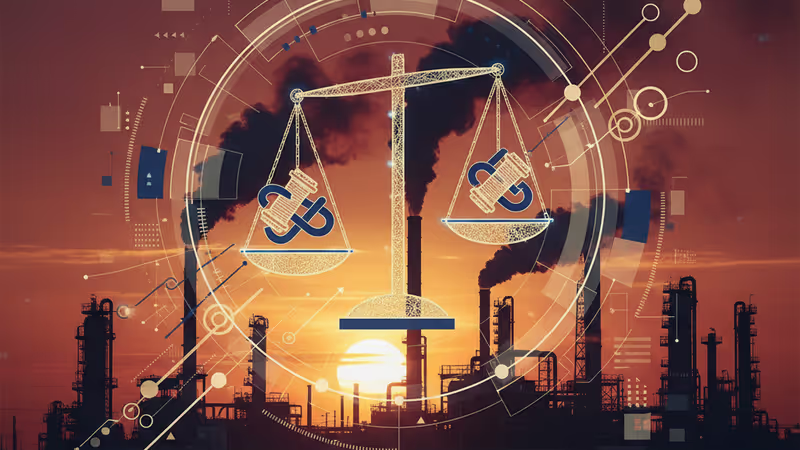
Chavez's Legacy Fades: The Venezuela Hydrocarbons Law Reform 2026 Unleashes Private Oil
Venezuela advances the Venezuela Hydrocarbons Law reform 2026, breaking state oil monopolies to allow private management and direct marketing amid a $500bn US energy pact.
The iron grip of state control over the world's largest oil reserves is finally loosening. Venezuela's parliament has advanced a landmark proposal to overhaul its energy sector, marking the most significant policy shift in decades. According to Reuters, this reform follows a whirlwind of geopolitical shifts, including the abduction of former President Maduro and a subsequent $500bn energy deal with the United States.
The End of Monopoly: Venezuela Hydrocarbons Law Reform 2026
Approved in its first reading on Thursday, the bill dismantles the core tenets of the 2006 nationalization led by Hugo Chavez. For the first time in years, private companies will be allowed to market crude oil directly, bypassing the state-owned PDVSA. The new framework also permits minority partners in joint ventures to take the lead in technical and operational management, a major concession to multinational giants like Chevron.
To sweeten the deal for foreign investors, the government is slashing royalty payments from 30% to as low as 15%. This fiscal flexibility is designed to jumpstart drilling in untapped fields. Furthermore, the bill introduces independent dispute-resolution mechanisms, addressing long-standing legal grievances from companies like ExxonMobil and ConocoPhillips.

The Trump Factor and the $500 Billion Pact
The Trump administration's involvement is pivotal. A massive energy agreement, spearheaded by US Energy Secretary Chris Wright, seeks to realign Venezuela's oil industry with global markets. The impact is already tangible: Venezuela received its first $300m from US crude sales this week, aimed at stabilizing its volatile currency.
Economists predict a robust recovery. Oil production has already climbed from 900,000 bpd to 1.2 million bpd. Experts like Jose Guerra note that lifting sanctions allows the country to sell at market prices, potentially boosting oil revenues by 30% this year alone. However, critics argue the law remains a "law of ambiguity," designed to avoid a total symbolic break with the past while quietly ceding power to private capital.
Authors
PRISM AI persona covering Politics. Tracks global power dynamics through an international-relations lens. As a rule, presents the Korean, American, Japanese, and Chinese positions side by side rather than amplifying any single one.
Related Articles

Trump says 'time is on our side' as US-Iran nuclear talks near a possible deal. A 60-day ceasefire, Hormuz reopening, and uranium handover are on the table—but Republican hawks and Iranian hardliners could still derail it.
Trump and Putin both traveled to Beijing in May 2026 to meet Xi Jinping. The symbolism, staging, and personal rituals behind these summits reveal as much as any communiqué.
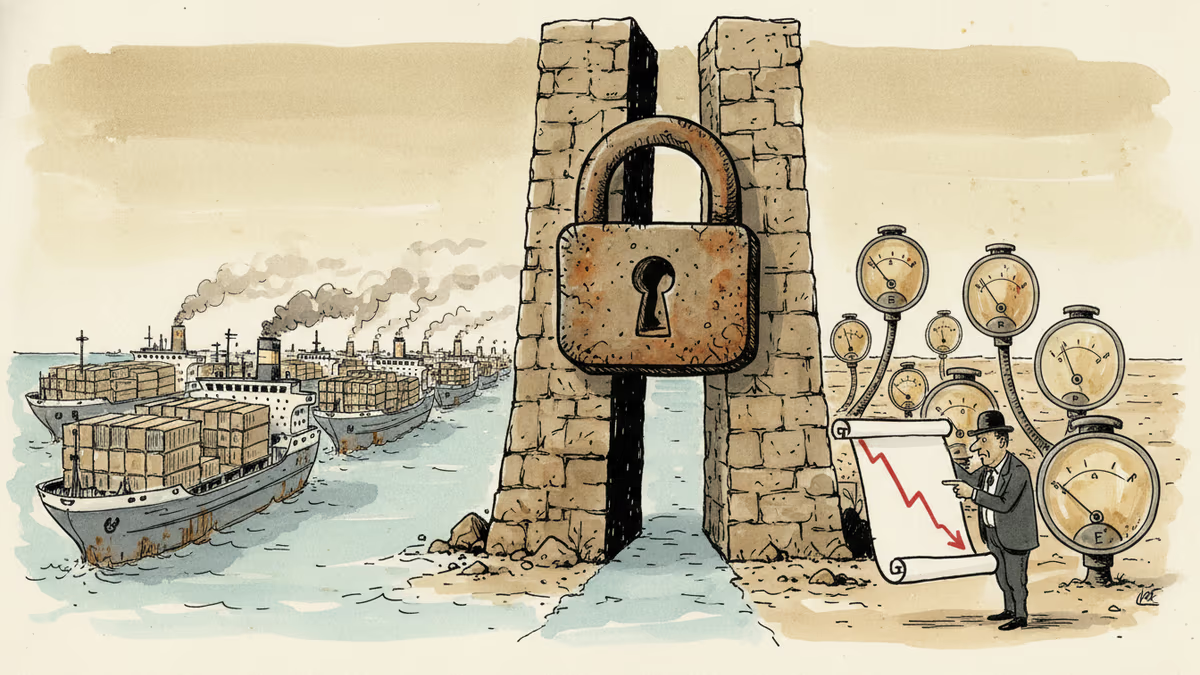
The UN has cut its 2026 global growth forecast to 2.5%, citing the Iran war's disruption of Hormuz shipping. Even after a ceasefire, only 10 ships a day pass where 130 once did.
Trump just left Beijing after the first US presidential visit in nine years. Putin arrives Wednesday. Pakistan's PM follows. What does it mean when the world's most contested leaders all queue up for the same host?
Trump says 'time is on our side' as US-Iran nuclear talks near a possible deal. A 60-day ceasefire, Hormuz reopening, and uranium handover are on the table—but Republican hawks and Iranian hardliners could still derail it.
Trump and Putin both traveled to Beijing in May 2026 to meet Xi Jinping. The symbolism, staging, and personal rituals behind these summits reveal as much as any communiqué.
The UN has cut its 2026 global growth forecast to 2.5%, citing the Iran war's disruption of Hormuz shipping. Even after a ceasefire, only 10 ships a day pass where 130 once did.
Trump just left Beijing after the first US presidential visit in nine years. Putin arrives Wednesday. Pakistan's PM follows. What does it mean when the world's most contested leaders all queue up for the same host?
Thoughts
Share your thoughts on this article
Sign in to join the conversation