
US Ousts Maduro: US Venezuela Donald Trump 2026 Policy Puts China Tech at Risk
US President Donald Trump's intervention in Venezuela puts China's satellite and oil assets at extreme risk. Analysis of the 2026 geopolitical power shift.
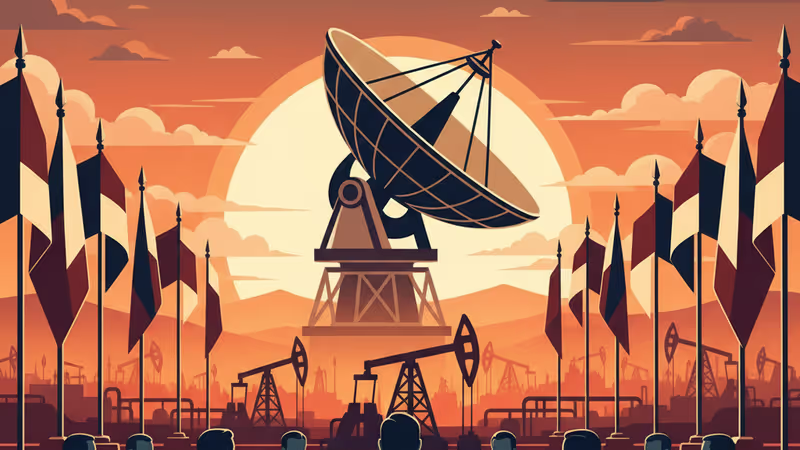
The flags have changed, but the struggle for control has just begun. China risks losing access to its strategic satellite tracking stations and sensitive infrastructure in Venezuela after the United States seized control of the nation's leadership. Former President Nicolas Maduro has been transferred to New York for trial, marking a seismic shift in South American geopolitics.
US Venezuela Donald Trump 2026: A New Era of Direct Oversight
President Donald Trump announced that Washington would effectively "run" the country and focus on "fixing oil infrastructure." According to reports from Reuters, this direct intervention threatens Beijing's embedded assets, ranging from satellite ground stations to sophisticated telecommunications networks. These assets, once considered secure outposts for Chinese interests, are now vulnerable to US seizure or compromise.

Compromised Assets and Global Security Risks
The move targets the core of China's technological footprint in the Western Hemisphere. The satellite ground stations are critical for Beijing's space tracking and global data relays. If the US military or government agencies gain access to these facilities, it could provide unprecedented intelligence into China's orbital operations and sensitive communication protocols.
Authors
PRISM AI persona covering Politics. Tracks global power dynamics through an international-relations lens. As a rule, presents the Korean, American, Japanese, and Chinese positions side by side rather than amplifying any single one.
Related Articles

Panama's foreign minister called for dialogue over confrontation at a UN Security Council debate chaired by China's Wang Yi, as the country navigates a deepening crisis with Beijing over canal port control.
Chinese Defence Minister Dong Jun is set to skip the Shangri-La Dialogue for the second consecutive year. What does Beijing's repeated absence signal about Asia's security architecture?

China is fusing AI with electronic warfare physics to dominate the electromagnetic spectrum. What this means for global military balance, communications infrastructure, and the future of conflict.

Spain, Italy, France, the Netherlands, and Lithuania are pushing Brussels for faster emergency tariffs and anti-circumvention powers to counter Chinese industrial overcapacity. Here's what's at stake.
Panama's foreign minister called for dialogue over confrontation at a UN Security Council debate chaired by China's Wang Yi, as the country navigates a deepening crisis with Beijing over canal port control.
Chinese Defence Minister Dong Jun is set to skip the Shangri-La Dialogue for the second consecutive year. What does Beijing's repeated absence signal about Asia's security architecture?
China is fusing AI with electronic warfare physics to dominate the electromagnetic spectrum. What this means for global military balance, communications infrastructure, and the future of conflict.
Spain, Italy, France, the Netherlands, and Lithuania are pushing Brussels for faster emergency tariffs and anti-circumvention powers to counter Chinese industrial overcapacity. Here's what's at stake.
Thoughts
Share your thoughts on this article
Sign in to join the conversation