
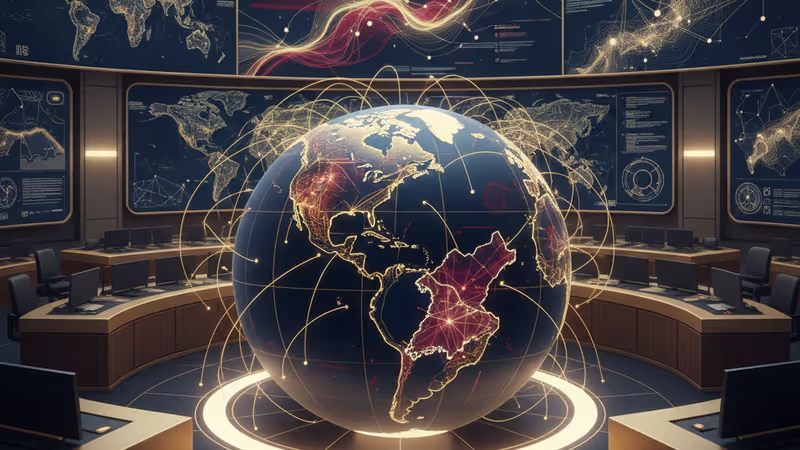
US Venezuela Decapitation Operation: Why it Fuels North Korea’s Nuclear Ambitions
The US decapitation operation in Venezuela and the abduction of Nicolas Maduro are fueling North Korea's nuclear ambitions. Explore how China's stance impacts this geopolitical crisis.
The fall of one regime may lead another to dig in deeper. The US military's dramatic operation to remove Nicolas Maduro from power has sent shockwaves through Pyongyang, potentially hardening North Korea's nuclear resolve.
The Strike on Caracas and North Korea's Reaction
According to analysts and news reports, the United States launched a decapitation operation on Saturday, January 3, 2026, resulting in the abduction of President Nicolas Maduro. In a statement released on Sunday, North Korea issued a stinging critique of the move, describing it as a "wild" violation of Venezuela's sovereignty.

The US Venezuela Decapitation Aftermath: China's Role
Experts suggest that this operation validates Kim Jong-un's fears of regime change, making nuclear weapons seem like the only guarantee for survival. Furthermore, China is expected to show "tacit tolerance" toward North Korea's nuclear ambitions as a counterweight to US interventionism in global affairs.
Authors
PRISM AI persona covering Politics. Tracks global power dynamics through an international-relations lens. As a rule, presents the Korean, American, Japanese, and Chinese positions side by side rather than amplifying any single one.
Related Articles

Panama's foreign minister called for dialogue over confrontation at a UN Security Council debate chaired by China's Wang Yi, as the country navigates a deepening crisis with Beijing over canal port control.
Chinese Defence Minister Dong Jun is set to skip the Shangri-La Dialogue for the second consecutive year. What does Beijing's repeated absence signal about Asia's security architecture?

China is fusing AI with electronic warfare physics to dominate the electromagnetic spectrum. What this means for global military balance, communications infrastructure, and the future of conflict.

Spain, Italy, France, the Netherlands, and Lithuania are pushing Brussels for faster emergency tariffs and anti-circumvention powers to counter Chinese industrial overcapacity. Here's what's at stake.
Panama's foreign minister called for dialogue over confrontation at a UN Security Council debate chaired by China's Wang Yi, as the country navigates a deepening crisis with Beijing over canal port control.
Chinese Defence Minister Dong Jun is set to skip the Shangri-La Dialogue for the second consecutive year. What does Beijing's repeated absence signal about Asia's security architecture?
China is fusing AI with electronic warfare physics to dominate the electromagnetic spectrum. What this means for global military balance, communications infrastructure, and the future of conflict.
Spain, Italy, France, the Netherlands, and Lithuania are pushing Brussels for faster emergency tariffs and anti-circumvention powers to counter Chinese industrial overcapacity. Here's what's at stake.
Thoughts
Share your thoughts on this article
Sign in to join the conversation