

Vance 2028: The MAGA Machine Anoints Its Heir, Kicking Off a Four-Year Power Play
An early endorsement of VP JD Vance for President in 2028 by Turning Point USA signals a major power play to define the post-Trump future of the MAGA movement.
The Lede: The 2028 Race is Already Here
While Washington is focused on the current administration, the starting gun for the 2028 presidential race just fired in Phoenix. The endorsement of Vice President JD Vance by Turning Point USA (TPUSA) CEO Erika Kirk is far more than a ceremonial nod. It is a calculated, strategic move by the MAGA movement's most powerful youth organization to anoint an heir apparent and consolidate its power base years ahead of schedule. For global executives and strategists, this signals an attempt to institutionalize the 'America First' ideology beyond Donald Trump, with profound implications for future trade, regulation, and geopolitical stability.
Why It Matters: The New GOP Power Brokers
This early endorsement is a declaration that the locus of power in the Republican party has fundamentally shifted. It's no longer dictated solely by party elders or traditional fundraising networks. The new kingmakers are digitally-native, ideologically-driven media organizations with massive grassroots reach.
- Preemptive Strike on Rivals: By crowning Vance so early, TPUSA is attempting to clear the primary field for 2028. Potential challengers are now forced to react, either by bending the knee to the movement's chosen candidate or preparing for a costly war against its most energetic and organized faction.
- Institutionalizing a Movement: The core challenge for populist movements is succession. Can the loyalty commanded by a singular, charismatic figure like Donald Trump be transferred? This endorsement is the first major test, aiming to prove that MAGA is an institution, not just a personality cult.
- Global Policy Signal: International partners and competitors will interpret this as a sign that the nationalist, protectionist, and alliance-skeptic tenets of the 'America First' doctrine are being cemented as the long-term future of the Republican party. This forces long-range recalculations in foreign ministries and boardrooms from Brussels to Beijing.
The Analysis: Succession and the Modern Media Machine
Historically, presidential primary campaigns have been marathons of retail politics, slowly building momentum in early states like Iowa and New Hampshire. This move bypasses that tradition entirely, leveraging a national media platform to create a sense of inevitability. TPUSA, founded by the late Charlie Kirk, perfected a model of campus organizing fused with a relentless digital content machine that speaks directly to a younger conservative base, often sidestepping legacy media.
This maneuver places other potential 2028 Republican hopefuls—governors and senators who might run on a platform of electability or a different brand of conservatism—in a difficult position. They are now on the clock. Do they risk alienating the highly-motivated TPUSA base by challenging its chosen successor, or do they wait, hoping for an opening that may never come? Vance, as a sitting Vice President with deep ties to the movement's intellectual and populist wings, represents a unique bridge figure. This endorsement is an attempt to make that bridge the only one worth crossing for any ambitious Republican.
PRISM Insight: The Politicization of Everything as a Service
The TPUSA endorsement exemplifies the 'platformization' of political movements. Organizations like TPUSA operate less like traditional political groups and more like tech-driven media platforms. They build an audience, cultivate loyalty through constant content engagement (conferences, social media, podcasts), and then monetize that influence by directing it toward specific political outcomes—in this case, a presidential endorsement.
This is the blueprint for future political warfare: building decentralized, always-on digital ecosystems that can be activated instantly. For other political actors, the challenge is no longer just winning a news cycle, but building a competing ecosystem. For investors, the political tech sector—spanning data analytics, alternative social platforms, and digital fundraising tools—is set for sustained growth as this model becomes the norm across the political spectrum.
PRISM's Take: The Gambit to End the Next Primary Before It Begins
This is not merely an endorsement; it's a strategic gambit to foreclose on the future of the Republican party. TPUSA is wagering that its influence over the MAGA base is strong enough to anoint a successor and prevent the kind of chaotic, multi-candidate primary that first brought Donald Trump to power in 2016. By backing Vance, they are choosing an ideologically-aligned figure who also holds the institutional power of the Vice Presidency.
The central question for the next four years is whether this attempt at a controlled succession will work. Will the movement's loyalty transfer seamlessly from Trump to Vance, or will other ambitious figures see an opportunity to build their own coalitions? This move doesn't end the fight for the soul of the Republican party; it simply defines the battlefield for the next decade. The world will be watching to see if the machine is now more powerful than the man who built it.
Related Articles

Elise Stefanik's career is a case study in political reinvention. We analyze her strategic pivot and what it means for the GOP, US policy, and brand risk.

An internal battle over antisemitism reveals a deep ideological fracture in the American conservative movement, with major implications for tech, policy, and global stability.
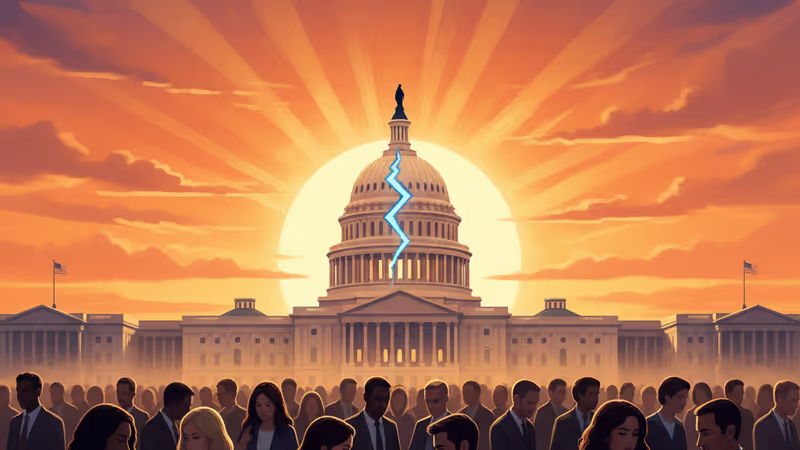
An internal struggle in the Republican party over 'America First' principles is creating seismic shifts in U.S. foreign policy, impacting global alliances and investment strategies.
When a government's policy wins clash with public economic anxiety, it creates global instability. Our analysis breaks down the geopolitical and market risks.