
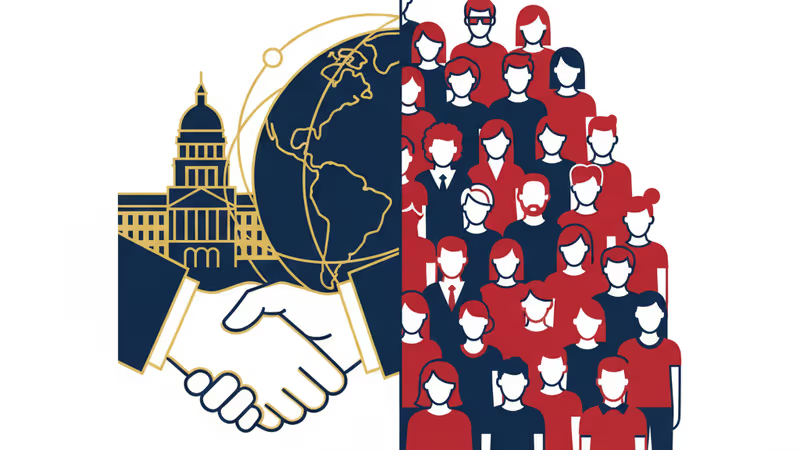
The Global Risk of the Great Disconnect: Why Economic Data and Public Reality Are Diverging
When a government's policy wins clash with public economic anxiety, it creates global instability. Our analysis breaks down the geopolitical and market risks.
The Lede: Beyond the Headlines
An incumbent administration points to a landmark climate bill, robust job growth, and strengthening international alliances. Simultaneously, polls show a populace deeply anxious about the cost of living and the nation's direction. This widening chasm between official policy narratives and public economic sentiment is far more than a domestic political headache; it's a critical leading indicator of global market volatility and geopolitical instability that every executive and investor must now track.
Why It Matters: The Second-Order Effects
When a government's perception of its success diverges sharply from the lived experience of its citizens, predictable and dangerous consequences ripple across the globe. This isn't just about election outcomes; it's about the operational environment for global business.
- Policy Whiplash: Governments facing a discontented electorate are prone to sudden, often populist, policy shifts. This can manifest as protectionist trade tariffs, unpredictable industrial subsidies, or price controls—all of which create massive uncertainty for global supply chains and investment planning.
- Erosion of Allied Trust: For international partners, a government that seems out of touch with its own people is an unreliable ally. Long-term commitments on security (like NATO funding), climate accords (like the Paris Agreement), or trade frameworks become subject to the whims of domestic political turmoil, forcing other nations to hedge their strategic bets.
- Market Miscalculation: Relying on traditional macroeconomic indicators like GDP or headline unemployment can be dangerously misleading. A so-called 'vibecession'—where sentiment remains negative despite positive data—means that consumer and business behavior may not follow traditional economic models, leading to flawed market forecasts and investment theses.
The Analysis: A New Kind of Disconnect
Historically, incumbent leaders have often struggled to sell their successes. The phrase "It's the economy, stupid" became a political mantra for a reason. However, the current environment is fundamentally different, driven by a unique confluence of factors.
From Macro Data to Kitchen Tables
The post-pandemic economy has created a statistical mirage. Governments can correctly point to low unemployment and resilient GDP growth. Yet, these macro figures fail to capture the visceral impact of inflation on non-discretionary items like food and fuel, which disproportionately shapes household sentiment. While wage growth may be outpacing inflation on paper, the psychological weight of a $100 grocery bill that used to be $70 is far more powerful. This is a global phenomenon, visible in the UK, Germany, and beyond, challenging leaders who rely on traditional economic scorecards.
The Geopolitical Dimension
This internal disconnect presents a strategic vulnerability that adversaries are keen to exploit. State-backed disinformation campaigns no longer need to invent elaborate falsehoods; they can simply amplify existing, legitimate anxieties. By pouring fuel on the fire of economic discontent through social media and state-run news outlets, nations like Russia and China can weaken a rival's social cohesion and undermine its government's ability to act decisively on the world stage—a low-cost, high-impact form of hybrid warfare.
PRISM Insight: The New Alpha is Alternative Data
The failure of legacy economic indicators to capture reality creates a significant opportunity. The new 'alpha' for investors, strategists, and intelligence analysts lies in alternative data streams that measure economic reality from the ground up. Forward-thinking firms are already moving beyond government-issued statistics and are instead focusing on:
- Real-Time Transactional Data: Analyzing anonymized credit card spending to see precisely where consumers are cutting back.
- Sentiment Analysis: Using AI to scrape social media and forums to create a real-time index of public mood on everything from gas prices to housing costs.
- Supply Chain Intelligence: Leveraging satellite imagery and shipping data to predict shortages and price hikes before they appear in official inflation reports.
Organizations that can build a more accurate, high-frequency picture of the 'street-level' economy will gain a decisive advantage in navigating the resulting market and political volatility.
PRISM's Take: The Perception Gap is Now a Systemic Risk
The gap between a government's declared victories and the public's perceived reality is no longer just a feature of election cycles; it is a core systemic risk to the international order. It breeds the populism that unravels trade agreements, fuels the nationalism that fractures alliances, and creates the domestic paralysis that prevents nations from addressing global challenges. For business leaders and policymakers, the most critical question has shifted from "How is the economy performing?" to "How is the economy being experienced?" The stability of our interconnected world depends on closing this gap. Those who ignore it will be blindsided by the turbulence it inevitably creates.
Related Articles
The EU and US debate seizing frozen Russian assets for Ukraine, a move that could fund the war but risks fracturing the global financial system. An analysis.
An ICJ ruling on AI weapons is reshaping geopolitics. Discover the impact on US-China relations, the tech industry, and the future of international law.
The EU's new anti-subsidy weapon targets Chinese firms, escalating the global trade conflict. We analyze the critical impact on supply chains and investments.
A senior US official's claim on Venezuela's oil, backed by a military blockade, signals a dangerous new doctrine in global geopolitics. PRISM analyzes the impact.