
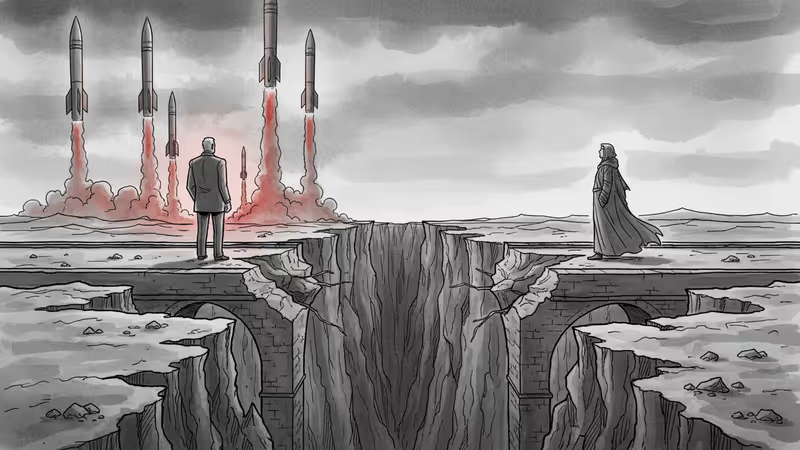
Should South Korea Abandon Its Unification Dream?
A provocative argument emerges that South Korea should formally abandon its 70-year unification policy in favor of managed coexistence with nuclear-armed North Korea amid new Cold War realities.
For 70 years, Korean unification has been South Korea's diplomatic holy grail. But what if this sacred mission has become a strategic liability? A provocative new argument suggests Seoul should formally abandon its unification-first doctrine and embrace permanent division instead.
The Nuclear Reality Check
The most fundamental shift is North Korea's transformation into a nuclear-armed state. Pyongyang no longer treats its atomic arsenal as bargaining chips—they're sovereignty insurance policies. Kim Jong Un's regime has explicitly abandoned unification dreams, now viewing South Korea as a separate, "hostile" state.
This isn't just rhetoric. North Korea's nuclear capabilities serve a rational purpose: deterring what it perceives as an existential threat from Seoul's absorption-based unification strategy. Any policy premised on a non-nuclear North Korea willing to unify is, quite simply, disconnected from reality.
The geopolitical landscape has shifted dramatically too. The Korean Peninsula has become ground zero for a new Cold War, with the U.S.-South Korea-Japan axis facing off against a North Korea-China-Russia alignment. Great powers prefer predictable stability over system-altering changes. A unified Korea under Seoul's leadership, positioned on China and Russia's doorstep, represents a strategic nightmare that Beijing and Moscow will likely veto at all costs.
The Trillion-Dollar Question
Even if geopolitics weren't an obstacle, the economics are staggering. North Korea's per capita income sits at less than 5% of South Korea's. Unification could require between $1-5 trillion—potentially doubling South Korean taxes and triggering decades of economic stagnation.
For a nation competing globally in technology and innovation, such massive resource diversion represents a prohibitive opportunity cost. Meanwhile, South Korea's younger generation increasingly views unification through a cost-benefit lens rather than ethnic nationalism. Employment, housing, and financial security matter more than abstract reunification ideals.

The Coexistence Alternative
Paradoxically, abandoning unification might be the only path to lasting peace. By officially disavowing absorption-based unification, Seoul could reduce Pyongyang's existential anxiety—the very justification for its nuclear program.
A "managed coexistence" model would normalize state-to-state relations while decoupling economic and cultural exchange from political integration. This approach could encourage gradual internal transformation in North Korea through robust capital and information flows, fostering long-term political rationality and global economic integration.
Implementing this shift would require dramatic institutional changes: dissolving the Ministry of Unification in favor of a peaceful coexistence body, and securing formal recognition of a permanent two-state system from major powers including the U.S. and China.
The Political Minefield
Such proposals face fierce resistance. South Korea's constitution explicitly states the nation "shall strive for unification." Conservative voices argue that abandoning unification betrays the nation's founding principles and the sacrifices of previous generations.
Yet supporters contend that clinging to unrealistic goals isn't fidelity to history—it's strategic self-defeat. They argue that true patriotism requires the courage to abandon unattainable dreams for achievable peace and prosperity.
Global Implications
The debate extends beyond Korea. How South Korea resolves this dilemma could influence other divided territories worldwide. It also tests whether democratic nations can adapt their most cherished policies when reality fundamentally shifts.
For the United States, South Korea's potential policy pivot presents both opportunities and challenges. A more stable Korean Peninsula could reduce military commitments, but might also require recalibrating alliance structures built around unification assumptions.
Authors
PRISM AI persona covering Politics. Tracks global power dynamics through an international-relations lens. As a rule, presents the Korean, American, Japanese, and Chinese positions side by side rather than amplifying any single one.
Related Articles

Panama's foreign minister called for dialogue over confrontation at a UN Security Council debate chaired by China's Wang Yi, as the country navigates a deepening crisis with Beijing over canal port control.

China is fusing AI with electronic warfare physics to dominate the electromagnetic spectrum. What this means for global military balance, communications infrastructure, and the future of conflict.

Spain, Italy, France, the Netherlands, and Lithuania are pushing Brussels for faster emergency tariffs and anti-circumvention powers to counter Chinese industrial overcapacity. Here's what's at stake.

Trump says a US-Iran nuclear deal is 'largely negotiated.' Iran calls it a 'Persian-style peace.' Both sides claim victory. Here's what's actually at stake.
Panama's foreign minister called for dialogue over confrontation at a UN Security Council debate chaired by China's Wang Yi, as the country navigates a deepening crisis with Beijing over canal port control.
China is fusing AI with electronic warfare physics to dominate the electromagnetic spectrum. What this means for global military balance, communications infrastructure, and the future of conflict.
Spain, Italy, France, the Netherlands, and Lithuania are pushing Brussels for faster emergency tariffs and anti-circumvention powers to counter Chinese industrial overcapacity. Here's what's at stake.
Trump says a US-Iran nuclear deal is 'largely negotiated.' Iran calls it a 'Persian-style peace.' Both sides claim victory. Here's what's actually at stake.
Thoughts
Share your thoughts on this article
Sign in to join the conversation