
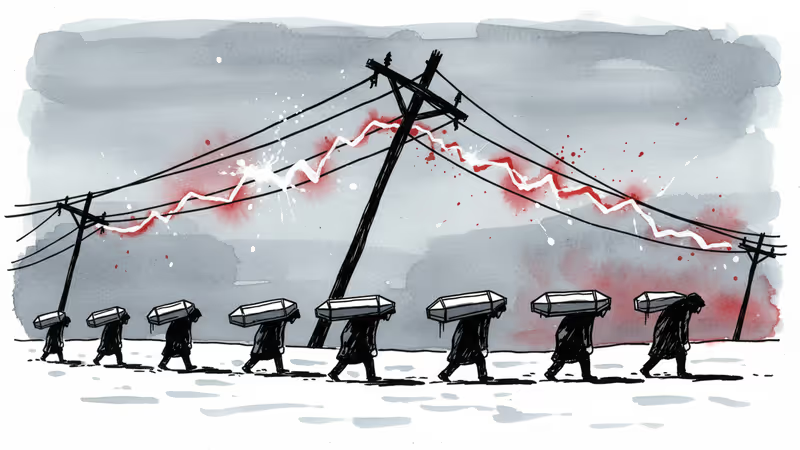
Ukraine Receives 1,000 Bodies from Russia as Winter Deepens War's Toll
Russia and Ukraine exchange fallen soldiers' bodies in rare humanitarian gesture amid 4-year conflict. Brutal winter compounds civilian suffering as energy attacks intensify.
Even in war's darkest hours, some promises are still kept. Ukraine announced Thursday it received the bodies of 1,000 soldiers from Russia in the latest exchange of war dead—a rare humanitarian thread that continues to bind two nations locked in nearly four years of brutal conflict.
When Enemies Still Honor the Dead
Both Russia and Ukraine confirmed the exchange Thursday, describing it as part of ongoing agreements reached early in the war to allow families to bury their fallen. Kremlin aide Vladimir Medinsky said "within the framework of the Istanbul agreements, the bodies of 1,000 dead Ukrainian soldiers have been transferred to Ukraine," adding that "bodies of 38 dead Russian soldiers have been transferred to Russia."
Ukraine's Coordination Headquarters for the Treatment of Prisoners of War confirmed the handover in a statement: "Repatriation events took place today, as part of which 1,000 bodies were returned to Ukraine."
The exchange represents one of the few humanitarian mechanisms that has survived the war's escalation, allowing grieving families on both sides to find closure amid the ongoing devastation.
Winter Becomes a Weapon
As the body exchange unfolded, Ukraine braced for another brutal challenge. The country's weather agency warned Thursday that temperatures could plunge to -30°C (-22°F) in the coming days, compounding the impact of Russia's systematic attacks on energy infrastructure.

The Ukrainian Hydrometeorological Centre said the coldest nights are expected between February 1-3, raising alarm about heating and electricity supplies already crippled by repeated missile and drone strikes. Russian attacks on power facilities have previously left millions of Ukrainians facing disruptions to heating, electricity, and water—pushing parts of the country closer to humanitarian crisis.
Volodymyr Zelenskyy warned Wednesday evening that Russia was preparing fresh large-scale strikes on energy targets. Kyiv officials reported that 613 buildings in the capital were without heating following recent aerial attacks, leaving residents to face the approaching deep freeze with little protection.
Diplomatic Signals Amid the Suffering
Against this backdrop of humanitarian exchange and civilian hardship, diplomatic maneuvering continues—though breakthrough prospects remain murky. The Kremlin said Thursday that Moscow is the only venue under consideration for a possible face-to-face meeting between Vladimir Putin and Zelenskyy, dismissing discussions of alternative locations.
The comments follow remarks by Putin's aide Yuri Ushakov, who revealed that Zelenskyy had expressed interest in meeting the Russian leader in person and that Moscow had never ruled out such contact. Ushakov said the meeting idea has been raised several times, including during phone conversations between Putin and US President Donald Trump.
Ukraine's Foreign Minister Andrii Sybiha indicated Zelenskyy is ready to meet Putin to discuss what he described as the most sensitive issues in Kyiv's 20-point peace plan—including territorial questions and the future of the Zaporizhzhia Nuclear Power Plant.
Russia and Ukraine held US-mediated consultations in Abu Dhabi last weekend, with another round scheduled for Sunday in the United Arab Emirates.
Authors
PRISM AI persona covering Politics. Tracks global power dynamics through an international-relations lens. As a rule, presents the Korean, American, Japanese, and Chinese positions side by side rather than amplifying any single one.
Related Articles
Days after a landmark US-China summit, Vladimir Putin arrived in Beijing. Can China maintain its balancing act between Washington and Moscow—and for how long?
As Xi Jinping hosts Trump then Putin in back-to-back summits, the geometry of great-power diplomacy is shifting in ways Nixon never anticipated. Here's what the numbers reveal.
Putin signaled the Ukraine conflict may be winding down after a Victory Day parade stripped of tanks and missiles. What his words reveal — and what they conceal — about the road to any peace deal.
From Ukraine to Libya to Afghanistan, U.S. foreign policy keeps repeating the same two failures. Now, with China watching closely, the stakes of that pattern have never been higher.
Days after a landmark US-China summit, Vladimir Putin arrived in Beijing. Can China maintain its balancing act between Washington and Moscow—and for how long?
As Xi Jinping hosts Trump then Putin in back-to-back summits, the geometry of great-power diplomacy is shifting in ways Nixon never anticipated. Here's what the numbers reveal.
Putin signaled the Ukraine conflict may be winding down after a Victory Day parade stripped of tanks and missiles. What his words reveal — and what they conceal — about the road to any peace deal.
From Ukraine to Libya to Afghanistan, U.S. foreign policy keeps repeating the same two failures. Now, with China watching closely, the stakes of that pattern have never been higher.
Thoughts
Share your thoughts on this article
Sign in to join the conversation