
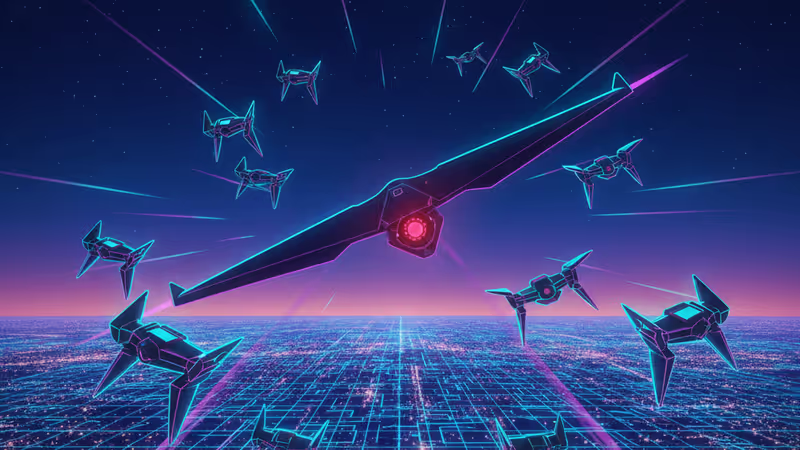
Ukraine's $1,000 Drones Are Slaying Russian Missiles, Rewriting the Rules of Air Power
Ukraine is deploying inexpensive interceptor drones, some costing just $1,000, to counter Russian aerial attacks. This strategy is rewriting the economics of air defense and shaping the future of warfare.
Ukraine is rapidly deploying fleets of inexpensive interceptor drones to counter Russia's sophisticated aerial attacks, fundamentally altering modern air defense strategy. These homegrown systems are neutralizing high-altitude suicide drones at a fraction of the cost of conventional missiles, providing a critical shield for the nation's cities and energy infrastructure.
According to reports from the Associated Press, these systems have progressed from prototype to mass production within months in 2025. Field technicians are now seen swiftly assembling the equipment, a sign of Kyiv's strategic shift toward affordable, mass-produced defensive weapons that can be replaced far more easily than their expensive counterparts.
The New Economics of War
The economic advantage is proving decisive. Interceptors like the Sting, produced by the volunteer-driven startup Wild Hornets, and the new Bullet from General Cherry, can cost as little as $1,000. Pilots operate them with viewing displays or first-person-view (FPV) goggles, accelerating rapidly to collide with enemy drones.
They're targeting Russian drones, predominantly the Iranian-designed Shahed, which cost anywhere from $10,000 to $300,000 each. "We are inflicting serious economic damage," said Andrii Lavrenovych, a strategic council member at General Cherry.
A High-Stakes Innovation Race
This defensive shift is part of an ongoing innovation battle. Russia has been developing numerous variants of its triangle-winged Shahed aircraft, equipping them with jammers, cameras, and even turbojet engines to fly faster and higher. A Ukrainian unit commander, known only by the call sign "Loi," stated, "The enemy does not sleep, and neither do we."
However, defense analysts caution that these interceptors aren't a panacea. Federico Borsari, an analyst at the Center for European Policy Analysis, calls them a "cornerstone of modern counter-unmanned aerial systems" but warns, "It would be a mistake to see them as a silver bullet." Their effectiveness, he explains, hinges on a wider ecosystem of sensors, rapid command and control systems, and skilled operators.
This content is AI-generated based on source articles. While we strive for accuracy, errors may occur. We recommend verifying with the original source.
Related Articles
Citing national security, the U.S. Federal Communications Commission (FCC) has banned the sale of all new foreign-made drones, a move set to heavily impact market leader DJI.

California regulators are investigating why Waymo's robotaxi fleet stalled during a San Francisco power outage. The incident raises critical questions about AV reliability and its dependence on urban infrastructure.
CBP's pivot from Predator drones to a portable 'shadow fleet' isn't just a border strategy—it's a blueprint for widespread domestic surveillance.

Amazon's Alexa+ is adding integrations with Expedia, Yelp, Angi, and Square, launching in 2026. Discover how the AI assistant is evolving into a powerful app platform for booking and services.
Citing national security, the U.S. Federal Communications Commission (FCC) has banned the sale of all new foreign-made drones, a move set to heavily impact market leader DJI.
California regulators are investigating why Waymo's robotaxi fleet stalled during a San Francisco power outage. The incident raises critical questions about AV reliability and its dependence on urban infrastructure.
CBP's pivot from Predator drones to a portable 'shadow fleet' isn't just a border strategy—it's a blueprint for widespread domestic surveillance.
Amazon's Alexa+ is adding integrations with Expedia, Yelp, Angi, and Square, launching in 2026. Discover how the AI assistant is evolving into a powerful app platform for booking and services.