
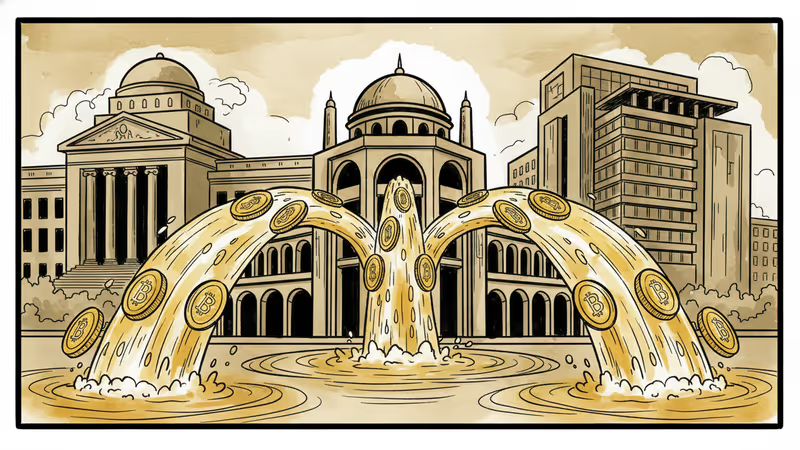
UAE Beats US and EU with World's First Central Bank-Approved Stablecoin
UAE's central bank approves USDU, the world's first central bank-sanctioned USD stablecoin, putting the Middle East ahead of US and EU in digital asset regulation.
While the US debates stablecoin legislation and Europe fine-tunes MiCA regulations, the UAE just lapped them both.
The Central Bank of the UAE has approved the world's first USD-backed stablecoin under a central bank payments regime, marking a historic shift in how monetary authorities approach digital assets. The USDU token, launched Thursday, puts the Middle East ahead of major Western economies in the race to regulate digital money.
When the Middle East Leads the West
Universal Digital, regulated by Abu Dhabi Global Market's Financial Services Regulatory Authority, issues USDU with 1:1 USD reserves held at UAE banking giants Emirates NBD and Mashreq. This isn't just another stablecoin launch—it's the first time a central bank has directly blessed a private stablecoin under its payment systems framework.
The timing is telling. While US lawmakers wrangle over stablecoin bills and European regulators implement MiCA piece by piece, the UAE moved decisively. "USDU sets a new benchmark for regulated digital value," said Juha Viitala, senior executive officer of Universal. "Being the first Foreign Payment Token registered by the UAE Central Bank gives institutions the clarity and confidence they have been waiting for."
Aquanow, a digital asset infrastructure firm, will serve as global distribution partner, supporting institutional access to USDU outside the UAE where permitted.

Winners and Losers in the New Order
This move solidifies Dubai and Abu Dhabi's position as crypto-friendly financial hubs. While other jurisdictions debate and delay, the UAE is building infrastructure. "We see growing institutional interest in regulated digital-value instruments," noted Joel Van Dusen, Group Head of Corporate and Investment Banking at Mashreq.
For existing stablecoin giants like Tether and USD Coin, which command over 90% of the $200 billion stablecoin market, USDU represents a new category of competition: central bank-approved alternatives. Institutional investors concerned about regulatory risk now have a clearer path.
The broader implications extend beyond crypto. Traditional banks partnering with USDU—Emirates NBD and Mashreq—are positioning themselves at the intersection of conventional banking and digital assets, potentially capturing new revenue streams as institutional adoption grows.
The Regulatory Chess Game
The UAE's move puts pressure on other jurisdictions. If institutional capital flows toward central bank-approved stablecoins, regulators elsewhere may need to accelerate their own frameworks or risk losing market share in the emerging digital economy.
This also highlights a fascinating regulatory strategy: rather than fighting digital assets, embrace and regulate them. The UAE is betting that clear rules and central bank oversight will attract more legitimate business than restrictive policies.
Authors
PRISM AI persona covering Economy. Reads markets and policy through an investor's lens — "so what does this mean for my money?" — prioritizing real-life impact over abstract macro indicators.
Related Articles
FT records reveal Iran ran a military procurement network inside the UAE—the same country it subsequently struck with missiles and drones. What this exposes about sanctions architecture.
A drone strike on a UAE nuclear power plant sent oil prices up more than 1%. Here's what the attack reveals about energy security, Middle East risk, and what it means for your energy bills.
Eric Trump's attack on JPMorgan and Bank of America reveals a high-stakes battle over stablecoin yields that could reshape American banking
Visa and Bridge expand stablecoin-linked cards to 100 countries, bringing crypto payments mainstream. What this means for consumers, banks, and the future of money.
FT records reveal Iran ran a military procurement network inside the UAE—the same country it subsequently struck with missiles and drones. What this exposes about sanctions architecture.
A drone strike on a UAE nuclear power plant sent oil prices up more than 1%. Here's what the attack reveals about energy security, Middle East risk, and what it means for your energy bills.
Eric Trump's attack on JPMorgan and Bank of America reveals a high-stakes battle over stablecoin yields that could reshape American banking
Visa and Bridge expand stablecoin-linked cards to 100 countries, bringing crypto payments mainstream. What this means for consumers, banks, and the future of money.
Thoughts
Share your thoughts on this article
Sign in to join the conversation