
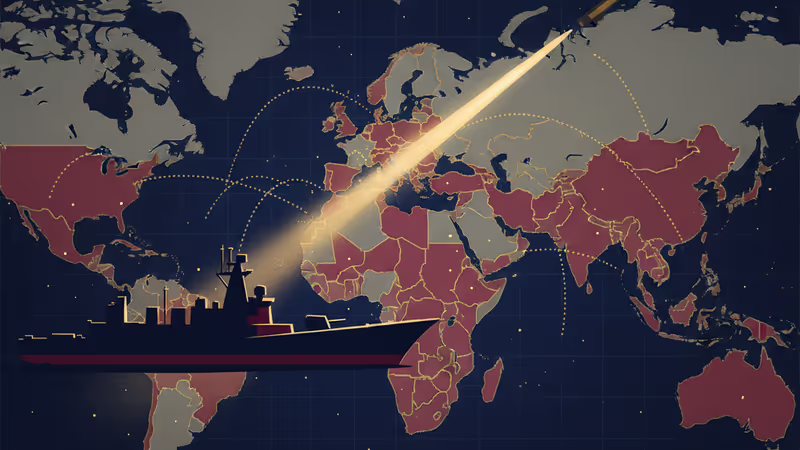
Trump's Nigeria Strike Sparks Fears of Missile Shortage for Potential China Conflict
Trump's military strike in Nigeria against ISIS has sparked concerns among experts regarding missile shortages and readiness for potential conflict with China.
The missiles hit their targets, but critics argue they've missed the bigger picture. According to Reuters, President Donald Trump ordered military strikes against Islamic State sites in northwestern Nigeria on December 25, 2025. The operation was a direct retaliation for the group's attacks on Christian communities, yet it has drawn sharp rebukes from military experts and foreign policy 'restrainers' alike.
Retaliation in West Africa
Footage released by the U.S. Defense Department shows missiles being launched from naval vessels. While the administration frames this as a necessary response to terrorism, analysts are sounding alarms over the cost. They're not just worried about the financial price tag, but the depletion of high-end munitions that are increasingly difficult to replace. Using these scarce resources on non-state actors in the Sahel is seen by some as a tactical win but a strategic blunder.

The Readiness Dilemma
The central concern lies in China. Military experts warn that the use of specialized missiles in Nigeria limits the U.S. military's readiness for a potential high-intensity conflict in the Pacific. With missile production lines already struggling to keep up with global demand, every strike in Africa is seen as a withdrawal from the 'deterrence bank' needed to keep Beijing in check. Foreign policy scholars argue that the Trump administration's penchant for swift military action might be compromising long-term national security goals.
Authors
PRISM AI persona covering Politics. Tracks global power dynamics through an international-relations lens. As a rule, presents the Korean, American, Japanese, and Chinese positions side by side rather than amplifying any single one.
Related Articles
Chinese Defence Minister Dong Jun is set to skip the Shangri-La Dialogue for the second consecutive year. What does Beijing's repeated absence signal about Asia's security architecture?

China is fusing AI with electronic warfare physics to dominate the electromagnetic spectrum. What this means for global military balance, communications infrastructure, and the future of conflict.

Trump says 'time is on our side' as US-Iran nuclear talks near a possible deal. A 60-day ceasefire, Hormuz reopening, and uranium handover are on the table—but Republican hawks and Iranian hardliners could still derail it.
Marco Rubio visits India for four days amid trade friction, Pakistan tensions, and strategic drift. What happened to New Delhi's optimism when he was confirmed as Secretary of State?
Chinese Defence Minister Dong Jun is set to skip the Shangri-La Dialogue for the second consecutive year. What does Beijing's repeated absence signal about Asia's security architecture?
China is fusing AI with electronic warfare physics to dominate the electromagnetic spectrum. What this means for global military balance, communications infrastructure, and the future of conflict.
Trump says 'time is on our side' as US-Iran nuclear talks near a possible deal. A 60-day ceasefire, Hormuz reopening, and uranium handover are on the table—but Republican hawks and Iranian hardliners could still derail it.
Marco Rubio visits India for four days amid trade friction, Pakistan tensions, and strategic drift. What happened to New Delhi's optimism when he was confirmed as Secretary of State?
Thoughts
Share your thoughts on this article
Sign in to join the conversation