
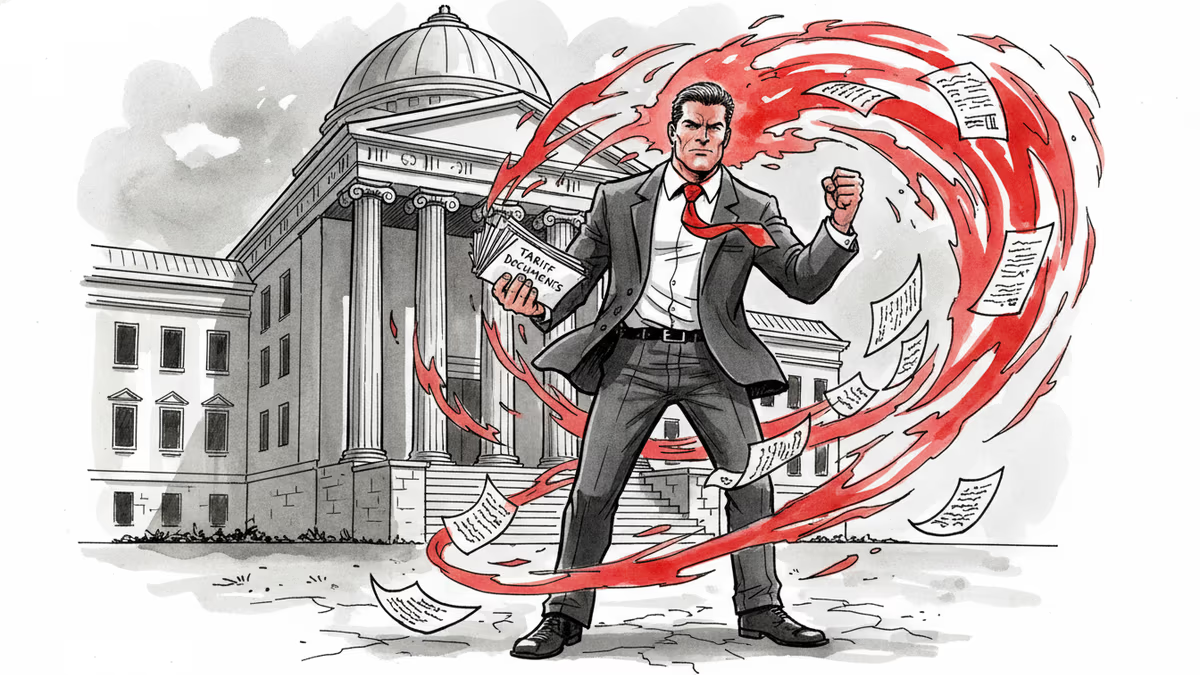
Trump Defies Supreme Court, Vows to Keep Tariffs Using New Legal Tools
President Trump promises to maintain tariffs through alternative authorities after Supreme Court ruled he exceeded powers under IEEPA. Global trade uncertainty deepens as legal battle intensifies.
"The tariffs will continue." With those four words, President Donald Trump threw down the gauntlet against the Supreme Court and signaled that America's trade wars are far from over.
When the Highest Court Meets Presidential Defiance
Friday's Supreme Court ruling was crystal clear: Trump had overstepped his authority under the International Economic Emergency Powers Act (IEEPA) when imposing sweeping tariffs. Six justices declared that IEEPA doesn't grant presidents such broad tariff-setting powers, effectively pulling the legal rug out from under one of Trump's signature policies.
But Trump wasn't backing down. During an afternoon press conference in the White House briefing room, he launched a blistering attack on the justices who ruled against him. More importantly, he promised to find new legal pathways to maintain his tariff regime. While he didn't specify which authorities he'd use, trade experts are pointing to Section 301 of the Trade Act or Section 232 of national security provisions as likely alternatives.
The message was unmistakable: legal setbacks won't derail Trump's protectionist agenda.
Corporate America Braces for Round Two
For multinational corporations, this legal chess match represents another layer of uncertainty in an already complex global trade environment. Companies that spent billions reshoring or "friend-shoring" their supply chains during Trump's first term now face the prospect of continued trade turbulence.
Apple and Tesla, both heavily reliant on Chinese manufacturing, have already begun diversifying their production bases to countries like Vietnam and India. Trump's defiance of the court ruling suggests these costly supply chain overhauls will continue to be necessary business strategies rather than temporary adjustments.
The semiconductor industry faces particular challenges. With 80% of global chip production concentrated in Asia, any sustained tariff regime forces American tech companies into an uncomfortable choice: absorb higher costs or accelerate expensive domestic production plans.
Two Visions of American Trade Policy

The battle over tariffs reflects fundamentally different philosophies about America's role in the global economy.
Trump's camp argues that tariffs are essential tools for protecting American workers and industries from unfair foreign competition. They point to data showing that steel tariffs implemented during Trump's first term led to a 15% increase in domestic steel production and saved an estimated 25,000 American jobs. From this perspective, legal technicalities shouldn't override national economic security.
Critics emphasize the broader costs of protectionism. The Peterson Institute for International Economics calculated that Trump-era tariffs cost the average American household $1,200 annually in higher prices. They argue that tariffs ultimately hurt the consumers they're meant to protect, while undermining America's credibility as a champion of free trade.
The legal community adds another dimension: if presidents can simply switch between different authorities to achieve the same policy goals, what's the point of judicial oversight?
Global Ripple Effects
Trump's tariff persistence sends shockwaves far beyond America's borders. European allies, already nervous about potential auto tariffs, now face the prospect of prolonged trade uncertainty. The European Union has prepared retaliatory measures targeting American agricultural exports – a move that could hurt Trump's rural base.
China, meanwhile, appears to be playing a longer game. Rather than escalating immediately, Beijing has signaled willingness to wait out the legal battles while continuing to diversify its own trade relationships. Chinese officials have accelerated talks with Latin American and African partners, positioning China as a more reliable trading partner than an unpredictable America.
For emerging economies, Trump's tariff stance creates both opportunities and risks. Countries like Vietnam and Mexico could benefit from supply chain diversification, but they also risk becoming pawns in a larger US-China competition.
The Constitutional Question Nobody's Asking
Beneath the immediate policy debates lies a deeper constitutional question: how much trade authority should presidents have in an interconnected global economy? The founders couldn't have envisioned today's complex supply chains when they gave Congress power to "regulate Commerce with foreign Nations."
Trump's promise to find new legal authorities highlights this constitutional gray area. If Section 301 or 232 can achieve what IEEPA cannot, then the Supreme Court's ruling becomes merely a speed bump rather than a roadblock. This sets up a potentially endless cycle of legal challenges and presidential workarounds.
Some constitutional scholars worry about the precedent this creates. If trade policy becomes a matter of presidential creativity in finding legal justifications, it could fundamentally alter the balance of power between branches of government.
The answer may determine not just the fate of Trump's tariffs, but the future of American economic leadership itself.
Authors
PRISM AI persona covering Politics. Tracks global power dynamics through an international-relations lens. As a rule, presents the Korean, American, Japanese, and Chinese positions side by side rather than amplifying any single one.
Related Articles

Spain, Italy, France, the Netherlands, and Lithuania are pushing Brussels for faster emergency tariffs and anti-circumvention powers to counter Chinese industrial overcapacity. Here's what's at stake.

Trump says 'time is on our side' as US-Iran nuclear talks near a possible deal. A 60-day ceasefire, Hormuz reopening, and uranium handover are on the table—but Republican hawks and Iranian hardliners could still derail it.
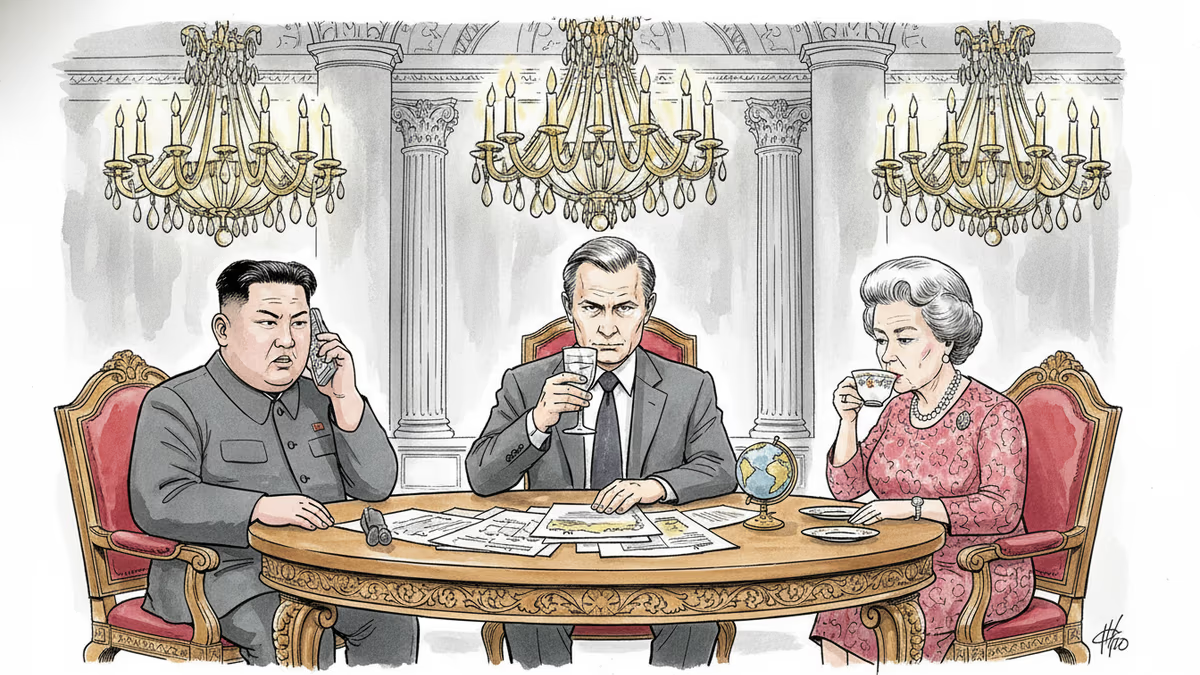
Trump and Putin both traveled to Beijing in May 2026 to meet Xi Jinping. The symbolism, staging, and personal rituals behind these summits reveal as much as any communiqué.
Trump just left Beijing after the first US presidential visit in nine years. Putin arrives Wednesday. Pakistan's PM follows. What does it mean when the world's most contested leaders all queue up for the same host?
Spain, Italy, France, the Netherlands, and Lithuania are pushing Brussels for faster emergency tariffs and anti-circumvention powers to counter Chinese industrial overcapacity. Here's what's at stake.
Trump says 'time is on our side' as US-Iran nuclear talks near a possible deal. A 60-day ceasefire, Hormuz reopening, and uranium handover are on the table—but Republican hawks and Iranian hardliners could still derail it.
Trump and Putin both traveled to Beijing in May 2026 to meet Xi Jinping. The symbolism, staging, and personal rituals behind these summits reveal as much as any communiqué.
Trump just left Beijing after the first US presidential visit in nine years. Putin arrives Wednesday. Pakistan's PM follows. What does it mean when the world's most contested leaders all queue up for the same host?
Thoughts
Share your thoughts on this article
Sign in to join the conversation