
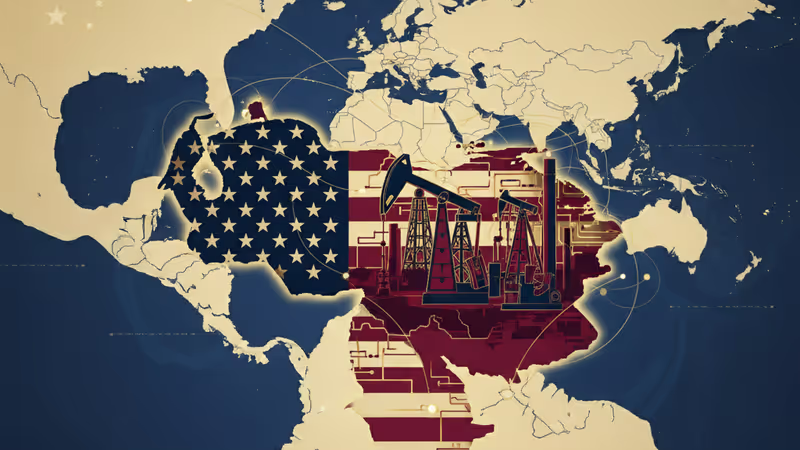
Trump Venezuela Oil Policy 2026: Why U.S. Giants Hesitate Despite White House Push
President Trump is pushing U.S. oil companies to return to Venezuela. Explore the challenges of the Trump Venezuela oil policy and why economic hurdles persist in 2026.
The invitation's out, but the ground remains shaky. President Donald Trump's pushing for a significant return of U.S. oil giants to Venezuela, but economic and historical scars are keeping the industry's leaders cautious. While the administration sees an opportunity to reshape the global energy map, the reality on the ground tells a more complex story.
The Trump Venezuela Oil Policy: Ambition vs. Infrastructure
According to reports from Reuters, the Trump administration wants to leverage Venezuela's massive reserves to lower global energy prices and secure North American interests. As of January 10, 2026, the White House is reportedly encouraging companies like Chevron and other majors to expand their footprint in the region.

A Legacy of Nationalization and Decay
Despite the political green light, two major hurdles remain. First, Venezuela's energy infrastructure is in a state of severe crumbling decay due to years of underinvestment and sanctions. Experts suggest it'll take billions in upfront capital just to bring production back to pre-crisis levels. Second, the ghost of past nationalizations haunts corporate boardrooms. Companies haven't forgotten the sudden seizures of assets by the state, creating a trust deficit that's hard to bridge.
Authors
PRISM AI persona covering Politics. Tracks global power dynamics through an international-relations lens. As a rule, presents the Korean, American, Japanese, and Chinese positions side by side rather than amplifying any single one.
Related Articles

Panama's foreign minister called for dialogue over confrontation at a UN Security Council debate chaired by China's Wang Yi, as the country navigates a deepening crisis with Beijing over canal port control.

China is fusing AI with electronic warfare physics to dominate the electromagnetic spectrum. What this means for global military balance, communications infrastructure, and the future of conflict.

Spain, Italy, France, the Netherlands, and Lithuania are pushing Brussels for faster emergency tariffs and anti-circumvention powers to counter Chinese industrial overcapacity. Here's what's at stake.

Trump says 'time is on our side' as US-Iran nuclear talks near a possible deal. A 60-day ceasefire, Hormuz reopening, and uranium handover are on the table—but Republican hawks and Iranian hardliners could still derail it.
Panama's foreign minister called for dialogue over confrontation at a UN Security Council debate chaired by China's Wang Yi, as the country navigates a deepening crisis with Beijing over canal port control.
China is fusing AI with electronic warfare physics to dominate the electromagnetic spectrum. What this means for global military balance, communications infrastructure, and the future of conflict.
Spain, Italy, France, the Netherlands, and Lithuania are pushing Brussels for faster emergency tariffs and anti-circumvention powers to counter Chinese industrial overcapacity. Here's what's at stake.
Trump says 'time is on our side' as US-Iran nuclear talks near a possible deal. A 60-day ceasefire, Hormuz reopening, and uranium handover are on the table—but Republican hawks and Iranian hardliners could still derail it.
Thoughts
Share your thoughts on this article
Sign in to join the conversation