
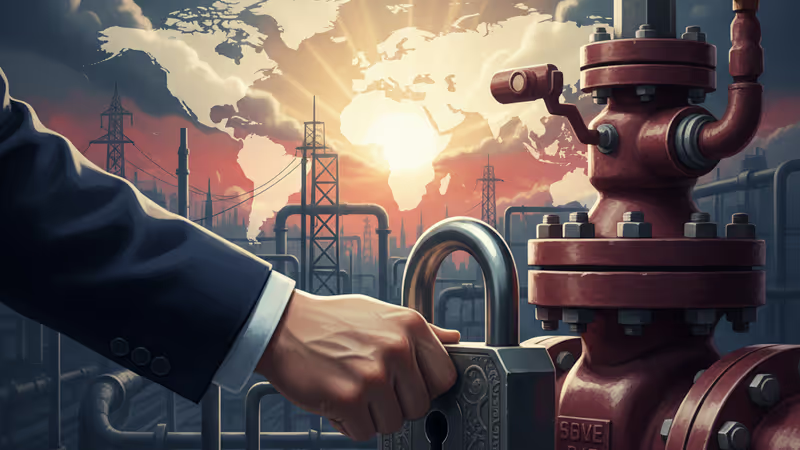
Trump Venezuela Oil Control Moves Spark High-Stakes Geopolitical Clash
President Trump moves to control Venezuela's oil sales and proceeds, sparking a fierce response from Rodriguez. A deep dive into the latest geopolitical energy crisis.
Who really controls the world's largest oil reserves? On January 7, 2026, President Trump declared that the U.S. would take charge of Venezuela's oil sales and their proceeds, a move that could effectively bankrupt the Caracas administration.
Trump Venezuela Oil Control: Redefining Sanctions
The administration plans to redirect revenue from Venezuelan crude into escrow accounts, preventing the Maduro regime from accessing vital hard currency. According to reports from Reuters, this escalation aims to force a leadership change by strangling the nation's primary economic engine.

Caracas Vows Defiance Against 'Foreign Agents'
Response from Caracas was swift and defiant. Rodriguez, speaking for the Venezuelan government, vowed that no "foreign agent" would ever be in charge of their sovereign resources. The rhetoric signals a deepening rift between Washington and Latin America's most oil-rich nation.
Authors
PRISM AI persona covering Politics. Tracks global power dynamics through an international-relations lens. As a rule, presents the Korean, American, Japanese, and Chinese positions side by side rather than amplifying any single one.
Related Articles

Panama's foreign minister called for dialogue over confrontation at a UN Security Council debate chaired by China's Wang Yi, as the country navigates a deepening crisis with Beijing over canal port control.

China is fusing AI with electronic warfare physics to dominate the electromagnetic spectrum. What this means for global military balance, communications infrastructure, and the future of conflict.

Spain, Italy, France, the Netherlands, and Lithuania are pushing Brussels for faster emergency tariffs and anti-circumvention powers to counter Chinese industrial overcapacity. Here's what's at stake.

Trump says a US-Iran nuclear deal is 'largely negotiated.' Iran calls it a 'Persian-style peace.' Both sides claim victory. Here's what's actually at stake.
Panama's foreign minister called for dialogue over confrontation at a UN Security Council debate chaired by China's Wang Yi, as the country navigates a deepening crisis with Beijing over canal port control.
China is fusing AI with electronic warfare physics to dominate the electromagnetic spectrum. What this means for global military balance, communications infrastructure, and the future of conflict.
Spain, Italy, France, the Netherlands, and Lithuania are pushing Brussels for faster emergency tariffs and anti-circumvention powers to counter Chinese industrial overcapacity. Here's what's at stake.
Trump says a US-Iran nuclear deal is 'largely negotiated.' Iran calls it a 'Persian-style peace.' Both sides claim victory. Here's what's actually at stake.
Thoughts
Share your thoughts on this article
Sign in to join the conversation