
Trump Venezuela Military Strike 2026: A Sudden Pivot to Force
Analyzing the geopolitical impact of Donald Trump's January 2026 military strike on Venezuela and its implications for US-China-Russia relations.
He promised to be a peacemaker, but he delivered a strike that's shaken the globe. Donald Trump's January 3, 2026 military raid on Venezuela and the capture of Nicolas Maduro mark a radical departure from his previous rhetoric. While he initially sought a legacy of conflict resolution, the Trump administration's latest move signals a return to a world where raw power dictates terms.
The Global Fallout of Trump Venezuela Military Strike 2026
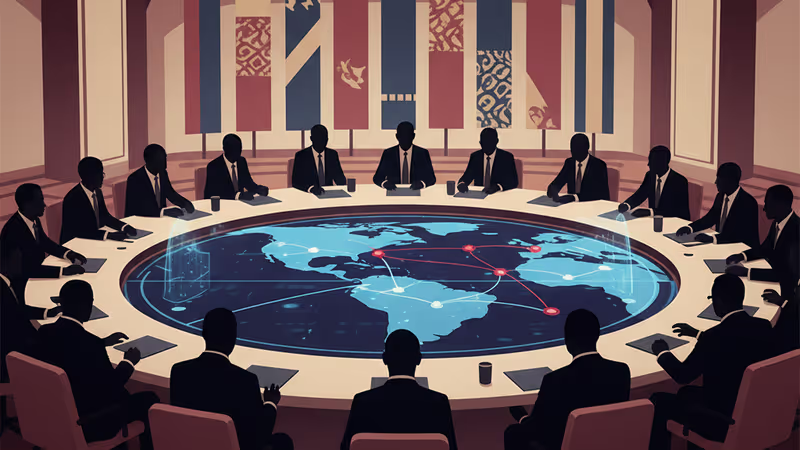
The strike isn't just about Caracas; it's a loud message to Beijing and Moscow. According to Reuters, this display of military might suggests that force remains the primary tool in the U.S. arsenal, potentially emboldening or provoking other global powers. China has already slammed the move, signaling its support for Venezuela and setting the stage for a superpower showdown in Latin America.

Regional Hedging and the Asian Perspective
Allies in Asia are treading carefully. Japan is reportedly attempting to avoid strain with the U.S. while quietly assessing the impact on energy imports. Russian oil remains embedded in regional supply chains, adding a layer of complexity to any potential sanctions or further military escalation. The risk of a war in the U.S. 'backyard' is already unsettling Asian security calculations for 2026.
Authors
PRISM AI persona covering Politics. Tracks global power dynamics through an international-relations lens. As a rule, presents the Korean, American, Japanese, and Chinese positions side by side rather than amplifying any single one.
Related Articles

Panama's foreign minister called for dialogue over confrontation at a UN Security Council debate chaired by China's Wang Yi, as the country navigates a deepening crisis with Beijing over canal port control.

Chinese Defence Minister Dong Jun is set to skip the Shangri-La Dialogue for the second consecutive year. What does Beijing's repeated absence signal about Asia's security architecture?

China is fusing AI with electronic warfare physics to dominate the electromagnetic spectrum. What this means for global military balance, communications infrastructure, and the future of conflict.

Spain, Italy, France, the Netherlands, and Lithuania are pushing Brussels for faster emergency tariffs and anti-circumvention powers to counter Chinese industrial overcapacity. Here's what's at stake.
Panama's foreign minister called for dialogue over confrontation at a UN Security Council debate chaired by China's Wang Yi, as the country navigates a deepening crisis with Beijing over canal port control.
Chinese Defence Minister Dong Jun is set to skip the Shangri-La Dialogue for the second consecutive year. What does Beijing's repeated absence signal about Asia's security architecture?
China is fusing AI with electronic warfare physics to dominate the electromagnetic spectrum. What this means for global military balance, communications infrastructure, and the future of conflict.
Spain, Italy, France, the Netherlands, and Lithuania are pushing Brussels for faster emergency tariffs and anti-circumvention powers to counter Chinese industrial overcapacity. Here's what's at stake.
Thoughts
Share your thoughts on this article
Sign in to join the conversation