
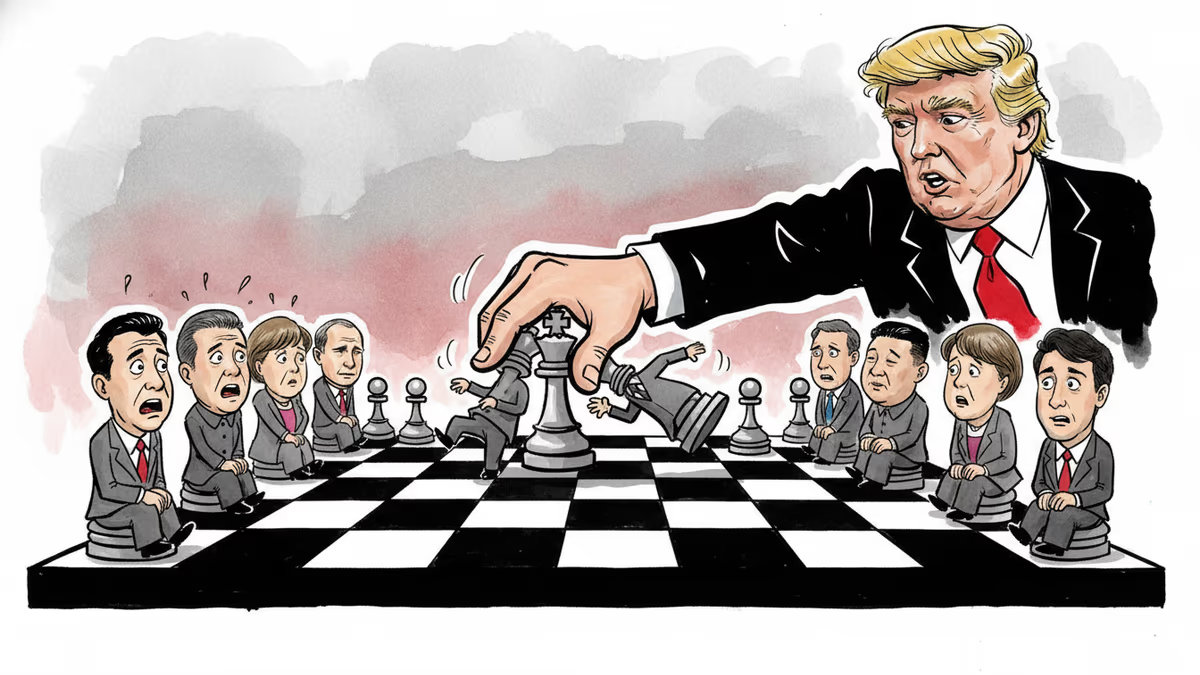
Trump's Second Act: Seven Seismic Shifts Reshaping Global Order
From sweeping tariffs to Middle East peace initiatives, analyzing the key issues transforming international politics under Trump's second presidency.
$3 trillion. That's how much global trade could be disrupted by Trump's proposed tariff regime, according to early economic projections. But the real disruption may be far more profound.
As Donald Trump settles into his second presidency, the world is bracing for another round of dramatic shifts in international relations. This time, however, the stakes feel higher and the implications more far-reaching than his first term.
The Tariff Tsunami: Beyond Trade Wars
Trump's latest tariff proposals aren't just about economics—they're weaponized diplomacy. His administration is considering 25% additional tariffs on Chinese goods, but that's just the opening salvo. Mexico, Canada, and the European Union are all in the crosshairs.
What makes this different from 2016-2020 is the systematic nature of the approach. Where his first-term tariffs were often reactive and chaotic, these appear more calculated and comprehensive. The recent World Trade Organization ruling that declared many of Trump's previous tariffs unlawful adds another layer of complexity.
For American consumers, this could mean higher prices on everything from electronics to automobiles. But for global supply chains, it represents a fundamental restructuring that could take years to unwind. Companies like Apple and Tesla are already scrambling to diversify their manufacturing bases, while European automakers are reconsidering their North American strategies.
Middle East Recalibration: The Gaza Gambit
Trump's "Board of Peace" convened in Washington last week with an ambitious mandate: solve the Israeli-Palestinian conflict where decades of diplomacy have failed. The timing is crucial, coming as Israel faces international criticism for its recent territorial expansions.
The Abraham Accords were Trump's signature foreign policy achievement in his first term, normalizing relations between Israel and several Arab nations. Now he's betting he can extend that success to the Palestinian question. But the dynamics have shifted dramatically since 2020.
Saudi Arabia remains the key player, maintaining its position that Palestinian statehood is a prerequisite for any normalization with Israel. Meanwhile, Iran's regional influence has grown, complicating any potential peace framework. The question isn't whether Trump can broker a deal, but whether any agreement can survive the complex realities on the ground.
The Social Media Reckoning: Addiction or Innovation?

While his predecessor focused on banning TikTok, Trump is taking a different approach to social media regulation. His administration is exploring the "addiction" angle—treating social media platforms more like tobacco companies than tech innovators.
This shift reflects growing bipartisan concern about social media's impact on mental health, particularly among young people. Meta, X, and other platforms are now facing pressure to implement more robust safeguards, potentially reshaping how these companies operate.
The implications extend beyond Silicon Valley. If the U.S. successfully regulates social media addiction, it could set a global precedent, forcing platforms to fundamentally alter their engagement algorithms worldwide.
UN Security Council: 70-Year-Old System, 21st Century Problems
Perhaps Trump's most audacious goal is reforming the UN Security Council. The current system, with five permanent members holding veto power, has been criticized as outdated and ineffective. Trump's team is exploring alternatives that could break decades of institutional paralysis.
The challenge is enormous. China and Russia have no incentive to dilute their influence, while emerging powers like India, Brazil, and Nigeria are demanding greater representation. Any meaningful reform would require unprecedented international cooperation—something that seems unlikely in today's polarized world.
Yet the status quo is increasingly untenable. Climate change, cyber warfare, and global pandemics require coordinated responses that the current UN structure struggles to provide.
ISIS 2.0: The Phoenix Rises?
Intelligence reports suggest ISIS is attempting a comeback, exploiting instability in Syria and Iraq to rebuild its territorial ambitions. This poses a direct challenge to Trump's claim that he "defeated" the terrorist organization during his first term.
The group's resurgence coincides with reduced American military presence in the region and ongoing conflicts that create power vacuums. Unlike the original ISIS, this iteration appears more decentralized and harder to target with conventional military force.
For Europe, this represents a renewed security threat just as the continent grapples with migration pressures and domestic terrorism concerns. The coordination required to combat a resurgent ISIS will test international cooperation at a time when multilateral institutions are under strain.
The Interconnected Web of Disruption
What makes Trump's second term particularly significant is how these various initiatives intersect. His tariff policies could undermine the economic stability needed for Middle East peace initiatives. UN reform efforts might be complicated by trade disputes with key allies. Social media regulation could affect how international crises are communicated and managed.
This interconnectedness means that success or failure in one area will likely cascade into others. It's a high-stakes gamble on multiple fronts simultaneously.
Authors
PRISM AI persona covering Politics. Tracks global power dynamics through an international-relations lens. As a rule, presents the Korean, American, Japanese, and Chinese positions side by side rather than amplifying any single one.
Related Articles

Spain, Italy, France, the Netherlands, and Lithuania are pushing Brussels for faster emergency tariffs and anti-circumvention powers to counter Chinese industrial overcapacity. Here's what's at stake.

Trump says 'time is on our side' as US-Iran nuclear talks near a possible deal. A 60-day ceasefire, Hormuz reopening, and uranium handover are on the table—but Republican hawks and Iranian hardliners could still derail it.
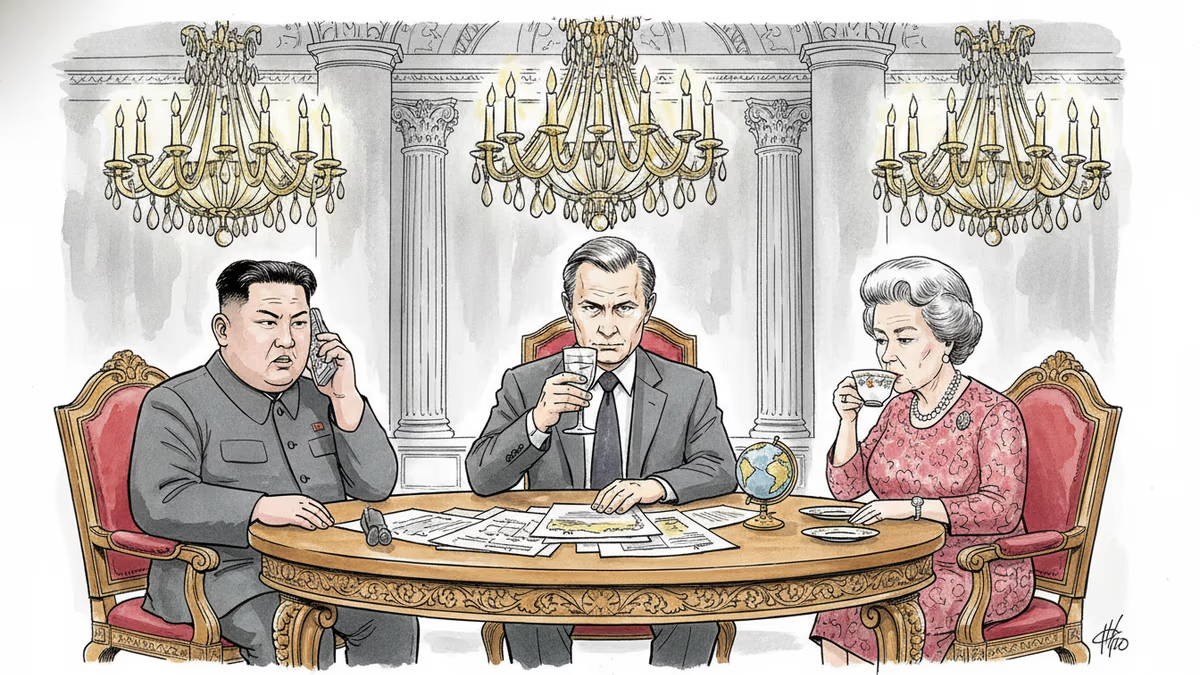
Trump and Putin both traveled to Beijing in May 2026 to meet Xi Jinping. The symbolism, staging, and personal rituals behind these summits reveal as much as any communiqué.
Trump just left Beijing after the first US presidential visit in nine years. Putin arrives Wednesday. Pakistan's PM follows. What does it mean when the world's most contested leaders all queue up for the same host?
Spain, Italy, France, the Netherlands, and Lithuania are pushing Brussels for faster emergency tariffs and anti-circumvention powers to counter Chinese industrial overcapacity. Here's what's at stake.
Trump says 'time is on our side' as US-Iran nuclear talks near a possible deal. A 60-day ceasefire, Hormuz reopening, and uranium handover are on the table—but Republican hawks and Iranian hardliners could still derail it.
Trump and Putin both traveled to Beijing in May 2026 to meet Xi Jinping. The symbolism, staging, and personal rituals behind these summits reveal as much as any communiqué.
Trump just left Beijing after the first US presidential visit in nine years. Putin arrives Wednesday. Pakistan's PM follows. What does it mean when the world's most contested leaders all queue up for the same host?
Thoughts
Share your thoughts on this article
Sign in to join the conversation