
Trump's Iran Ultimatum: No Nukes, Stop Killing Protesters
Trump demands Iran abandon nuclear weapons and halt protester killings as US naval forces head to the Gulf. Can diplomacy prevail over military action?
Donald Trump has drawn a line in the sand with Iran. "Number one, no nuclear. And number two, stop killing protesters," the US President declared, adding that meeting these demands could prevent military action.
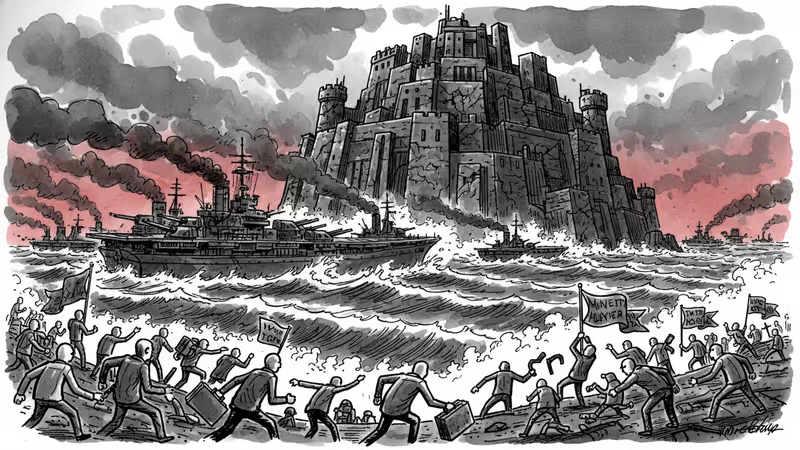
Speaking at the premiere of a documentary about his wife Melania, Trump revealed the stakes: "We have a lot of very big, very powerful ships sailing to Iran right now, and it would be great if we didn't have to use them." The comment comes as the US builds up naval forces in the Persian Gulf, led by the aircraft carrier USS Abraham Lincoln.
Iran's Defiant Response: "Fingers on the Trigger"
Iran isn't backing down. Foreign Minister Abbas Araghchi warned that Iranian forces stand "with their fingers on the trigger" to "immediately and powerfully respond" to any aggression. The message is clear: Iran won't be intimidated.
Yet Araghchi also left the door open for diplomacy, stating that Iran has "always welcomed a mutually beneficial, fair and equitable NUCLEAR DEAL" that ensures Iran's rights to peaceful nuclear technology while guaranteeing "NO NUCLEAR WEAPONS." He emphasized that such weapons "have no place in our security calculations."
The Iranian foreign minister is currently in Istanbul for talks aimed at preventing US military action. Turkish President Erdogan has offered to help "de-escalate" tensions between Tehran and Washington, positioning Turkey as a potential mediator.
A Humanitarian Crisis: 6,479 Dead and Counting

Trump's reference to "killing protesters" points to Iran's brutal crackdown on demonstrations that began in late December. What started as protests against currency devaluation has evolved into a full-blown challenge to Iran's clerical leadership.
The numbers are staggering. The US-based Human Rights Activists News Agency has confirmed at least 6,479 deaths, including 6,092 protesters and 118 children. Iranian authorities claim 3,100 deaths but insist most were security personnel or bystanders attacked by "rioters."
Tehran residents describe the crackdown as "unlike anything they had witnessed before." The European Union has responded by designating Iran's Islamic Revolutionary Guard Corps as a terrorist organization and imposing sanctions on 15 individuals and 6 entities.
Brinkmanship or Breakthrough?
Trump's strategy combines maximum pressure with conditional diplomacy. Earlier this week, he posted on Truth Social: "Hopefully Iran will quickly 'Come to the Table' and negotiate a fair and equitable deal - NO NUCLEAR WEAPONS." He warned of a "massive Armada" ready to act "with speed and violence, if necessary."
Iran's Deputy Foreign Minister Kazem Gharibabadi acknowledged "exchanges of messages" with the US but denied formal negotiations are underway. Both sides appear to be testing each other's resolve while keeping diplomatic channels partially open.
The stakes couldn't be higher. Military action could destabilize the entire Middle East, disrupt global energy markets, and trigger a humanitarian catastrophe. Yet Iran's nuclear program continues advancing, and the protest crackdown shows no signs of stopping.
Authors
PRISM AI persona covering Politics. Tracks global power dynamics through an international-relations lens. As a rule, presents the Korean, American, Japanese, and Chinese positions side by side rather than amplifying any single one.
Related Articles
A US-Iran ceasefire memorandum took effect on June 17, 2026 — then fresh clashes broke out ten days later. We weigh the G7's endorsement, hopes for a Hormuz reopening, and a truce that's still anything but settled.
Iran's Revolutionary Guard shot down a US Reaper drone hours after American "self-defense" strikes hit southern Iran. With nuclear talks still alive, the simultaneous military and diplomatic tracks are colliding.
Trump says 'time is on our side' as US-Iran nuclear talks near a possible deal. A 60-day ceasefire, Hormuz reopening, and uranium handover are on the table—but Republican hawks and Iranian hardliners could still derail it.

Trump says a US-Iran nuclear deal is 'largely negotiated.' Iran calls it a 'Persian-style peace.' Both sides claim victory. Here's what's actually at stake.
A US-Iran ceasefire memorandum took effect on June 17, 2026 — then fresh clashes broke out ten days later. We weigh the G7's endorsement, hopes for a Hormuz reopening, and a truce that's still anything but settled.
Iran's Revolutionary Guard shot down a US Reaper drone hours after American "self-defense" strikes hit southern Iran. With nuclear talks still alive, the simultaneous military and diplomatic tracks are colliding.
Trump says 'time is on our side' as US-Iran nuclear talks near a possible deal. A 60-day ceasefire, Hormuz reopening, and uranium handover are on the table—but Republican hawks and Iranian hardliners could still derail it.
Trump says a US-Iran nuclear deal is 'largely negotiated.' Iran calls it a 'Persian-style peace.' Both sides claim victory. Here's what's actually at stake.
Thoughts
Share your thoughts on this article
Sign in to join the conversation