
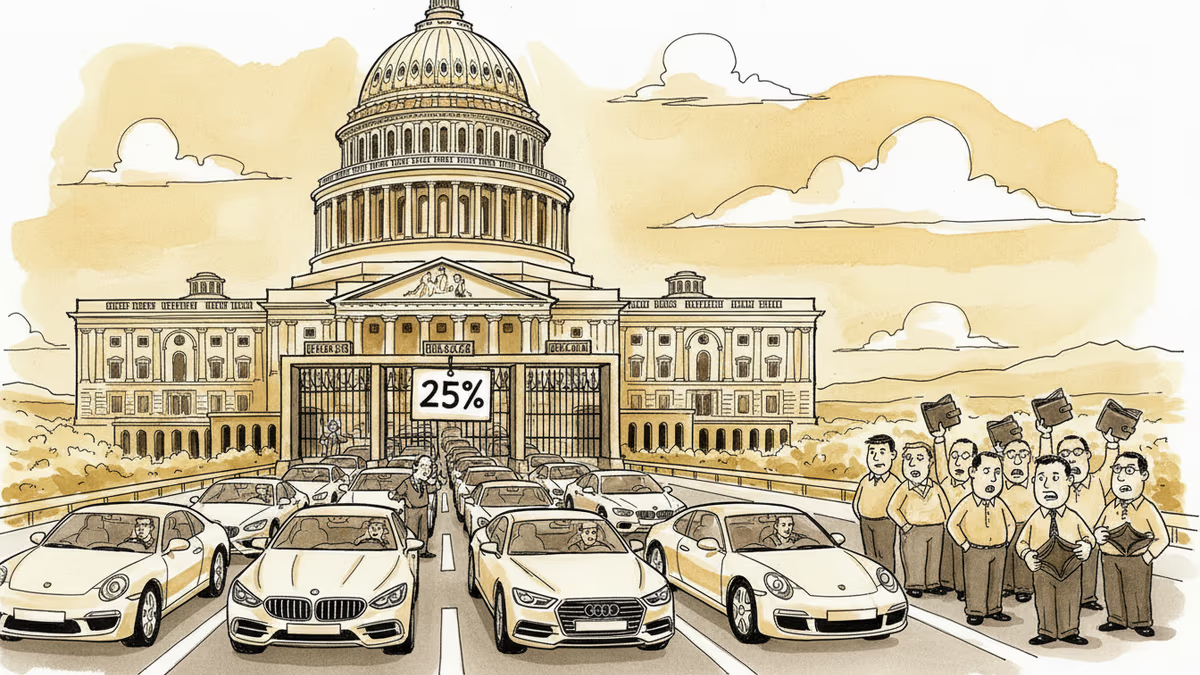
Trump's 25% EU Auto Tariff: Who Really Pays?
Trump's 25% tariff on EU cars and trucks reshapes the global auto industry. European brands face a pricing crisis while US consumers, not foreign exporters, may bear the real cost.
The sticker price on a European car just got a lot stickier — and it's American buyers who'll feel it first.
The Trump administration has imposed a 25% tariff on all passenger cars and trucks imported from the European Union, escalating from the previous rate of just 2.5%. The move — a tenfold increase overnight — marks one of the most aggressive trade actions against a major US ally in decades, and sends shockwaves through an industry already navigating an electric vehicle transition and fragile supply chains.
What Happened, and Why Now
The White House framed the tariff as a corrective measure against what it calls a structurally unfair trading relationship. The EU charges 10% on American-made cars entering Europe; the US had been charging only 2.5% on European imports. Trump has long viewed this asymmetry as a symbol of American weakness in trade negotiations, and the auto sector — politically potent, symbolically loaded — was always a likely flashpoint.
The timing matters. With midterm positioning already underway and manufacturing-state voters in focus, the tariff serves a domestic political purpose as much as an economic one. Detroit's legacy automakers have publicly supported some form of trade protection, even as their own supply chains run through European factories and parts suppliers.
The brands most exposed are obvious: Volkswagen, BMW, Mercedes-Benz, and Stellantis all ship significant volumes of European-built vehicles to the US market. A 25% tariff, if passed through to consumers, could add several thousand dollars to the price of a mid-range German sedan — enough to shift buying decisions meaningfully.
The Counterintuitive Losers: American Consumers
Here's the part that tends to get lost in the political framing: tariffs are not paid by foreign governments or foreign companies. They are paid by the US importers — and ultimately passed on to American buyers.
A BMW 3 Series assembled in Munich and shipped to a dealership in Ohio doesn't get cheaper because Washington imposed a tax on it. The dealer pays the tariff at customs, and that cost flows downstream. Analysts estimate that sustained 25% tariffs could add $5,000 to $15,000 to the price of affected European models, depending on the vehicle segment. For luxury buyers, that may be absorbable. For shoppers cross-shopping European brands against Japanese or Korean alternatives, it's a decisive nudge.

The irony is familiar. When the US imposed voluntary export restraints on Japanese automakers in the early 1980s, American consumers paid higher prices for both Japanese and domestic cars — because reduced competition let Detroit raise its own prices too. The policy protected jobs in the short run but cost consumers billions.
Winners, Relative and Absolute
Not everyone loses. Automakers with established US manufacturing footprints gain a structural price advantage — at least on models built domestically.
Hyundai and Kia have been quietly positioning for exactly this scenario. Hyundai's dedicated EV facility in Georgia — the Hyundai Motor Group Metaplant America — began operations in 2024, and the company has steadily increased its US-built vehicle share. When a European competitor's price rises by $8,000 due to tariffs, a comparably-specced Hyundai built in Savannah looks considerably more attractive.
Tesla, which manufactures entirely in the US (and China, for non-US markets), is insulated from this particular tariff. So is any Toyota, Honda, or Subaru model rolling off a US assembly line.
But the picture isn't clean even for apparent winners. GM, Ford, and Stellantis source components from European suppliers. A 25% tariff on finished vehicles could cascade into pressure on parts imports too, depending on how broadly the administration defines its trade actions going forward.
Europe's Response: Calibrated, Not Panicked
The European Commission has signaled a measured but firm response. Brussels has a well-worn playbook: target politically sensitive American exports — Harley-Davidson motorcycles, Kentucky bourbon, Florida orange juice — in ways designed to inflict pain in swing states rather than maximize economic damage.
This approach worked as a pressure tactic in 2018, when Harley-Davidson announced it would shift some production overseas to avoid EU retaliatory tariffs, handing Trump a public relations setback. The same logic applies now.
Yet neither side wants a full trade war. The EU's economy is under pressure from sluggish growth and energy costs. The US auto industry's supply chain is too entangled with European partners for a clean decoupling. Negotiations remain open, and a phased reduction or sector-specific carve-out remains possible — particularly if European automakers accelerate commitments to build more in the United States.
Compare: Who Stands Where
| Stakeholder | Immediate Impact | Strategic Position |
|---|---|---|
| EU automakers (VW, BMW, Mercedes) | Margin squeeze or US price hikes | Must accelerate US production investment |
| US consumers | Higher prices on European models | Fewer affordable choices in affected segments |
| Hyundai / Kia (US-built models) | Relative price advantage | Benefits if tariff pressure persists |
| Tesla / US-built domestics | Insulated from this tariff | Gains competitive headroom |
| US parts suppliers (EU-sourced) | Input cost risk | Exposure depends on tariff scope |
| EU governments | Political pressure to retaliate | Leverage through targeted counter-tariffs |
This content is AI-generated based on source articles. While we strive for accuracy, errors may occur. We recommend verifying with the original source.
Related Articles

Trump's Beijing visit was a masterclass in diplomatic theater. Warm handshakes, viral selfies, and noodle runs. But Taiwan, Iran, and rare earths remain untouched. Here's what the spectacle obscures.
Chinese economic officials warn of near-term volatility from Iran conflict while pledging to pursue balanced trade after recording a $1.2 trillion surplus, raising questions about policy credibility.
Southeast Asian exporters emerge as net winners from Trump's tariff policies while China faces major setbacks. Analysis of the shifting global supply chain dynamics.
Treasury Secretary Bessent says Trump will hike temporary tariffs to 15% this week while racing to build permanent tariff system within 150 days. Can they pull it off?
Trump's Beijing visit was a masterclass in diplomatic theater. Warm handshakes, viral selfies, and noodle runs. But Taiwan, Iran, and rare earths remain untouched. Here's what the spectacle obscures.
Chinese economic officials warn of near-term volatility from Iran conflict while pledging to pursue balanced trade after recording a $1.2 trillion surplus, raising questions about policy credibility.
Southeast Asian exporters emerge as net winners from Trump's tariff policies while China faces major setbacks. Analysis of the shifting global supply chain dynamics.
Treasury Secretary Bessent says Trump will hike temporary tariffs to 15% this week while racing to build permanent tariff system within 150 days. Can they pull it off?
Thoughts
Share your thoughts on this article
Sign in to join the conversation