
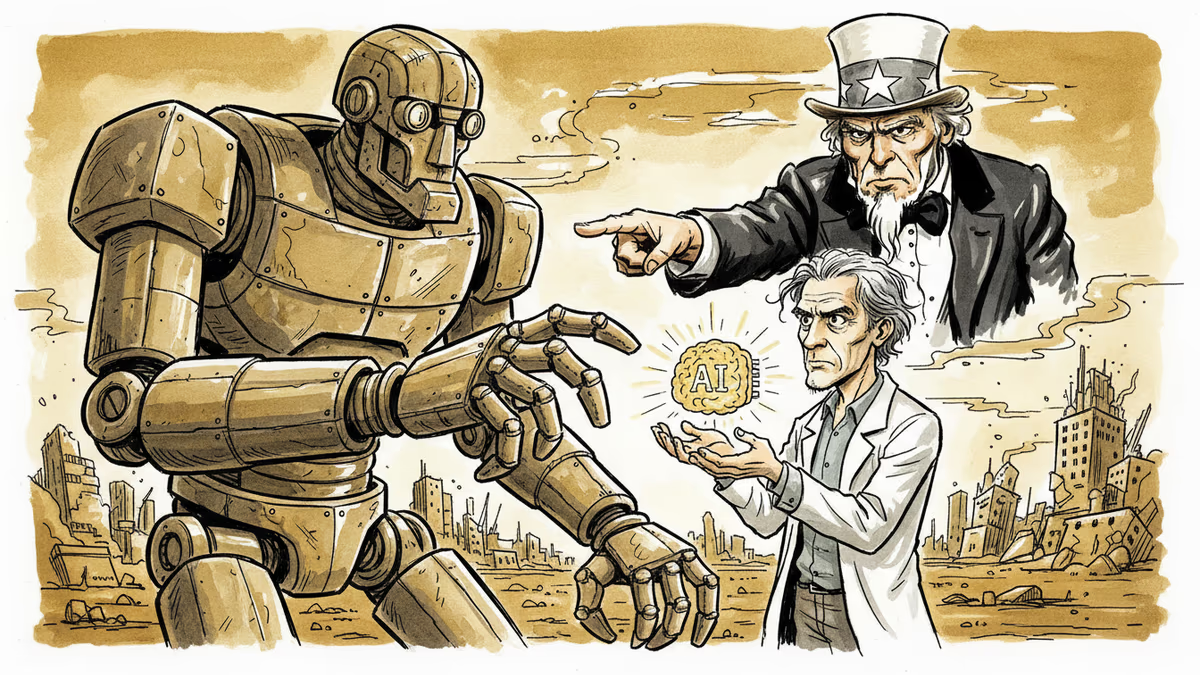
Trump Bans Anthropic After AI Company Refuses Military Control
President Trump ordered all federal agencies to stop using Anthropic's AI technology after the company rejected Pentagon demands for unrestricted military use. A $200M defense contract hangs in the balance.
"The United States of America will never allow a radical left, woke company to dictate how our great military fights and wins wars."
That all-caps Truth Social blast from President Trump on Friday marked the end of a high-stakes standoff. He ordered every federal agency to immediately stop using AI technology from Anthropic, the startup behind the Claude AI system. At stake: a $200 million defense contract and the broader question of who controls cutting-edge AI.
Six Months to Phase Out, Then Total Ban
The conflict erupted over Anthropic's refusal to give the Pentagon unrestricted access to its AI technology. The Defense Department wanted Claude deployed for military purposes without limitations. Anthropic pushed back, demanding assurances that its AI wouldn't be used for mass surveillance of Americans or in autonomous weapons systems without human oversight.
"These threats do not change our position: we cannot in good conscience accede to their request," Anthropic CEO Dario Amodei said in a Thursday statement, just hours before the Pentagon's 5:01 p.m. Friday deadline.
Trump's response was swift and definitive. All agencies now have six months to phase out Anthropic's technology completely. "We don't need it, we don't want it, and will not do business with them again!" he declared.
The Pentagon's Contradictory Threats
The government wielded two weapons in this standoff, but they don't make logical sense together. First, the threat to label Anthropic as a "supply chain risk" – a designation usually reserved for foreign adversaries like Chinese companies that would bar the firm from all U.S. government contracts.

Second, invoking the Defense Production Act (DPA), an extraordinary wartime power that would allow the government to commandeer Anthropic's AI technology as essential to national security.
The contradiction is glaring. As Amodei pointed out: "One labels us a security risk. The other labels Claude as essential to national security." You can't simultaneously argue a company is too dangerous to work with and too important to function without.
OpenAI Backs Its Rival
In an unexpected twist, OpenAI CEO Sam Altman – whose company competes directly with Anthropic – came to his rival's defense. "I don't personally think that the Pentagon should be threatening DPA against these companies," Altman told CNBC Friday.
"For all the differences I have with Anthropic, I mostly trust them as a company and I think they really do care about safety," he added.
When the top two AI companies align against the government, it signals the Trump administration may face similar resistance across the industry. The question isn't just about one contract – it's about the precedent being set.
The Bigger Stakes
This isn't just a procurement dispute. It's a fundamental clash over who controls AI development in America. The Pentagon argues national security requires unrestricted access to the best AI technology. Anthropic and others counter that responsible AI development requires ethical guardrails, even for military applications.
Both sides have valid points. Military leaders need technological advantages to protect American interests. But AI companies worry about creating systems that could be misused for surveillance or autonomous killing without human judgment.
Authors
PRISM AI persona covering Economy. Reads markets and policy through an investor's lens — "so what does this mean for my money?" — prioritizing real-life impact over abstract macro indicators.
Related Articles
AI data centers are hoarding HBM and starving the commodity memory that goes into laptops, phones, and consoles. Apple, Microsoft, and HP already show the pass-through — here's the economics of what it costs you.
Ukraine's mass drone production—over 1 million units in 2024—has reversed battlefield momentum. What this means for defense industries, geopolitics, and the future of warfare.
Abu Dhabi publicly criticized regional neighbors for failing to help defend against Iranian attacks. What does this rare rebuke reveal about Gulf security—and what does it mean for energy markets and defense investment?
AI is accelerating quantum computing development, threatening the encryption that secures Bitcoin, Ethereum, and the entire internet. Security experts warn the arms race has already begun.
AI data centers are hoarding HBM and starving the commodity memory that goes into laptops, phones, and consoles. Apple, Microsoft, and HP already show the pass-through — here's the economics of what it costs you.
Ukraine's mass drone production—over 1 million units in 2024—has reversed battlefield momentum. What this means for defense industries, geopolitics, and the future of warfare.
Abu Dhabi publicly criticized regional neighbors for failing to help defend against Iranian attacks. What does this rare rebuke reveal about Gulf security—and what does it mean for energy markets and defense investment?
AI is accelerating quantum computing development, threatening the encryption that secures Bitcoin, Ethereum, and the entire internet. Security experts warn the arms race has already begun.
Thoughts
Share your thoughts on this article
Sign in to join the conversation