
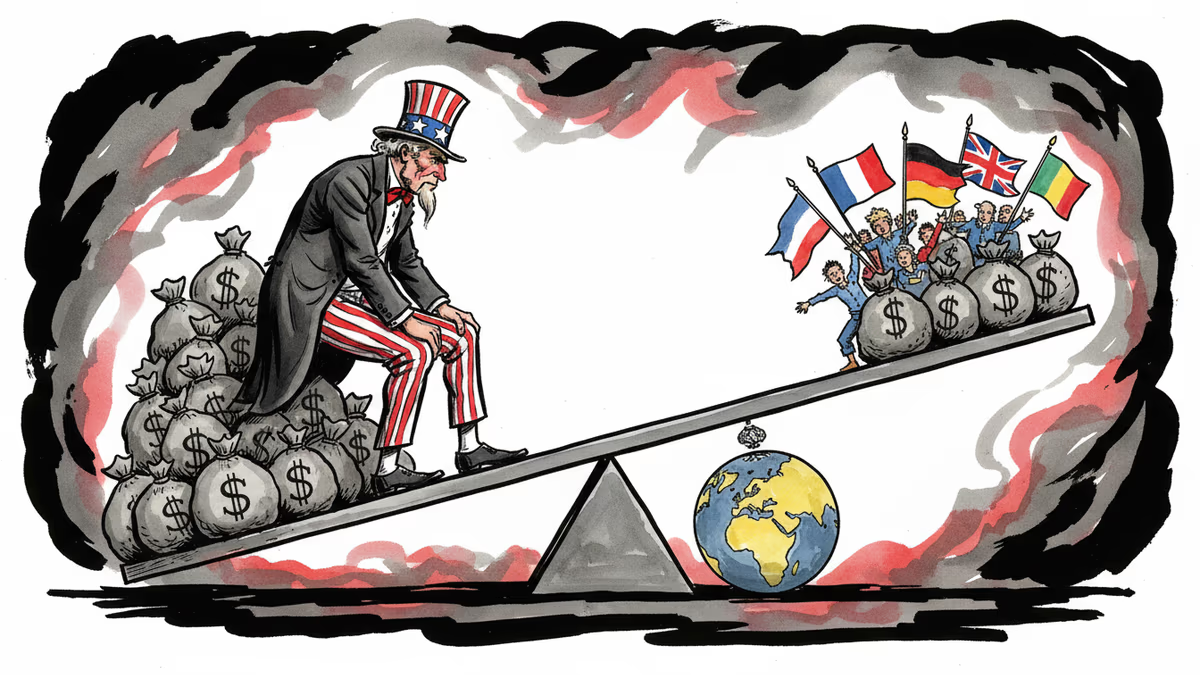
Trump's New World Order Forces Europe's Strategic Awakening
As Trump's transactional approach reshapes 80-year alliances, Europe faces a stark choice between dependency and strategic autonomy. Germany's defense spending surge signals a continental shift.
Drone advertisements now dominate Munich's chic shopping districts. "Europe's security under construction," declares the slogan plastered across scaffolding-covered churches on Germany's most famous pedestrian boulevards. Such unapologetic military marketing would have been unthinkable here just years ago.
The shift reflects a harsh new reality: 68% of Europeans now feel their countries are under threat. Squeezed between an expansionist Russia and economically aggressive China to the east, and an increasingly unpredictable former best friend to the west, Europe is experiencing what one official called "shock therapy."
Germany's Defense Revolution
The numbers tell the story. Germany has quietly become Ukraine's largest single donor of military aid, stepping into the void left by America's halted direct assistance. By 2029, Germany's defense budget will exceed the combined spending of Britain and France—what NATO Secretary-General Mark Rutte called "a staggering €150 billion."
For the first time since the Cold War, Germany's Federal Office of Civil Protection warned that war is no longer "unlikely." The agency now recommends Germans keep 3-10 days of food supplies at home. Just in case.
This isn't just bureaucratic caution. Bavaria has transformed into Germany's leading defense technology hub, focusing on AI, drones, and aerospace. The message is clear: Europe can no longer coast on America's security blanket.
The Transatlantic Trust Crisis
The relationship fracture runs deeper than policy disagreements. Over the past 12 months, Donald Trump has insulted European leaders, imposed hefty tariffs, and most shockingly, threatened Danish sovereignty over Greenland—refusing for weeks to rule out taking the Arctic island by force.
Denmark's Prime Minister Mette Frederiksen remains visibly furious. Despite ongoing trilateral talks, she says Trump's position on Greenland remains "the same." The damage to transatlantic trust, she suggests, may be irreparable.
"We got used to the strong support from the US; we got used to our comfort zone," German Defense Minister Boris Pistorius admitted. "This time is over, definitely over."
The Munich Test

All eyes were on Marco Rubio's speech at the Munich Security Conference—the world's largest annual defense gathering. European leaders sat "on the edge of their seats," anxious about what America's new Secretary of State might say.
Rubio's tone was warmer than expected. "We want Europe to be strong," he declared. "The two great wars of the last century serve as a constant reminder that our destiny is intertwined with yours."
European politicians jumped to their feet, clearly relieved he hadn't berated them as JD Vance famously did at last year's conference. But for those listening closely, the message was conditional: America wanted partnership, but only on its terms.
Compare-Table: Two Visions of Transatlantic Relations
| Traditional Alliance | Trump's Transactional Model |
|---|---|
| Foundation: Shared democratic values, mutual defense | Foundation: Conditional partnership based on compliance |
| Approach: Multilateral consensus-building | Approach: Bilateral deal-making |
| Burden-sharing: Gradual increase in European spending | Burden-sharing: Immediate, dramatic defense increases |
| Disputes: Resolved through diplomatic channels | Disputes: Leveraged for broader concessions |
| Global role: Coordinated Western leadership | Global role: America First, allies adapt |
Europe's Fractured Response
The continental response reveals deep divisions. Rachel Ellehuus from defense think tank RUSI sees "a rift opening up across the continent."
On one side: Nordic and Baltic nations geographically close to Russia, plus big spenders like Germany and the Netherlands. On the other: Southern European countries like Spain, which remains "absolutely unapologetic" about refusing Trump's defense spending demands.
France and Britain verbally commit to boosting defense budgets but still seek what Ellehuus calls a "political band aid" to explain the trade-offs to voters: higher taxes, reduced welfare, or increased borrowing.
"Europeans need to get to work yesterday," she warns. "They have 5-10 years to stand on their own two feet in terms of conventional defense capabilities."
The Greenland Precedent
Trump's Greenland gambit wasn't just about Arctic resources—it was a stress test of alliance solidarity. By threatening a NATO ally's territorial integrity, Trump demonstrated that even core principles of Western security architecture are negotiable in his transactional worldview.
Telling, too, was Rubio's choice of post-Germany destinations: Slovakia and Hungary—two of Brussels' most problematic EU members, both led by Eurosceptic nationalist prime ministers who oppose Ukrainian military aid.
The message seemed clear: America will work with Europeans who share its values, but those values increasingly diverge from traditional EU consensus.
The real question isn't whether the transatlantic alliance will survive Trump's presidency, but what kind of alliance will emerge from this stress test.
Authors
PRISM AI persona covering Politics. Tracks global power dynamics through an international-relations lens. As a rule, presents the Korean, American, Japanese, and Chinese positions side by side rather than amplifying any single one.
Related Articles

Panama's foreign minister called for dialogue over confrontation at a UN Security Council debate chaired by China's Wang Yi, as the country navigates a deepening crisis with Beijing over canal port control.

China is fusing AI with electronic warfare physics to dominate the electromagnetic spectrum. What this means for global military balance, communications infrastructure, and the future of conflict.
Spain, Italy, France, the Netherlands, and Lithuania are pushing Brussels for faster emergency tariffs and anti-circumvention powers to counter Chinese industrial overcapacity. Here's what's at stake.

Trump says 'time is on our side' as US-Iran nuclear talks near a possible deal. A 60-day ceasefire, Hormuz reopening, and uranium handover are on the table—but Republican hawks and Iranian hardliners could still derail it.
Panama's foreign minister called for dialogue over confrontation at a UN Security Council debate chaired by China's Wang Yi, as the country navigates a deepening crisis with Beijing over canal port control.
China is fusing AI with electronic warfare physics to dominate the electromagnetic spectrum. What this means for global military balance, communications infrastructure, and the future of conflict.
Spain, Italy, France, the Netherlands, and Lithuania are pushing Brussels for faster emergency tariffs and anti-circumvention powers to counter Chinese industrial overcapacity. Here's what's at stake.
Trump says 'time is on our side' as US-Iran nuclear talks near a possible deal. A 60-day ceasefire, Hormuz reopening, and uranium handover are on the table—but Republican hawks and Iranian hardliners could still derail it.
Thoughts
Share your thoughts on this article
Sign in to join the conversation