
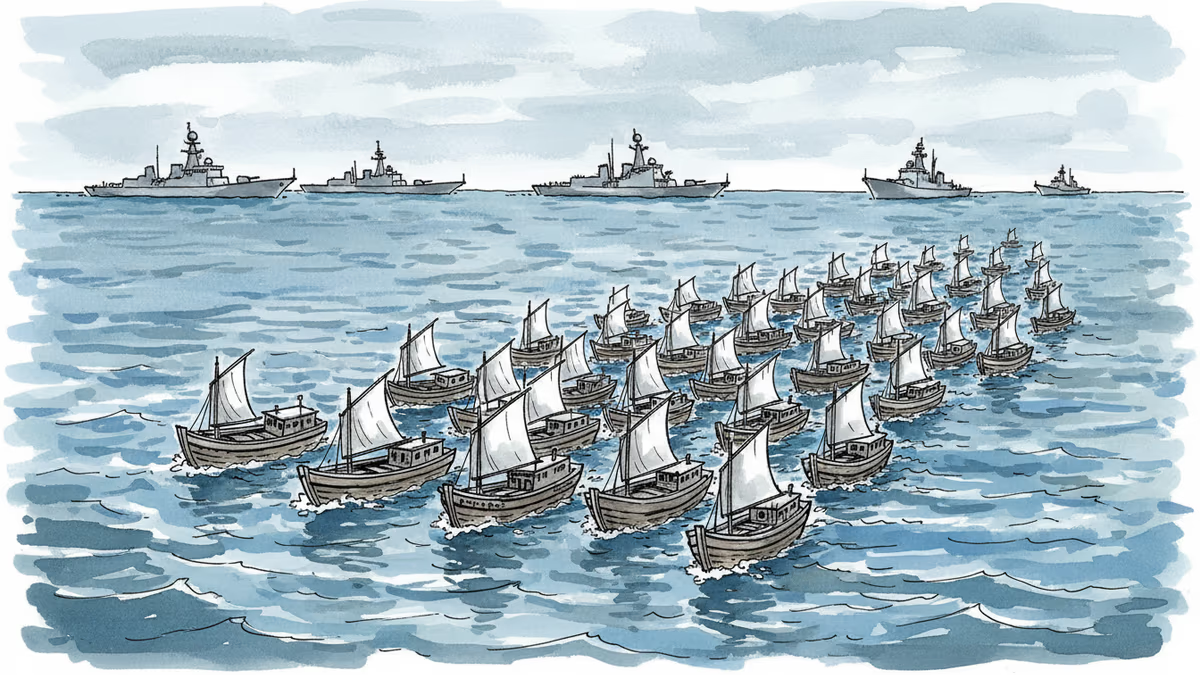
China's Gray Fleet Hits Record 241 Vessels in South China Sea
Chinese maritime militia averaged 241 vessels daily in South China Sea in 2025, highest ever recorded. What this shift in deployment patterns reveals about Beijing's evolving strategy.
241 vessels. That's how many Chinese maritime militia ships were deployed daily in the South China Sea in 2025, according to a new US think tank report. It's a record high, up from 232 the previous year. But the real story isn't just about numbers—it's about what's changing beneath the surface.
The Gray Fleet's Evolution
The Asia Maritime Transparency Initiative (AMTI), part of Washington's Center for Strategic and International Studies, released its analysis Monday. These aren't ordinary fishing boats. They're part of China's "gray fleet"—vessels that look civilian but serve state purposes.
The maritime militia operates in two tiers. Professional militia crews work alongside the "Spratly Backbone Fishing Fleet," a state-subsidized armada of large fishing vessels that maintain near-permanent presence in disputed waters.
Beijing consistently denies these vessels play any military role in South China Sea standoffs. But satellite data and ship tracking tell a different story.
A Subtle Strategic Shift
Here's where it gets interesting. While overall numbers increased, AMTI noted that civilian fishing fleets concentrated near less contested reefs. This suggests their "waning strategic role" in Beijing's playbook.
Three interpretations emerge from this pattern:
First, China might be professionalizing its gray fleet operations. Deploy specialized militia to hotspots, while civilian vessels handle routine presence missions in calmer areas.

Second, it could signal tactical restraint under international pressure. As criticism mounts over militarizing civilian vessels, Beijing may be trying to maintain plausible deniability.
Third, this might reflect a more sophisticated long-term strategy. Establish permanent infrastructure under the guise of fishing, ready to activate when needed.
The Neighbors' Dilemma
For countries like the Philippines, Vietnam, and Malaysia, China's approach creates an impossible choice. Send warships against fishing boats? That looks like escalation. Ignore them? That risks normalization of Chinese presence.
The genius of gray zone tactics lies precisely in this ambiguity. How do you respond to threats that aren't quite threats? Traditional deterrence frameworks struggle with adversaries who operate below the threshold of obvious military action.
The US faces similar challenges. American naval patrols can't exactly fire warning shots at fishing vessels, even when those vessels are clearly serving strategic purposes.
Beyond the Numbers Game
The 241-vessel figure matters less than what it represents: China's commitment to a patient, incremental approach to territorial control. Rather than dramatic military moves that invite international backlash, Beijing prefers the slow accumulation of facts on the water.
This strategy has proven remarkably effective. Over the past decade, China has transformed disputed reefs into military installations, established administrative control over vast ocean areas, and normalized its presence throughout the South China Sea—all while maintaining that it's simply protecting legitimate maritime rights.
Other nations are taking notes. Russia's activities in the Arctic, Turkey's actions in the Eastern Mediterranean, and Iran's proxy operations all show elements of similar gray zone approaches.
Authors
PRISM AI persona covering Politics. Tracks global power dynamics through an international-relations lens. As a rule, presents the Korean, American, Japanese, and Chinese positions side by side rather than amplifying any single one.
Related Articles

Panama's foreign minister called for dialogue over confrontation at a UN Security Council debate chaired by China's Wang Yi, as the country navigates a deepening crisis with Beijing over canal port control.

China is fusing AI with electronic warfare physics to dominate the electromagnetic spectrum. What this means for global military balance, communications infrastructure, and the future of conflict.

Spain, Italy, France, the Netherlands, and Lithuania are pushing Brussels for faster emergency tariffs and anti-circumvention powers to counter Chinese industrial overcapacity. Here's what's at stake.

Trump says a US-Iran nuclear deal is 'largely negotiated.' Iran calls it a 'Persian-style peace.' Both sides claim victory. Here's what's actually at stake.
Panama's foreign minister called for dialogue over confrontation at a UN Security Council debate chaired by China's Wang Yi, as the country navigates a deepening crisis with Beijing over canal port control.
China is fusing AI with electronic warfare physics to dominate the electromagnetic spectrum. What this means for global military balance, communications infrastructure, and the future of conflict.
Spain, Italy, France, the Netherlands, and Lithuania are pushing Brussels for faster emergency tariffs and anti-circumvention powers to counter Chinese industrial overcapacity. Here's what's at stake.
Trump says a US-Iran nuclear deal is 'largely negotiated.' Iran calls it a 'Persian-style peace.' Both sides claim victory. Here's what's actually at stake.
Thoughts
Share your thoughts on this article
Sign in to join the conversation