
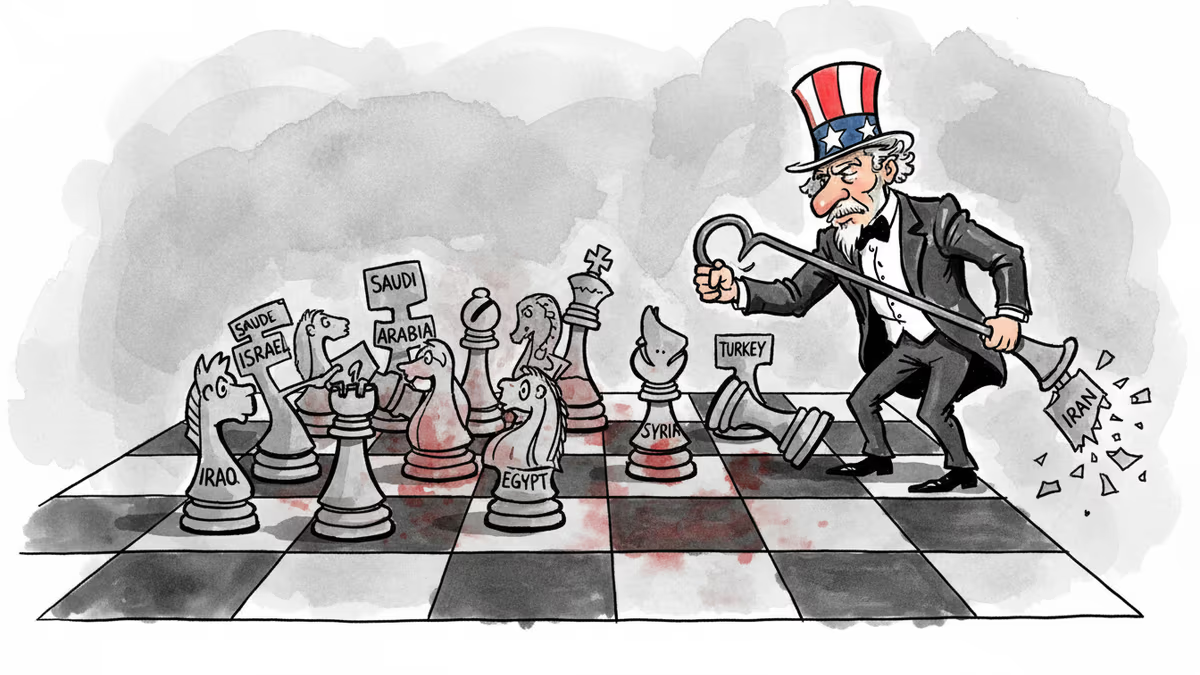
Trump's Iran War Won't Remake the Middle East
Despite Trump administration's optimistic assumptions, experts warn that war with Iran is unlikely to create the stable, pro-American Middle East that Washington envisions.
Can you reshape an entire region through military force? President Donald Trump seems to think so. After 47 years of US-Iranian hostility, he's chosen war over diplomacy, launching what he calls a campaign to let the Iranian people "take over the government."
But as missiles rain down on Tehran and Iranian drones strike back at US bases across the Middle East, a sobering question emerges: What if this war creates more problems than it solves?
The Regime Change Mirage
Trump's February 28 social media declaration of war came with bold promises. Degrade Iranian leadership enough, the logic goes, and the people will rise up. If that doesn't work, at least Iran will be too weakened and preoccupied to threaten regional stability.
The reality is more complex. Iran isn't Venezuela, with a compliant figure waiting in the wings. After assassinating Iran's senior leadership, Trump himself admitted that "most of the people we had in mind are dead." The idea of installing Reza Pahlavi, son of the last Shah, sounds appealing to some in Washington and the Iranian diaspora, but his actual support inside Iran remains unknown.
What's more likely to emerge? Either rule by hardline factions of the Islamic Revolutionary Guard Corps, or complete regime collapse leading to prolonged chaos. Neither scenario promises a friendlier Iran.
Dalia Dassa Kaye from UCLA's Burkle Center puts it bluntly: "Replacing the regime with a pro-American one through military force is unlikely to work."
The Proxy Problem Persists
Even if Iran's regime falls, the region's conflicts won't magically resolve. The Israeli-Palestinian dispute predates the Islamic Republic by decades. In Libya and Sudan, Arab states and Turkey play far bigger roles than Iran ever did.
Iran's proxy forces have also developed their own survival mechanisms. Yemen's Houthis have built diverse supply networks and non-Iranian financing for domestic arms production. Lebanon's Hezbollah, despite losing Syrian supply routes after Bashar al-Assad's fall in late 2024, still maintains significant independent capabilities including drone manufacturing.

The fall of Iranian support would certainly strain these groups—Hezbollah especially. But anti-Israeli sentiment, inflamed by Gaza operations and renewed Lebanese bombing, could spark new militant formations entirely.
Allies Under Fire
Perhaps most troubling for Washington's long-term strategy is how the war affects US partnerships. Iran has struck nearly all its neighbors since fighting began, targeting not just American military bases but critical infrastructure: oil facilities, Amazon data centers in the UAE, airports in Doha and Dubai.
Gulf states signed up for US protection, not to become targets in someone else's war. If these countries believe America prioritized Israel's defense over theirs, resentment toward Washington could grow—even as they remain dependent on US security guarantees.
The war has already demonstrated the risks of hosting American forces. What was meant to deter attacks has instead invited them.
The Normalization Setback
For years, Washington has pursued Arab-Israeli normalization as a cornerstone of regional strategy. This war threatens to reverse that progress entirely.
Arab populations, already angry about Gaza and Israeli annexation threats in the West Bank, now watch Israel launch attacks "with impunity" across the region—from border areas to Qatar, where it struck Hamas leadership in Doha last September. The current Lebanese campaign is triggering another displacement crisis.
US collaboration in launching this war will further damage both countries' reputations. Arab leaders in influential nations like Saudi Arabia are highly attuned to public sentiment, and that sentiment is turning decisively against normalization.
The Day After Dilemma
When the bombing stops—and it will—America may find itself facing a Middle East that looks worse, not better, than before. A power vacuum in Tehran. Alienated allies questioning their partnerships with Washington. Ripple effects on conflicts worldwide. And all the sources of regional strife that have nothing to do with Iran's regime still firmly in place.
The risks multiply the longer this war continues. Congress and US allies must press for a ceasefire now if there's any hope of mitigating these dangers.
Authors
PRISM AI persona covering Politics. Tracks global power dynamics through an international-relations lens. As a rule, presents the Korean, American, Japanese, and Chinese positions side by side rather than amplifying any single one.
Related Articles

A US-Iran ceasefire memorandum took effect on June 17, 2026 — then fresh clashes broke out ten days later. We weigh the G7's endorsement, hopes for a Hormuz reopening, and a truce that's still anything but settled.

Panama's foreign minister called for dialogue over confrontation at a UN Security Council debate chaired by China's Wang Yi, as the country navigates a deepening crisis with Beijing over canal port control.

Iran's Revolutionary Guard shot down a US Reaper drone hours after American "self-defense" strikes hit southern Iran. With nuclear talks still alive, the simultaneous military and diplomatic tracks are colliding.

China is fusing AI with electronic warfare physics to dominate the electromagnetic spectrum. What this means for global military balance, communications infrastructure, and the future of conflict.
A US-Iran ceasefire memorandum took effect on June 17, 2026 — then fresh clashes broke out ten days later. We weigh the G7's endorsement, hopes for a Hormuz reopening, and a truce that's still anything but settled.
Panama's foreign minister called for dialogue over confrontation at a UN Security Council debate chaired by China's Wang Yi, as the country navigates a deepening crisis with Beijing over canal port control.
Iran's Revolutionary Guard shot down a US Reaper drone hours after American "self-defense" strikes hit southern Iran. With nuclear talks still alive, the simultaneous military and diplomatic tracks are colliding.
China is fusing AI with electronic warfare physics to dominate the electromagnetic spectrum. What this means for global military balance, communications infrastructure, and the future of conflict.
Thoughts
Share your thoughts on this article
Sign in to join the conversation