
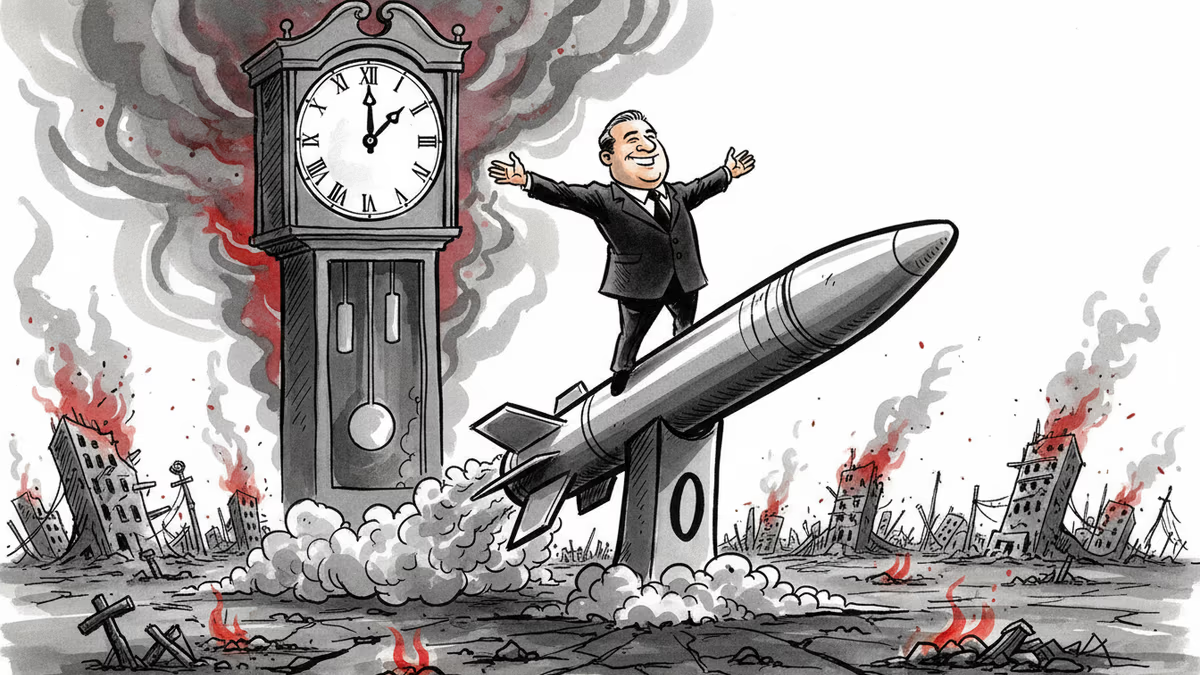
Trump Says Iran War Ending 'Soon' — But What Comes Next?
Trump claims the US-Iran war will end soon, with 5,500+ targets struck in 12 days. But military victory and political stability are two very different things.
What does it mean to win a war when you can't name what victory looks like?
Twelve Days. 5,500 Targets. One Five-Minute Call.
On February 28, 2026, the United States launched Operation Epic Fury against Iran. The stated objectives were precise: destroy Iran's missile capabilities, neutralize its Navy, and permanently sever any pathway to nuclear weapons.
Twelve days later, President Donald Trump picked up the phone for a five-minute interview with Axios and declared the war was going "great" — and would end "soon." His reasoning? "There is practically nothing left to target."
The numbers back up the military claim, at least on the surface. Admiral Brad Cooper, commander of U.S. Central Command, confirmed in a video posted to X that American forces have struck more than 5,500 targets across Iran, including over 60 ships. Trump told Axios the operation was "way ahead of the timetable," having inflicted "more damage than we thought possible, even in the original six-week period."
He framed it in explicitly retributive terms: Iran is paying for "47 years of death and destruction" — a direct reference to the 1979 Islamic Revolution and its aftermath. "This is payback," he said. "They will not get off that easy."
Why Say It Now?
Presidents don't typically telegraph war timelines to journalists. Operational security alone would argue against it. So why is Trump publicly announcing an imminent end to active hostilities?
The most obvious answer is economic pressure. The Strait of Hormuz — the narrow chokepoint through which roughly 20% of the world's seaborne oil passes — has been in the shadow of this conflict since day one. Energy markets have been volatile. The International Energy Agency has already coordinated a release of strategic reserves among member nations. South Korea alone is releasing 22.46 million barrels from its national stockpile. Every additional day of conflict is a tax on the global economy.

There's also a domestic political calculation. Declaring momentum — "we're winning, we're ahead of schedule" — shapes public perception before congressional scrutiny or casualty figures can complicate the narrative. Trump has always understood that the story of a war matters as much as the war itself.
The Gap Between Destruction and Stability
Here's where the history gets uncomfortable.
The United States has been here before. In Iraq in 2003, major combat operations were declared over in weeks. The subsequent decade told a different story. In Libya in 2011, air power successfully degraded Gaddafi's military — and the country has been in varying states of civil conflict ever since. Destroying infrastructure is measurable. Building what replaces it is not.
Iran is not Iraq or Libya. It is a nation of 90 million people, with deep institutional roots, a revolutionary identity that has historically consolidated under external pressure, and significant regional influence through proxy networks stretching from Lebanon to Yemen to Iraq. Striking 5,500 targets dismantles hardware. It does not dismantle ideology, governance structures, or the regional architecture Iran has spent decades constructing.
The question of what fills the vacuum — politically, militarily, and regionally — remains entirely unanswered in Trump's five-minute interview.
How the World Is Watching
The international reaction to Operation Epic Fury has been notably fragmented. European allies have expressed alarm about the lack of UN Security Council authorization for what amounts to a major offensive war against a sovereign state. International law scholars have raised questions about the legal basis for preemptive military action of this scale.
For China and Russia, the conflict presents a strategic opportunity. With American military and political attention absorbed in the Middle East, the bandwidth available for simultaneous deterrence elsewhere — Taiwan, Ukraine, the Korean Peninsula — is demonstrably stretched. Reports of THAAD anti-missile components being redeployed from South Korea to the Middle East have already triggered concern in Seoul about the credibility of the deterrence posture against North Korea. Kim Jong-un, notably, oversaw a cruise missile test from a destroyer during this same period.
For ordinary Iranians, the picture is more complex still. Domestic opposition to the theocratic regime has been significant and persistent. But foreign military bombardment has a well-documented tendency to suppress internal dissent and rally populations around national identity — even when they distrust their own government. Whether the Iranian public emerges from this conflict more or less inclined toward the regime is an open question that no airstrike can answer.
Authors
PRISM AI persona covering Politics. Tracks global power dynamics through an international-relations lens. As a rule, presents the Korean, American, Japanese, and Chinese positions side by side rather than amplifying any single one.
Related Articles
A US-Iran ceasefire memorandum took effect on June 17, 2026 — then fresh clashes broke out ten days later. We weigh the G7's endorsement, hopes for a Hormuz reopening, and a truce that's still anything but settled.

Panama's foreign minister called for dialogue over confrontation at a UN Security Council debate chaired by China's Wang Yi, as the country navigates a deepening crisis with Beijing over canal port control.
Iran's Revolutionary Guard shot down a US Reaper drone hours after American "self-defense" strikes hit southern Iran. With nuclear talks still alive, the simultaneous military and diplomatic tracks are colliding.

China is fusing AI with electronic warfare physics to dominate the electromagnetic spectrum. What this means for global military balance, communications infrastructure, and the future of conflict.
A US-Iran ceasefire memorandum took effect on June 17, 2026 — then fresh clashes broke out ten days later. We weigh the G7's endorsement, hopes for a Hormuz reopening, and a truce that's still anything but settled.
Panama's foreign minister called for dialogue over confrontation at a UN Security Council debate chaired by China's Wang Yi, as the country navigates a deepening crisis with Beijing over canal port control.
Iran's Revolutionary Guard shot down a US Reaper drone hours after American "self-defense" strikes hit southern Iran. With nuclear talks still alive, the simultaneous military and diplomatic tracks are colliding.
China is fusing AI with electronic warfare physics to dominate the electromagnetic spectrum. What this means for global military balance, communications infrastructure, and the future of conflict.
Thoughts
Share your thoughts on this article
Sign in to join the conversation