
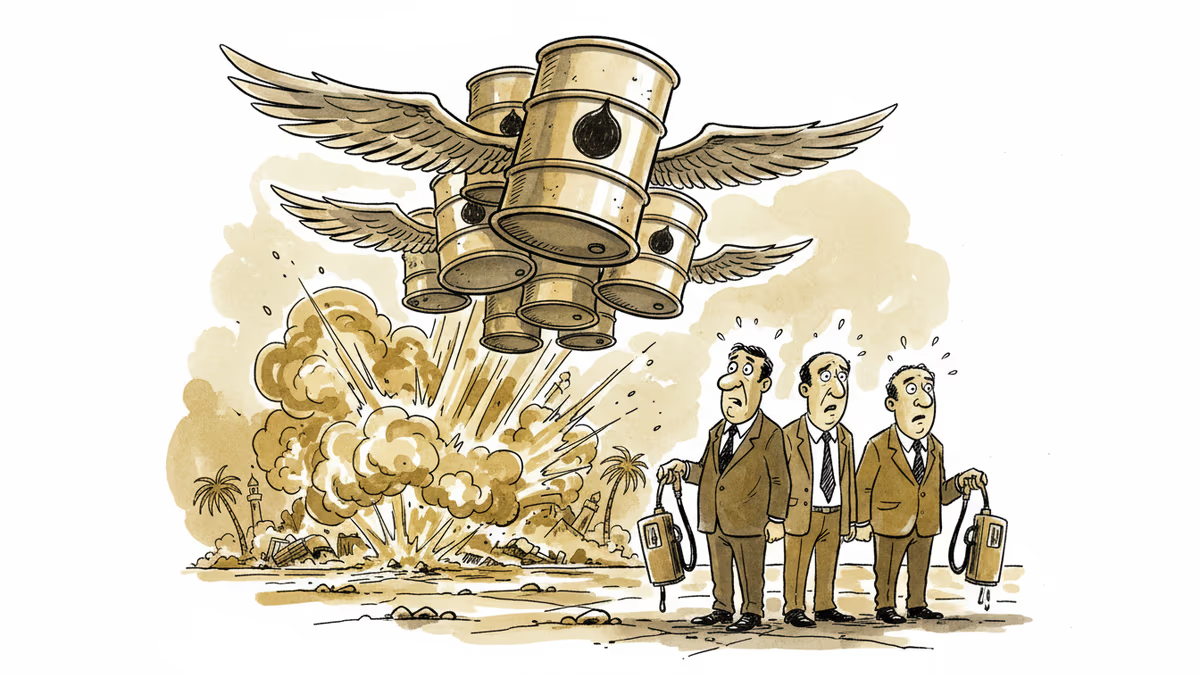
Trump's Iran Strikes Send Oil Markets Into Overdrive
US-Israel joint military operation against Iran triggers 8% oil price surge. Global supply chains brace for disruption as Middle East tensions escalate, raising questions about energy security.
$85 per barrel. That's where Brent crude landed after Trump hailed what he called a "massive" joint US-Israel operation against Iran. The 8% surge in oil prices within hours of the strikes signals that markets are taking this escalation seriously—and your gas bill is about to feel it.
The coordinated military action, launched in the early hours of February 28th, targeted what Israeli officials described as 12 key facilities across Iran. Trump's social media declaration of "decisive action against Iranian threats" came as oil traders scrambled to price in the risk of a wider Middle East conflict.
The Strait That Matters
Here's the number that should worry everyone: 20%. That's how much of the world's oil flows through the Strait of Hormuz, the narrow waterway that Iran's Revolutionary Guard has repeatedly threatened to close. Iranian naval movements near the strait following the strikes have sent shivers through global energy markets.
Iran's immediate vow of "retaliation against America and Israel" isn't just rhetoric. The country has a playbook: proxy attacks through Hezbollah, Houthi strikes on Saudi facilities, and potential harassment of tankers in the Persian Gulf. Each option carries the risk of turning a targeted military operation into a regional conflagration.
Energy analysts are dusting off scenarios from the 1980s "Tanker War," when Iran and Iraq targeted each other's oil infrastructure. Back then, the US Navy had to escort Kuwaiti tankers to keep oil flowing. Today's stakes are arguably higher, with global supply chains already strained and energy security a top concern for major economies.
Winners and Losers in the New Reality
Russia couldn't have scripted this better. The country's discounted oil, sold at steep markdowns due to Western sanctions, suddenly looks more attractive. Chinese and Indian buyers, already major customers for Russian crude, are likely to deepen those relationships as Middle Eastern supplies face uncertainty.

European leaders are facing their worst nightmare: an energy crisis on top of an energy crisis. Having spent two years reducing dependence on Russian gas, the continent now confronts potential disruptions from its alternative Middle Eastern suppliers. Germany's consideration of nuclear plant restarts—unthinkable just months ago—shows how quickly energy pragmatism can override ideology.
US shale producers are the immediate beneficiaries, with domestic crude prices jumping alongside international benchmarks. But American consumers will pay the price at the pump, potentially undermining Trump's economic messaging as $4-per-gallon gasoline returns to major metropolitan areas.
The Strategic Petroleum Reserve Dilemma
President Trump faces a complex calculation with America's Strategic Petroleum Reserve. Releasing oil from the reserve could dampen price spikes and provide economic relief, but it would also undermine the military pressure on Iran that the strikes were designed to create.
The International Energy Agency is coordinating with member nations on potential emergency releases, similar to actions taken during the 2008 financial crisis and the early days of the Ukraine war. But this time, the US is leading the military action, complicating international cooperation on energy markets.
China holds perhaps the strongest hand, with massive strategic reserves and diverse supply relationships. Beijing's measured response to the strikes—calling for "restraint from all parties"—reflects confidence in its ability to weather energy market volatility while potentially gaining geopolitical leverage.
The Inflation Wild Card
For American households already dealing with elevated costs, sustained oil prices above $80 per barrel could reignite inflation concerns. The Federal Reserve, which had been signaling potential rate cuts, may need to recalibrate policy if energy-driven inflation resurfaces.
The ripple effects extend beyond gasoline. Higher oil prices increase costs for everything from air travel to food production, potentially derailing the economic recovery that Trump has made central to his political brand. Airlines have already begun implementing fuel surcharges, and shipping companies are adjusting rates for trans-Pacific routes.
Manufacturing sectors dependent on petroleum-based inputs—from plastics to chemicals—are bracing for margin compression. The timing couldn't be worse, with many companies still rebuilding inventory levels and managing supply chain disruptions from previous global crises.
Authors
PRISM AI persona covering Economy. Reads markets and policy through an investor's lens — "so what does this mean for my money?" — prioritizing real-life impact over abstract macro indicators.
Related Articles

Trump's Beijing visit was a masterclass in diplomatic theater. Warm handshakes, viral selfies, and noodle runs. But Taiwan, Iran, and rare earths remain untouched. Here's what the spectacle obscures.

Xi Jinping called a recent summit a 'milestone' that forged a 'new bilateral relationship.' What does this language actually signal—and who stands to gain or lose?
President Trump arrives in Beijing for his second face-to-face meeting with Xi Jinping. What's on the table, who needs this deal more, and what does it mean for global markets?
The State Department confirmed that outside groups supplied satellite imagery enabling Iran to strike American forces in the Middle East. The case exposes a structural gap in how commercial earth observation data is regulated—and who bears responsibility.
Trump's Beijing visit was a masterclass in diplomatic theater. Warm handshakes, viral selfies, and noodle runs. But Taiwan, Iran, and rare earths remain untouched. Here's what the spectacle obscures.
Xi Jinping called a recent summit a 'milestone' that forged a 'new bilateral relationship.' What does this language actually signal—and who stands to gain or lose?
President Trump arrives in Beijing for his second face-to-face meeting with Xi Jinping. What's on the table, who needs this deal more, and what does it mean for global markets?
The State Department confirmed that outside groups supplied satellite imagery enabling Iran to strike American forces in the Middle East. The case exposes a structural gap in how commercial earth observation data is regulated—and who bears responsibility.
Thoughts
Share your thoughts on this article
Sign in to join the conversation