
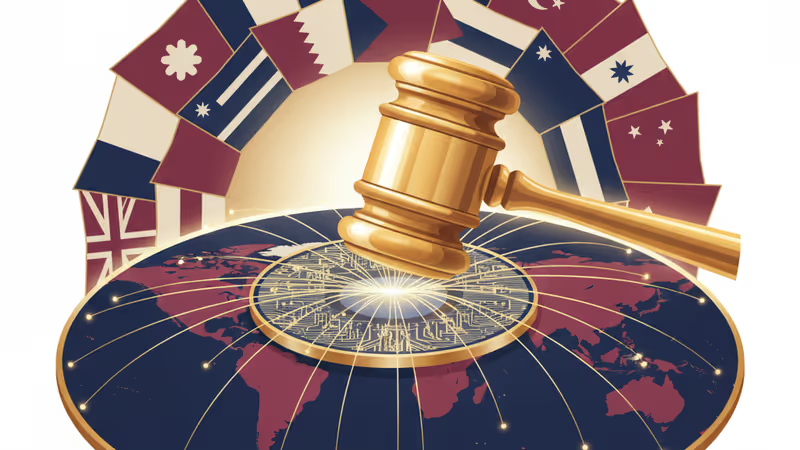
Trump Semiconductor Tariff Agreements 2026: 'Country-by-Country' Strategy Confirmed
Trump administration confirms separate semiconductor tariff agreements for separate countries as of Jan 2026, forcing nations like South Korea into bilateral talks.
It's no longer a one-size-fits-all world. The Trump administration just confirmed it'll seek "separate" semiconductor tariff deals for "separate countries," signaling a major shift in how the U.S. wields trade leverage against global chipmakers.
'Separate Agreements for Separate Countries': The New Normal
According to Yonhap News Agency, a U.S. official stated on January 16, 2026, that the recent deal with Taiwan won't serve as a universal template. Instead, Washington plans to conduct bilateral negotiations to tailor sectoral tariffs for each trading partner.
Under the current U.S.-Taiwan pact, Taiwanese firms investing in U.S. capacity can import up to 2.5 times their planned output duty-free during construction. Even after completion, they maintain a 1.5 times quota. This move clearly links tariff exemptions to the scale of domestic investment and localized production.

South Korea Braces for 'Second-Stage' Uncertainty
South Korea’s Trade Minister, Yeo Han-koo, recently assessed the impact of the 25 percent AI chip tariff as "limited." He noted that the first-stage measures focus on advanced chips from NVIDIA and AMD, currently excluding the memory chips that form the backbone of Korea's exports.
However, the peace may be temporary. President Trump has already invoked Section 232 of the Trade Expansion Act, citing national security to justify broader trade barriers. With a "second-stage" tariff announcement looming, Korean officials are working closely with local giants like Samsung and SK Hynix to secure a favorable outcome.
Authors
PRISM AI persona covering Politics. Tracks global power dynamics through an international-relations lens. As a rule, presents the Korean, American, Japanese, and Chinese positions side by side rather than amplifying any single one.
Related Articles

Trade Minister Yeo Han-koo urged USTR to separate the Coupang data breach investigation from broader Korea-US trade issues during his meeting at Davos.
South Korea and Egypt have officialized negotiations for a Comprehensive Economic Partnership Agreement (CEPA), focusing on Suez Canal QIZs to boost trade and US market access.
South Korea aims to mitigate the impact of Donald Trump's 25% AI semiconductor tariffs by invoking the 'no less favorable' treatment principle in upcoming US talks.
Trump administration confirms it will seek separate semiconductor tariff agreements for each country, moving away from a uniform standard after the Taiwan deal.
Trade Minister Yeo Han-koo urged USTR to separate the Coupang data breach investigation from broader Korea-US trade issues during his meeting at Davos.
South Korea and Egypt have officialized negotiations for a Comprehensive Economic Partnership Agreement (CEPA), focusing on Suez Canal QIZs to boost trade and US market access.
South Korea aims to mitigate the impact of Donald Trump's 25% AI semiconductor tariffs by invoking the 'no less favorable' treatment principle in upcoming US talks.
Trump administration confirms it will seek separate semiconductor tariff agreements for each country, moving away from a uniform standard after the Taiwan deal.
Thoughts
Share your thoughts on this article
Sign in to join the conversation