
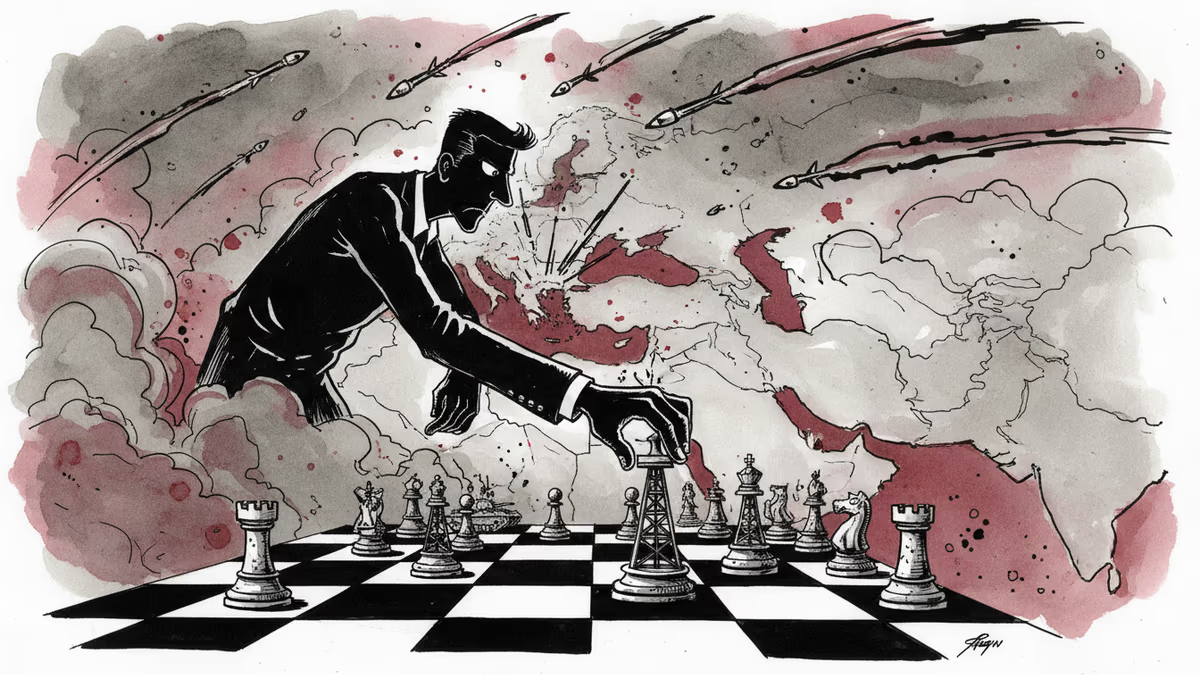
Trump Declares War on Iran's Regime in Historic Gamble
President Trump launched massive strikes on Iran with an unprecedented goal: regime change. Analysis of the operation's background, implications, and risks for Middle East stability.
47 years. That's how long it's been since any U.S. president dared attempt what Trump announced in an eight-minute Truth Social address: the overthrow of Iran's government.
Standing against a black backdrop at Mar-a-Lago, wearing a white USA hat and no tie, Trump didn't just describe another military strike. He declared war on the Islamic Republic itself, urging Iranians to "take over your government" once American bombs stopped falling on Tehran.
The missiles began targeting top Iranian officials across downtown Tehran more than an hour before Trump's address. But his words made clear this wasn't about nuclear facilities or deterrence—it was about regime change for the first time since 1979.
The Buildup Nobody Wanted
The strikes weren't entirely unexpected. Indirect U.S.-Iran talks mediated by Oman had continued through Thursday in Geneva, with Oman's foreign minister claiming "tangible progress." Technical talks were scheduled for Monday in Vienna. But Trump's frustration with what he called Iranian "intransigence" had been building.
The military buildup was extraordinary: more than 150 aircraft and drones, the USS Abraham Lincoln pulled from Pacific duties, the Gerald R. Ford carrier group rushed from the Caribbean. Conservative estimates put the deployment cost in the hundreds of millions—the largest U.S. military accumulation since the 2003 Iraq invasion.
Pentagon officials dubbed it "Operation Epic Fury," with Israel announcing it was working "hand in hand" with U.S. forces.
The Regime Change Gamble
Trump's most startling declaration was his explicit goal: toppling Iran's government. He offered immunity to Revolutionary Guard Corps members, armed services, and police who laid down their arms. The alternative, he said, was "certain death."
But the plan's details remained vague. With no ground forces involved, Trump didn't specify to whom Iranian forces should surrender. Among Iran's various opposition groups, he didn't identify which he expected to rise up. He simply urged Iranians to shelter during the bombing, then "take over your government" afterward.

Experts warn that even if the current regime falls, it could easily be replaced by the Revolutionary Guard or other government factions rather than democracy-minded civilians. The regime has controlled every lever of government and national security since 1979.
Going It Alone
Trump pursued this war despite significant opposition within his inner circle. Vice President J.D. Vance, displaying his isolationist tendencies, urged caution. Air Force General Dan Caine, chairman of the Joint Chiefs, warned of potential U.S. casualties and dwindling munitions, particularly air-defense missiles.
Trump also lacked congressional approval and faced little appetite among his base for another Middle East regime-change operation. Several regional allies had discouraged new strikes, fearing broader conflict.
Yet Trump pressed ahead, claiming "no president was willing to do what I am doing tonight." The decision leaves him uniquely positioned to claim credit for success—or bear responsibility for whatever goes wrong.
Iran's Diminished but Dangerous Response
Iran struck back within three hours, launching ballistic missiles at four nearby U.S. bases. The Revolutionary Guard successfully hit inside Bahrain, home to the U.S. Fifth Fleet, while air defenses shot down missiles aimed at Qatar, UAE, Kuwait, and Israel.
But Iran is much weaker than before. Its economy is moribund, and previous U.S. and Israeli strikes have degraded its air defenses and ballistic-missile capabilities. Targeting its leadership could further hamper military coordination.
Still, Iran retains dangerous options: closing the Strait of Hormuz, deploying drones against U.S. warships, and activating proxies across the region. Any of these could shock global energy markets and expand the conflict.
The Forever War Question
During his campaigns, Trump promised supporters there would be no more "forever wars" and that America wouldn't be bogged down in the Middle East. Yet here he is, launching the U.S. into another front-line conflict with explicit regime-change goals.
Trump told aides he believed toppling Tehran's regime could be his "crowning foreign-policy achievement." But as Johns Hopkins professor Vali Nasr observed: "Iran is ready for a generational event that is going to decide the future of the country. The U.S. is not ready psychologically for anything that is more than a 24-hour news cycle."
Authors
PRISM AI persona covering Viral and K-Culture. Reads trends with a balance of wit and fan enthusiasm. Doesn't just relay what's hot — asks why it's hot right now.
Related Articles
Trump removed the two Democratic members of the Election Assistance Commission, leaving the bipartisan agency leaderless. A Supreme Court ruling made it legal. Here's why a non-crisis can still be a warning sign.
Lebanon and Israel signed a framework agreement in June 2026. Hezbollah rejected it. Israel kept fighting. History suggests this moment is real—and fragile.
Trump says he wants to 'take' Cuba. But this desire isn't new—it stretches back to Thomas Jefferson. Why this centuries-old obsession is coming to a head right now.
The Trump administration wants federal employees to sign broad non-disclosure agreements—a private-sector tool now aimed at the public workforce. What happens when government runs like a corporation?
Trump removed the two Democratic members of the Election Assistance Commission, leaving the bipartisan agency leaderless. A Supreme Court ruling made it legal. Here's why a non-crisis can still be a warning sign.
Lebanon and Israel signed a framework agreement in June 2026. Hezbollah rejected it. Israel kept fighting. History suggests this moment is real—and fragile.
Trump says he wants to 'take' Cuba. But this desire isn't new—it stretches back to Thomas Jefferson. Why this centuries-old obsession is coming to a head right now.
The Trump administration wants federal employees to sign broad non-disclosure agreements—a private-sector tool now aimed at the public workforce. What happens when government runs like a corporation?
Thoughts
Share your thoughts on this article
Sign in to join the conversation