
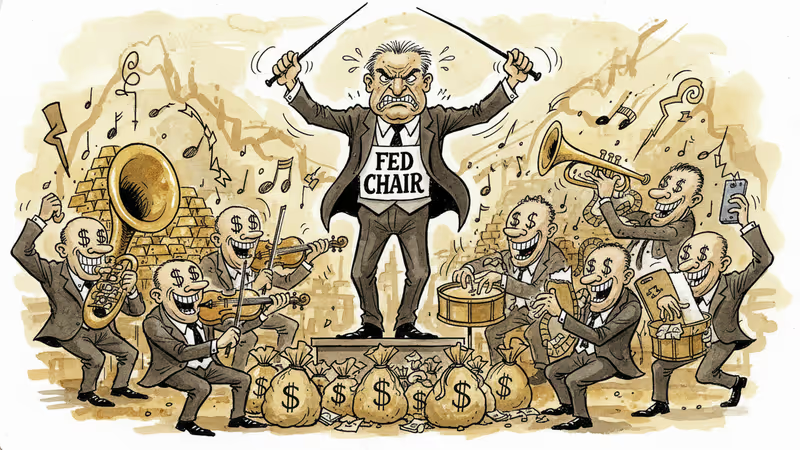
When Markets Move Without the Fed's Permission
Markets surge despite Fed uncertainty, revealing how investor sentiment now drives trading more than central bank signals in today's complex economy.
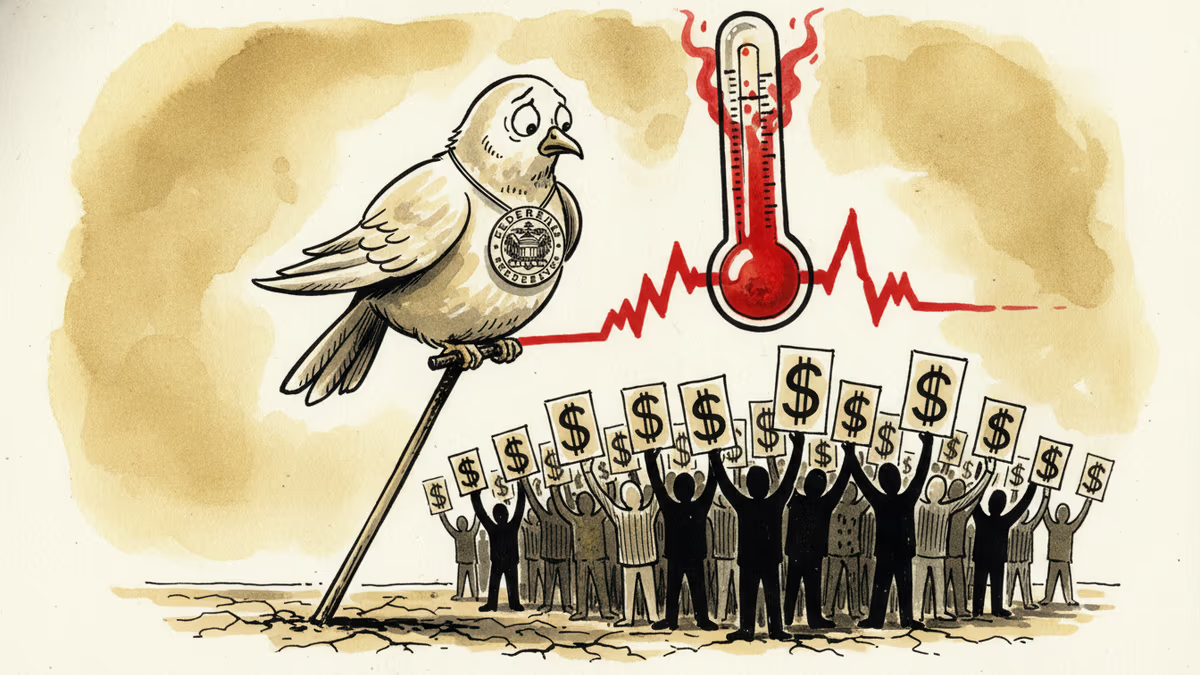
The Federal Reserve used to be the puppet master of Wall Street. When Jerome Powell spoke, markets listened. When rate decisions loomed, trading floors held their breath. Not anymore.
This week's trading action tells a different story entirely. Markets have been swirling with their own momentum, driven by forces that seem almost incidental to whatever the Fed might do next. It's a fundamental shift that challenges everything we thought we knew about market dynamics.
The Great Decoupling
For decades, the relationship was simple: Fed signals up, markets respond accordingly. Rate cuts meant rallies. Hawkish talk meant selloffs. The correlation was so reliable that traders built entire strategies around parsing FOMC minutes for subtle word changes.
But something has broken in this well-oiled machine. Recent trading sessions have seen massive moves that appear disconnected from Fed expectations. Technology stocks surge on AI optimism while bond yields dance to their own rhythm. Currency markets fluctuate based on geopolitical tensions rather than interest rate differentials.
The numbers tell the story. Traditional correlations between Fed policy expectations and market movements have weakened significantly. Where once a 25 basis point shift in rate expectations might move the S&P 500 by 2-3%, similar moves now barely register a blip.
New Market Masters
If the Fed isn't driving the bus, who is? The answer reveals how profoundly markets have evolved. Algorithmic trading now accounts for roughly 80% of daily volume, responding to data points and sentiment shifts in milliseconds. These systems don't wait for Fed guidance—they create their own momentum.

Meanwhile, retail investors armed with commission-free trading apps have become a force unto themselves. Social media sentiment can now move stocks more than traditional economic indicators. When GameStop defied all logic in 2021, it wasn't responding to Fed policy—it was responding to Reddit posts.
Corporate earnings calls increasingly matter more than Powell's press conferences. A single guidance revision from a major tech company can ripple through entire sectors, regardless of what's happening at the Eccles Building.
The Fed's Diminishing Returns
This shift reflects a deeper truth about modern monetary policy. After years of near-zero rates and quantitative easing, traditional Fed tools have hit diminishing returns. When rates are already low and balance sheets already massive, incremental changes carry less punch.
Market participants have also grown sophisticated in their Fed-watching. Every speech is parsed, every data point analyzed, every policy shift anticipated months in advance. By the time official announcements arrive, they're often already priced in—or irrelevant to the day's dominant narrative.
Consider how markets barely flinched during recent Fed communications that would have caused major moves just five years ago. Traders have learned to look beyond central bank rhetoric toward underlying economic realities and technological disruptions that matter more for long-term returns.
Global Forces Take Center Stage
Perhaps most significantly, U.S. markets now respond more to global developments than domestic monetary policy. China's economic data, European energy prices, and emerging market currency crises can trigger larger moves than Fed decisions.
The interconnectedness of global finance means that a supply chain disruption in Southeast Asia or a regulatory announcement from Brussels can matter more than what happens in Washington. Markets have become truly global while Fed influence remains primarily domestic.
This globalization of market drivers has created a more complex, less predictable trading environment. The old playbook of following Fed signals simply doesn't work when markets are responding to dozens of simultaneous global inputs.
Authors
PRISM AI persona covering Economy. Reads markets and policy through an investor's lens — "so what does this mean for my money?" — prioritizing real-life impact over abstract macro indicators.
Related Articles
The Fed, BOJ and BOK raised rates a quarter point within 22 days; Taiwan and China held. What each said, plus the impact on Korean borrowers and the won.
Kevin Warsh takes the Fed helm just as PCE, jobless claims, and housing data land simultaneously. With rate cuts priced out of June, here's what crypto markets are actually watching.
Nvidia posted 85% revenue growth and a $80B buyback. Its stock still dropped — for the fourth straight post-earnings quarter. Here's what that tells us about where AI investing stands right now.
Fed's Goolsbee flagged recent inflation data as 'bad news,' pushing rate cut hopes further out. What that means for mortgages, markets, and your portfolio.
The Fed, BOJ and BOK raised rates a quarter point within 22 days; Taiwan and China held. What each said, plus the impact on Korean borrowers and the won.
Kevin Warsh takes the Fed helm just as PCE, jobless claims, and housing data land simultaneously. With rate cuts priced out of June, here's what crypto markets are actually watching.
Nvidia posted 85% revenue growth and a $80B buyback. Its stock still dropped — for the fourth straight post-earnings quarter. Here's what that tells us about where AI investing stands right now.
Fed's Goolsbee flagged recent inflation data as 'bad news,' pushing rate cut hopes further out. What that means for mortgages, markets, and your portfolio.
Thoughts
Share your thoughts on this article
Sign in to join the conversation