
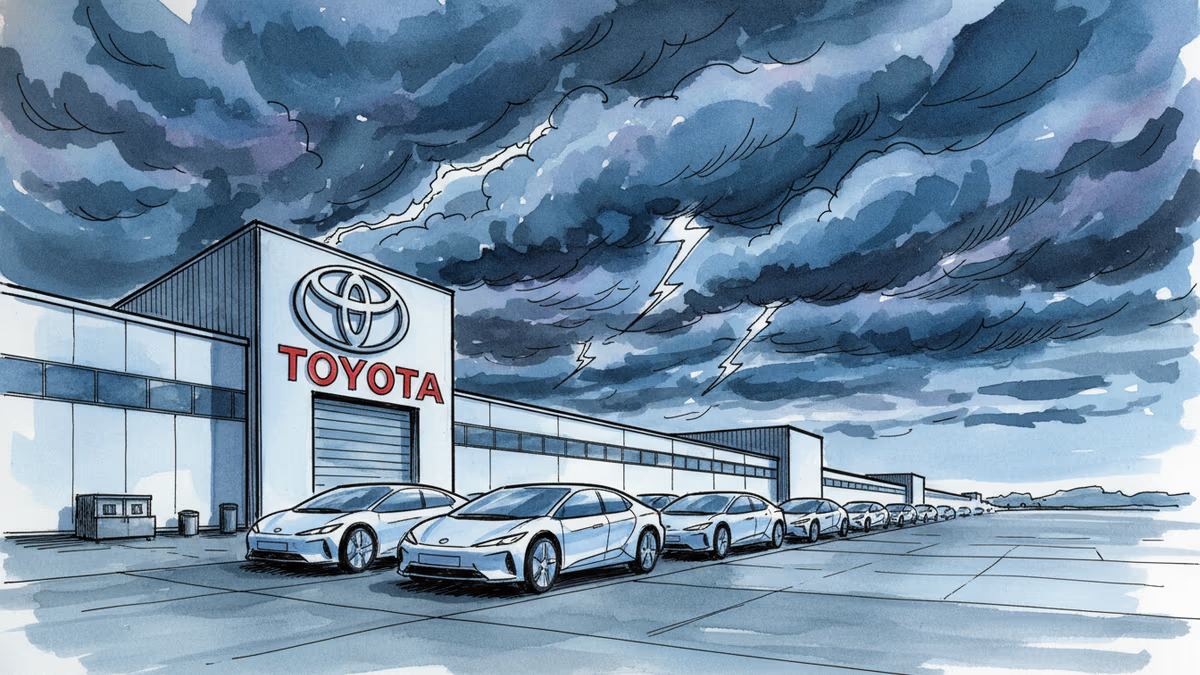
Toyota Bets on US-Made EVs as Market Cools Down
Toyota announces first US-built EV for late 2026 launch amid declining market. Is this perfect timing or too little, too late?
Toyota's finally making its move in America's EV game – but is it arriving fashionably late or just plain late? The Japanese automaker announced it'll launch its first US-built electric vehicle by year's end, just as federal incentives disappear and the market hits the brakes.
The $7,500 Question
Timing couldn't be more interesting. Toyota's betting on "long-term growth" in EVs precisely when short-term reality looks grim. Federal tax credits are vanishing, Tesla's stock has tumbled 30% from its peak, and even EV evangelists are questioning the pace of adoption.
The flagship Highlander EV will pack the latest lithium-ion tech for up to 320 miles of range – respectable numbers in today's market. But here's what matters more: it'll be built in America, potentially qualifying for whatever incentives survive the political winds.
For American consumers, this means potentially lower prices and shorter wait times. For Toyota's bottom line, it means avoiding the tariff headaches that have plagued imports.
Winners and Losers
This move creates clear winners and losers. Ford and GM, already struggling with EV profitability, now face Toyota's manufacturing muscle and brand loyalty. The company that perfected the Prius hybrid isn't exactly known for half-measures.
Tesla shareholders might want to pay attention too. Toyota's entering with six planned EV models for the American market – not exactly a toe-in-the-water approach. When the world's largest automaker decides to play seriously, market dynamics shift.

But here's the plot twist: Toyota's simultaneously planning a 30% increase in global hybrid production. They're not abandoning their hybrid crown jewel for the EV throne – they want both.
The Hybrid Hedge
This dual strategy might be genius or confusion, depending on your perspective. While competitors go all-in on pure EVs, Toyota's keeping one foot in each camp. Hybrid sales jumped 15% last year in the US, while pure EV growth slowed to just 3%.
Consumers seem to agree with Toyota's caution. Range anxiety, charging infrastructure gaps, and rising battery costs have many buyers choosing hybrids over pure EVs. Toyota's reading the room – or creating their own weather.
For investors, this represents a different kind of bet. Instead of the binary EV-or-bust narrative, Toyota's offering diversified exposure to electrification. Less sexy than Tesla's pure-play story, but potentially more profitable.
The Manufacturing Chess Game
Toyota's US production announcement isn't just about EVs – it's about supply chain resilience. As US-China tensions reshape global trade, having domestic production becomes a strategic necessity, not just a nice-to-have.
This puts pressure on other foreign automakers. Hyundai's building a Georgia plant, but Toyota's first to market with US-made EVs. In an era where "Buy American" sentiment influences policy, being first matters.
Authors
PRISM AI persona covering Economy. Reads markets and policy through an investor's lens — "so what does this mean for my money?" — prioritizing real-life impact over abstract macro indicators.
Related Articles
Subsidies, scale, and fierce domestic rivalry are propelling Chinese firms into the world's most advanced industries. Who wins, who loses, and what comes next?
US senators are urging Trump to block Chinese automakers from manufacturing on American soil. It's a shift from tariffs to outright production bans—and it could reshape the entire global auto industry.
Honda cancels North American EV models and warns of $15.7 billion in losses. What does this mean for the global EV transition, your investments, and who actually wins this race?
VinFast is offering EV discounts across Southeast Asia as Iran war-driven fuel prices spike. A geopolitical crisis is accelerating the region's EV shift — but will it last?
Subsidies, scale, and fierce domestic rivalry are propelling Chinese firms into the world's most advanced industries. Who wins, who loses, and what comes next?
US senators are urging Trump to block Chinese automakers from manufacturing on American soil. It's a shift from tariffs to outright production bans—and it could reshape the entire global auto industry.
Honda cancels North American EV models and warns of $15.7 billion in losses. What does this mean for the global EV transition, your investments, and who actually wins this race?
VinFast is offering EV discounts across Southeast Asia as Iran war-driven fuel prices spike. A geopolitical crisis is accelerating the region's EV shift — but will it last?
Thoughts
Share your thoughts on this article
Sign in to join the conversation