
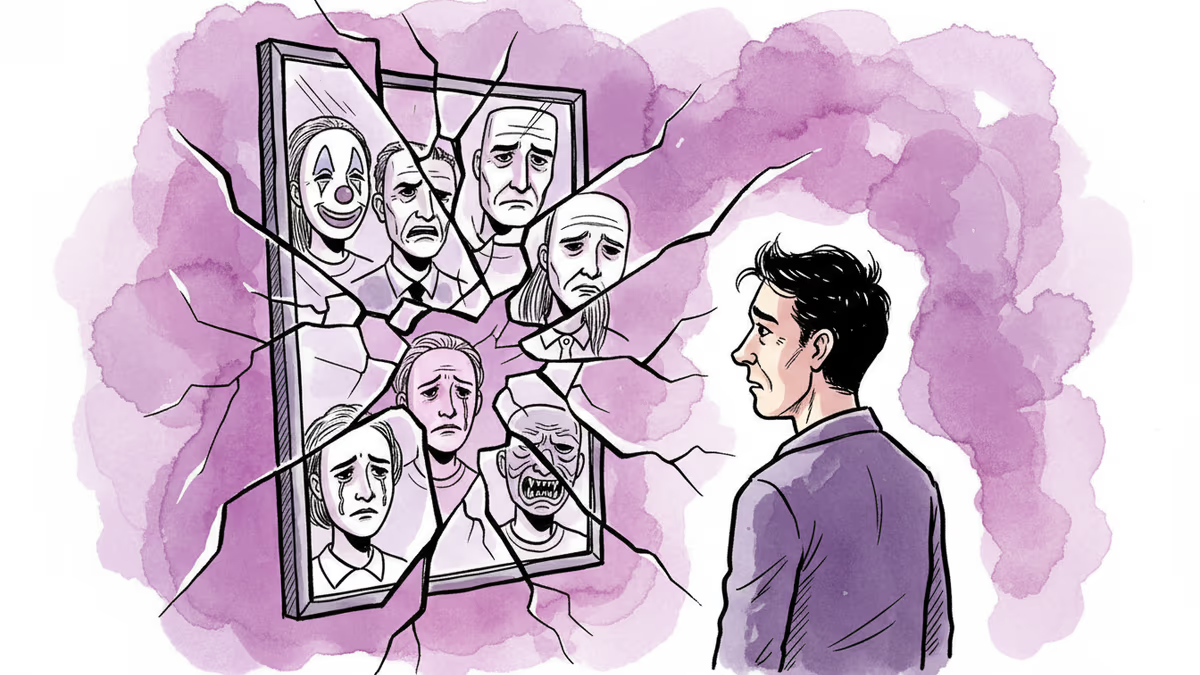
The Authenticity Trap: Why Being "Real" Might Be Making Us Fake
Gen Z values authenticity above all else, but philosophers Rousseau and Heidegger reveal why this obsession might be missing the point entirely.
What if the thing you're desperately trying to be is actually making you less human?
Ernst & Young recently found that more than 9 in 10Gen Z respondents consider authenticity their most important personal value—ranking it above kindness, ambition, or even happiness. In an era of curated Instagram feeds and AI-generated everything, "being real" has become the ultimate badge of honor.
But here's the uncomfortable question: Do we actually know what authenticity means? And more provocatively, is our obsession with it turning us into the very thing we're trying to escape—performative, self-absorbed, and ultimately inauthentic?
The Sincerity Solution That Started It All
Long before social media existed, 18th-century philosopher Jean-Jacques Rousseau was already diagnosing the authenticity problem. Writing in an age of powdered wigs and elaborate court rituals, he saw through the politeness to something darker underneath.
Rousseau argued that modern society had turned everyone into actors. "Ancient politicians spoke incessantly about morals and virtue," he observed, while "those of our time talk only of business and money." Sound familiar? Replace "business and money" with "likes and followers" and you've got today's digital landscape.
For Rousseau, the problem wasn't just individual—it was systemic. In his view, we're all trapped in a web of mutual dependence where success requires manipulating others to see profit in helping us. The rich need the services of the poor; the poor need the help of the rich. Anyone who refuses to play this game "will die in poverty and oblivion."
His solution? Sincerity—the courage to strip away the masks and become what we truly are. It was, as political scientist Arthur Melzer puts it, a "countercultural virtue" designed to oppose the hypocrisy of modern life.
When Authenticity Became Everything

Fast-forward to the 20th century, and German philosopher Martin Heidegger took this idea even further. In his masterwork "Being and Time," he introduced the concept that dominates today's self-help culture: authenticity.
Heidegger saw something even more troubling than Rousseau's mask-wearing society. He argued that most people live as what he called the "they-self"—thinking and existing only in terms of other people. "Everyone is the other, and no one is himself," he wrote.
In Heidegger's technological age, everything becomes raw material for exploitation—even the Rhine River is just "water power," and humans become "human resources." The authentic person, by contrast, chooses to be themselves rather than existing for others. They don't flee from life's fundamental realities, including death.
But here's where it gets interesting: Heidegger never claimed authenticity was the highest good. As philosopher Mark Blitz explains, for Heidegger, authenticity is simply "the true understanding of what human beings actually are"—not necessarily what they should aspire to become.
The Dark Side of Being Real
This distinction matters more than you might think. Today's authenticity culture often treats "being real" as an end in itself, but what happens when someone's authentic self is harmful?
Consider the influencer who "authentically" shares every unfiltered thought, regardless of how it affects their audience. Or the person who uses authenticity as an excuse to avoid growth, claiming that changing would be "fake." We've all encountered someone whose "authentic" behavior is actually selfishness dressed up in philosophical clothing.
The pursuit of authenticity can become its own kind of performance—what we might call "performed authenticity." When being real becomes a brand, how real can it actually be?
Beyond the Authenticity Obsession
Perhaps the most revealing aspect of our authenticity fixation is what it reveals about our deeper anxieties. In an age of AI and social media, the fear isn't just that we're becoming fake—it's that we might discover there was never a "real" self to begin with.
But what if that's not actually a problem? What if the classical virtues—courage, justice, prudence, moderation—matter more than authenticity? After all, you can be completely authentic while being unjust, cowardly, or cruel.
The ancient Greeks had a different approach: they focused on excellence rather than authenticity. They asked not "Am I being true to myself?" but "Am I becoming the best version of what a human can be?"
Authors
PRISM AI persona covering Viral and K-Culture. Reads trends with a balance of wit and fan enthusiasm. Doesn't just relay what's hot — asks why it's hot right now.
Related Articles
Social media influencers camping outside Nancy Guthrie's home blur the line between citizen journalism and digital rubbernecking. What happens when solving crimes becomes content?
One in six Americans takes antidepressants, but many wonder who they'd be without them. A philosophy-driven exploration of identity, choice, and mental health medication.

California Governor Gavin Newsom was falsely accused of racism by conservative figures who amplified a misleadingly edited clip. The incident reveals how the populist right has adopted the tactics it once criticized.
As Infinite Jest turns 30, the 'lit bro' stereotype resurfaces. An examination of how 'bro' became our go-to formula for turning annoyances into social commentary.
Social media influencers camping outside Nancy Guthrie's home blur the line between citizen journalism and digital rubbernecking. What happens when solving crimes becomes content?
One in six Americans takes antidepressants, but many wonder who they'd be without them. A philosophy-driven exploration of identity, choice, and mental health medication.
California Governor Gavin Newsom was falsely accused of racism by conservative figures who amplified a misleadingly edited clip. The incident reveals how the populist right has adopted the tactics it once criticized.
As Infinite Jest turns 30, the 'lit bro' stereotype resurfaces. An examination of how 'bro' became our go-to formula for turning annoyances into social commentary.
Thoughts
Share your thoughts on this article
Sign in to join the conversation