
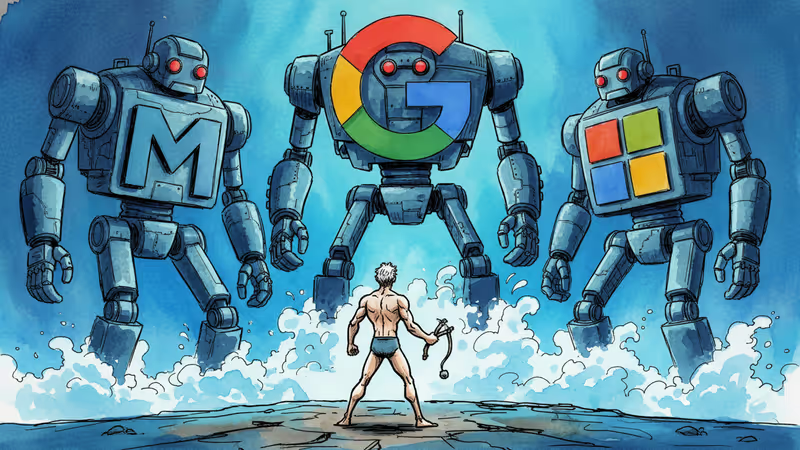
30-Person Startup Takes on Meta with $20M Open-Source AI Model
Arcee AI releases Trinity, a 400B parameter open-source model trained in 6 months for $20M, challenging Big Tech's AI dominance with permanent Apache licensing
A 30-person startup just declared war on Big Tech's AI monopoly. Arcee AI has released Trinity, a 400-billion parameter open-source AI model that took just six months and $20 million to train—a fraction of what tech giants typically spend.
The company claims Trinity is among the largest open-source foundation models ever released by a U.S. company, matching performance with Meta's Llama 4 Maverick in coding and reasoning benchmarks. But this isn't just about raw performance—it's about permanently disrupting who controls AI's future.
The Underdog's Calculated Gamble
While industry observers assumed the AI model race was over—with Google, Meta, and Microsoft carving up the market alongside their chosen partners like OpenAI and Anthropic—Arcee AI saw an opening. The startup used 2,048 Nvidia Blackwell B300 GPUs and burned through nearly half their total $50 million in funding to prove a point.
"Ultimately, the winners of this game, and the only way to really win over the usage, is to have the best open-weight model," said CTO Lucas Atkins. "To win the hearts and minds of developers, you have to give them the best."
The timeline was "very calculated," Atkins explained. As a former voice agent developer, he understood that hungry young talent with the right resources could move mountains. "We trusted that they'd rise to the occasion. And they certainly did, with many sleepless nights, many long hours."
America's Answer to China's AI Dominance
Behind Trinity's release lies a deeper strategic concern: many of the best open-source models are coming from China, leaving U.S. enterprises wary or outright banned from using them. Companies like China's Tsinghua University have released high-performing models like GLM-4.5, creating a competitive gap that worried American businesses.

Arcee didn't start as an AI lab. Originally, the company provided model customization for enterprise clients like SK Telecom, taking existing models from Meta, Mistral, or Chinese companies and post-training them for specific use cases. But as their client list grew, founder and CEO Mark McQuade realized the risks of depending on others.
"We were worried about relying on other companies," McQuade said. The decision to build their own model was "nerve-wracking"—fewer than 20 companies worldwide have ever pre-trained and released models at this scale.
The Permanent Open-Source Promise
What sets Trinity apart isn't just its performance—it's Arcee's commitment to the Apache license, ensuring the model stays permanently open. This comes after Meta CEO Mark Zuckerberg hinted last year that his company might not always make its most advanced models open source.
"Llama can be looked at as not truly open source as it uses a Meta-controlled license with commercial and usage caveats," Atkins argues. Some open-source organizations have questioned whether Llama qualifies as open source at all.
Trinity will be released in three flavors: a lightly post-trained instruct model for general chat, a base model without post-training, and "TrueBase"—a version with no instruct data that enterprises can customize from scratch without unwinding existing assumptions.
The Economics of AI Disruption
Arcee's business model reflects the changing economics of AI. While they'll offer hosted API access with competitive pricing (Trinity-Mini costs $0.045/$0.15 with a free tier), they're betting that truly open models will win developer mindshare over time.
The company still sells post-training and customization services—their original bread and butter. But Trinity represents a strategic shift toward becoming a full-fledged AI lab that can compete with the giants while maintaining democratic access to cutting-edge technology.
Currently, Trinity only supports text, lacking the multimodal capabilities of Llama 4 Maverick. But vision models are in development, with speech-to-text on the roadmap. The question isn't whether Arcee can catch up—it's whether their permanently open approach will attract the developer ecosystem away from Big Tech's walled gardens.
Authors
Related Articles
From DeepSeek to Qwen, Chinese open-source AI models are reshaping global standards with 1/7th the cost and matching performance. The infrastructure shift that's changing everything.

Europe is accelerating its push for AI digital sovereignty to break reliance on US tech giants. Inspired by DeepSeek's efficiency, EU labs are leveraging open-source models amidst growing political tensions with the Trump administration.

Black Forest Labs has released FLUX.2 [klein], featuring sub-0.5s image generation. The 4B model arrives with an Apache 2.0 license, ideal for enterprise use.

Alibaba Qwen downloads Hugging Face statistics reach 700 million as of January 2026, leading the global open-source AI market over Meta and OpenAI.
From DeepSeek to Qwen, Chinese open-source AI models are reshaping global standards with 1/7th the cost and matching performance. The infrastructure shift that's changing everything.
Europe is accelerating its push for AI digital sovereignty to break reliance on US tech giants. Inspired by DeepSeek's efficiency, EU labs are leveraging open-source models amidst growing political tensions with the Trump administration.
Black Forest Labs has released FLUX.2 [klein], featuring sub-0.5s image generation. The 4B model arrives with an Apache 2.0 license, ideal for enterprise use.
Alibaba Qwen downloads Hugging Face statistics reach 700 million as of January 2026, leading the global open-source AI market over Meta and OpenAI.
Thoughts
Share your thoughts on this article
Sign in to join the conversation