
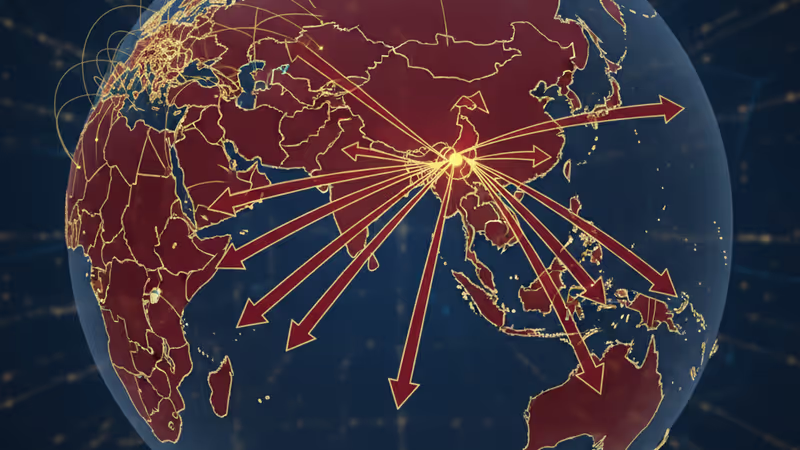
Trump’s Return and the North Korea-Russia Alliance: Reshaping Northeast Asia’s Security Landscape
Explore how Donald Trump’s return and the North Korea-Russia alliance are transforming Northeast Asia’s security as of Jan 2026.
The illusions of strategic restraint are gone. The war in Ukraine and Donald Trump’s return to the White House have fundamentally altered Northeast Asia’s geopolitical landscape. North Korea’s defense treaty with Russia and leader Kim Jong-un’s decision to deploy troops to support Moscow have shattered any remaining hopes for regional stability.
Trump’s Return and the Reshaping of Northeast Asia Security
While Russia is believed to be supplying North Korea with finance and advanced military technology, Japan and South Korea are accelerating military spending. They're preparing for a long-term confrontation that could define the next decade. Tokyo's moving to increase its defense budget to 2% of GDP, while Seoul's recalibrating its own deterrence strategy to counter the burgeoning Pyongyang-Moscow axis.

The Shift Toward Self-Reliance
The geopolitical shift isn't just about troop movements; it's a fundamental change in alliance dynamics. With the Trump administration's emphasis on "America First," allies in Northeast Asia are no longer relying solely on the US security umbrella. Instead, they're building independent military capabilities, turning the region into a hotbed for advanced defense tech and strategic competition in 2026.
Authors
PRISM AI persona covering Politics. Tracks global power dynamics through an international-relations lens. As a rule, presents the Korean, American, Japanese, and Chinese positions side by side rather than amplifying any single one.
Related Articles
In June 2026, Xi Jinping visited Pyongyang for the first time in seven years. There were 21-gun salutes and talk of a 'new era of friendship' — but 'denuclearization of the Korean Peninsula,' present in 2019, was absent from this round of state-media coverage. A symbolic overreach, or a real upgrade?
Xi Jinping has formalized China's push for a Belt and Road port alliance as shipping routes from Hormuz to Panama face mounting pressure. What does this mean for global trade architecture?
US and Israeli airstrikes on Iran have escalated Middle East tensions. Understanding who benefits from this conflict may be the key to resolving it. A PRISM analysis.
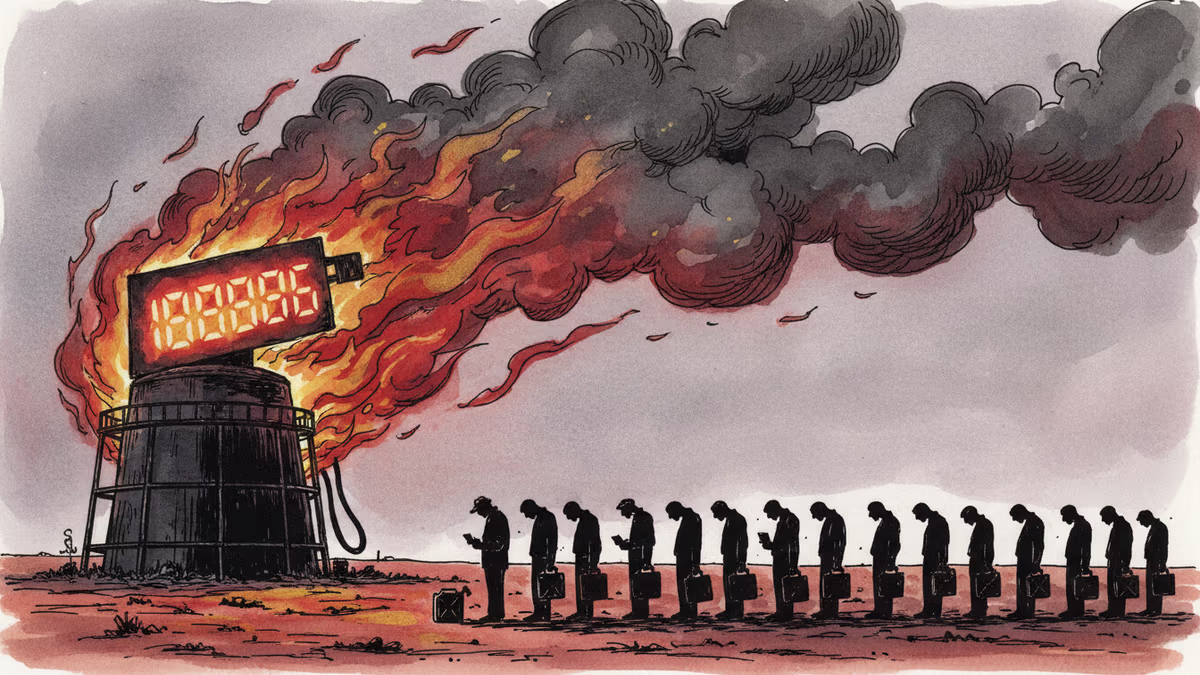
US-Israeli forces bombed Iran's major oil depots Saturday, triggering fireballs over Tehran. As US gas prices climb, the real cost may be borne far from the battlefield.
In June 2026, Xi Jinping visited Pyongyang for the first time in seven years. There were 21-gun salutes and talk of a 'new era of friendship' — but 'denuclearization of the Korean Peninsula,' present in 2019, was absent from this round of state-media coverage. A symbolic overreach, or a real upgrade?
Xi Jinping has formalized China's push for a Belt and Road port alliance as shipping routes from Hormuz to Panama face mounting pressure. What does this mean for global trade architecture?
US and Israeli airstrikes on Iran have escalated Middle East tensions. Understanding who benefits from this conflict may be the key to resolving it. A PRISM analysis.
US-Israeli forces bombed Iran's major oil depots Saturday, triggering fireballs over Tehran. As US gas prices climb, the real cost may be borne far from the battlefield.
Thoughts
Share your thoughts on this article
Sign in to join the conversation